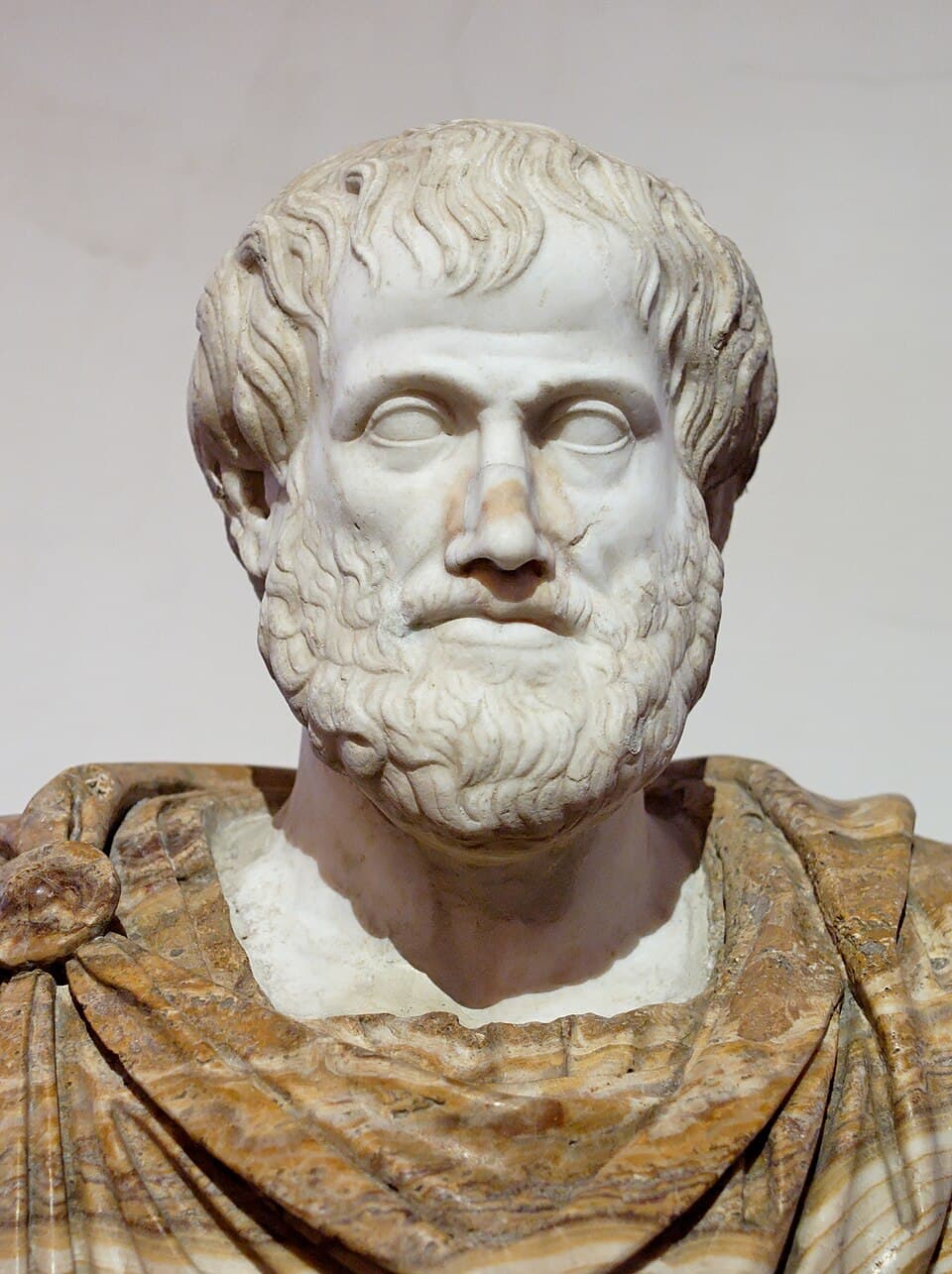
Aristotle
384–322 BC
Greek philosopher
Born in Stagira, Aristotle spent roughly twenty years at Plato’s Academy before developing a school of his own, the Lyceum in Athens. His inquiries ranged from marine animals to political constitutions. He also tutored the young Alexander of Macedon, although the extent of his influence on the future ruler remains uncertain.1. Christopher Shields, “Aristotle,” Stanford Encyclopedia of Philosophy, Winter 2023 edition, revised August 25, 2020, sec. 1.
Aristotle sought explanations that account for what things are, how they change, and what they are for. He developed tools for assessing arguments and connected ethics with political life. For him, flourishing involves exercising human capacities well through reason and excellence in action. Much of his surviving writing records investigations in progress, with difficulties still visible.2. Christopher Shields, “Aristotle,” Stanford Encyclopedia of Philosophy, Winter 2023 edition, revised August 25, 2020, secs. 2, 4, 7, and 12.
How to read Aristotle
Aristotle’s surviving treatises can be compressed and technical. Start with familiar human questions, then widen the inquiry. This thematic route is our editorial recommendation, not the order in which he wrote; keep a glossary as words such as substance, cause, and soul acquire specialised meanings.3. Christopher Shields, “Aristotle,” Stanford Encyclopedia of Philosophy, Summer 2026 archive, Revised 25 August 2020, Sections 2, 7–8, 11 and 13.
Character and community
Read Nicomachean Ethics first, especially Books I–II and VIII–IX, then Politics. Eudaimonia, often translated happiness, concerns living well across a life. Eudemian Ethics offers a comparison; Magna Moralia and Constitution of the Athenians carry attribution cautions.4. Richard Kraut, “Aristotle’s Ethics,” Stanford Encyclopedia of Philosophy, Summer 2026 archive, Revised 2 July 2022, Sections 1–2; glossary. Fred Miller, “Aristotle’s Political Theory,” Stanford Encyclopedia of Philosophy, Summer 2026 archive, Revised 1 July 2022, Sections 1–5; bibliography B.
Persuasion and poetry
Rhetoric and Poetics provide a change of pace. Follow how an argument, an audience’s emotions, or a plot produces its effect; their questions connect public speaking and imaginative writing to human judgement.5. Christopher Shields, “Aristotle,” Stanford Encyclopedia of Philosophy, Summer 2026 archive, Revised 25 August 2020, Sections 2, 7–8, 11 and 13.
Tools for reasoning
Try Categories and On Interpretation before the Analytics. Use Topics and Sophistical Refutations alongside them to distinguish sound deduction, scientific explanation, dialectical discussion, and merely persuasive-looking argument.6. Robin Smith, “Aristotle’s Logic,” Stanford Encyclopedia of Philosophy, Summer 2026 archive, Revised 22 November 2022, Sections 2, 4–8.
Nature and change
Physics introduces causes and change. The remaining natural treatises apply that inquiry to the heavens, material transformations, and weather. Watch the reasoning while recognising that these are ancient investigations.7. Christopher Shields, “Aristotle,” Stanford Encyclopedia of Philosophy, Summer 2026 archive, Revised 25 August 2020, Sections 2, 7–8, 11 and 13.
Living things
In On the Soul, soul names a principle of life, including plant life. Read Parts of Animals I for method, then sample the comparative inquiries and shorter biological studies. Parva Naturalia groups several small treatises.8. Christopher Shields, “Aristotle,” Stanford Encyclopedia of Philosophy, Summer 2026 archive, Revised 25 August 2020, Sections 2, 7–8, 11 and 13. James Lennox and Mariska Leunissen, “Aristotle’s Biology,” Stanford Encyclopedia of Philosophy, Summer 2026 archive, Revised 19 April 2026, Sections 1 and 3–5.
First principles
Return to Metaphysics after these foundations. Begin with Book I’s survey and Book IV’s account of being; tackle the concentrated arguments about substance in VII–IX with notes and frequent rereading.9. Christopher Shields, “Aristotle,” Stanford Encyclopedia of Philosophy, Summer 2026 archive, Revised 25 August 2020, Sections 2, 7–8, 11 and 13.
Transmitted with his works
These shorter works travelled with Aristotle’s treatises, but most are judged to come from his school or from later writers. Read them as evidence for the range of Peripatetic interests, from colours, sounds and mechanics to plants, wonders, winds, household management and a speech-writer’s handbook. Each reader page states its attribution caution.10. Christopher Shields, “Aristotle,” Stanford Encyclopedia of Philosophy, Summer 2026 archive, Revised 25 August 2020, Section 2. W. D. Ross (editor), “The Works of Aristotle, volume VI: Opuscula,” Oxford: Clarendon Press, 1913, Translators’ prefaces.
Reading guide sources
- Christopher Shields, “Aristotle,” Stanford Encyclopedia of Philosophy, Summer 2026 archive, Revised 25 August 2020, Sections 2, 7–8, 11 and 13.
- Richard Kraut, “Aristotle’s Ethics,” Stanford Encyclopedia of Philosophy, Summer 2026 archive, Revised 2 July 2022, Sections 1–2; glossary. Fred Miller, “Aristotle’s Political Theory,” Stanford Encyclopedia of Philosophy, Summer 2026 archive, Revised 1 July 2022, Sections 1–5; bibliography B.
- Christopher Shields, “Aristotle,” Stanford Encyclopedia of Philosophy, Summer 2026 archive, Revised 25 August 2020, Sections 2, 7–8, 11 and 13.
- Robin Smith, “Aristotle’s Logic,” Stanford Encyclopedia of Philosophy, Summer 2026 archive, Revised 22 November 2022, Sections 2, 4–8.
- Christopher Shields, “Aristotle,” Stanford Encyclopedia of Philosophy, Summer 2026 archive, Revised 25 August 2020, Sections 2, 7–8, 11 and 13.
- Christopher Shields, “Aristotle,” Stanford Encyclopedia of Philosophy, Summer 2026 archive, Revised 25 August 2020, Sections 2, 7–8, 11 and 13. James Lennox and Mariska Leunissen, “Aristotle’s Biology,” Stanford Encyclopedia of Philosophy, Summer 2026 archive, Revised 19 April 2026, Sections 1 and 3–5.
- Christopher Shields, “Aristotle,” Stanford Encyclopedia of Philosophy, Summer 2026 archive, Revised 25 August 2020, Sections 2, 7–8, 11 and 13.
- Christopher Shields, “Aristotle,” Stanford Encyclopedia of Philosophy, Summer 2026 archive, Revised 25 August 2020, Section 2. W. D. Ross (editor), “The Works of Aristotle, volume VI: Opuscula,” Oxford: Clarendon Press, 1913, Translators’ prefaces.
Works in the library
48 availableNicomachean Ethics
Virtue, friendship, and the shape of a flourishing life.
English · Drummond Percy ChaseEudemian Ethics
Another systematic treatment of character and human happiness.
English · Joseph SolomonMagna Moralia
A shorter ethical treatise whose authorship remains disputed.
English · St. George William Joseph Stock · Disputed attributionPolitics
Citizenship, constitutions, and the purposes of political association.
English · Benjamin JowettConstitution of the Athenians
Athenian institutions and history, probably written by a pupil.
English · Frederic George Kenyon · Disputed attributionRhetoric
Persuasion, argument, and the emotions of an audience.
English · William Rhys RobertsPoetics
Poetry and the construction and effects of tragedy.
English · Ingram BywaterCategories
Kinds of predication and the classification of what exists.
English · Octavius Freire OwenOn Interpretation
Assertions, negation, and the relation of language to thought.
English · Octavius Freire OwenPrior Analytics
The forms and validity of syllogistic deduction.
English · Octavius Freire OwenPosterior Analytics
Demonstration, explanation, and the conditions of scientific understanding.
English · Octavius Freire OwenTopics
Methods of dialectical argument from accepted opinions.
English · Octavius Freire OwenSophistical Refutations
Apparent arguments and the ways reasoning can go wrong.
English · Octavius Freire OwenPhysics
Change, nature, causes, time, and motion.
English · Robert Purves Hardie and Russell Kerr GayeOn the Heavens
The structure and motions of the cosmos.
English · John Leofric StocksOn Generation and Corruption
Coming to be, passing away, and material change.
English · Harold Henry JoachimMeteorology
Weather and other phenomena of the natural world.
English · Erwin Wentworth WebsterOn the Soul
Life, perception, and thinking through the concept of soul.
English · John Alexander SmithHistory of Animals
Comparative inquiries into the features and behaviour of animals.
English · D'Arcy Wentworth ThompsonParts of Animals
Explanations of animal anatomy and its functions.
English · William OgleMovement of Animals
The causes of animal movement and action.
English · Arthur Spenser Loat FarquharsonProgression of Animals
How different animals move from place to place.
English · Arthur Spenser Loat FarquharsonGeneration of Animals
Reproduction and the development of living things.
English · Arthur PlattMetaphysics
Being, substance, first principles, and ultimate explanation.
English · John Henry MacMahonOn Colours
How colours arise in light, air, water and bodies; a Peripatetic study transmitted with Aristotle’s works.
English · Thomas Tudor Loveday and Edward Seymour Forster · Spurious attributionOn Things Heard
Sound, voice and hearing; a Peripatetic study transmitted with Aristotle’s works.
English · Thomas Tudor Loveday and Edward Seymour Forster · Spurious attributionPhysiognomonics
Reading character from bodily features; a treatise transmitted under Aristotle’s name.
English · Thomas Tudor Loveday and Edward Seymour Forster · Spurious attributionOn Plants
The nature and parts of plants; a Greek text descended through Latin and Arabic versions of a lost treatise.
English · Edward Seymour Forster · Spurious attributionOn Marvellous Things Heard
A collection of wonders of nature and of distant places, compiled in the Peripatetic school.
English · Launcelot John George Downing Dowdall · Spurious attributionMechanics
Questions on the lever, the balance and other devices, explained through the circle.
English · Edward Seymour Forster · Disputed attributionOn Indivisible Lines
Arguments against the theory that there are indivisible lines.
English · Harold Henry Joachim · Spurious attributionSituations and Names of Winds
A short list of the winds by direction and local name.
English · Edward Seymour Forster · Spurious attributionOn Melissus, Xenophanes and Gorgias
A critical summary of the arguments of three early philosophers about being.
English · Thomas Tudor Loveday and Edward Seymour Forster · Spurious attributionVirtues and Vices
A brief catalogue of the virtues and vices of each part of the soul.
English · Joseph Solomon · Spurious attributionEconomics
The management of a household and of the finances of states and rulers; Books I–II.
English · Edward Seymour Forster · Disputed attributionRhetoric to Alexander
A practical handbook of public speaking, transmitted with a dedicatory letter to Alexander.
English · Edward Seymour Forster · Spurious attributionOn the Universe
The ordered universe, its regions and phenomena, and the god who sustains it.
English · Edward Seymour Forster · Disputed attributionOn Breath
Breath, respiration and the vital heat in animals.
English · John Frederic Dobson · Spurious attributionProblems
Questions with proposed answers on medicine, nature, music, character and much else, collected in the Peripatetic school.
English · Edward Seymour Forster · Disputed attributionSense and Sensibilia
The senses, their organs and their objects, especially colour, flavour and odour.
English · John Isaac BeareOn Memory and Recollection
What memory is, and how recollection searches for what is remembered.
English · John Isaac BeareOn Sleep and Waking
Why animals sleep and wake, and what happens in the body during sleep.
English · John Isaac BeareOn Dreams
What dreams are and how they arise from sense impressions.
English · John Isaac BeareOn Divination in Sleep
Whether dreams can foretell the future.
English · John Isaac BeareOn Length and Shortness of Life
Why some living things live long and others briefly.
English · William Alexander HammondOn Youth and Old Age, On Life and Death
Youth, age, life and death explained through the vital heat.
English · William Alexander HammondOn Respiration
Breathing and its purpose in animals, with a critique of earlier theories.
English · William Alexander HammondHistory of Animals, Book X
Causes of failure to conceive; transmitted as a tenth book of the History of Animals and labelled spurious in the translation.
English · Richard Cresswell · Spurious attribution
Sources & portrait
- Christopher Shields, “Aristotle,” Stanford Encyclopedia of Philosophy, Winter 2023 edition, revised August 25, 2020, sec. 1.
- Christopher Shields, “Aristotle,” Stanford Encyclopedia of Philosophy, Winter 2023 edition, revised August 25, 2020, secs. 2, 4, 7, and 12.
Portrait: Roman marble portrait after Lysippos, whose original dates to about 330 BCE; mantle added in a later restoration. Palazzo Altemps, Inv. 8575. Photograph: Jastrow, 2006. Image source. Public domain; photograph dedicated to the public domain by Jastrow. Displayed in monochrome with a circular crop.

