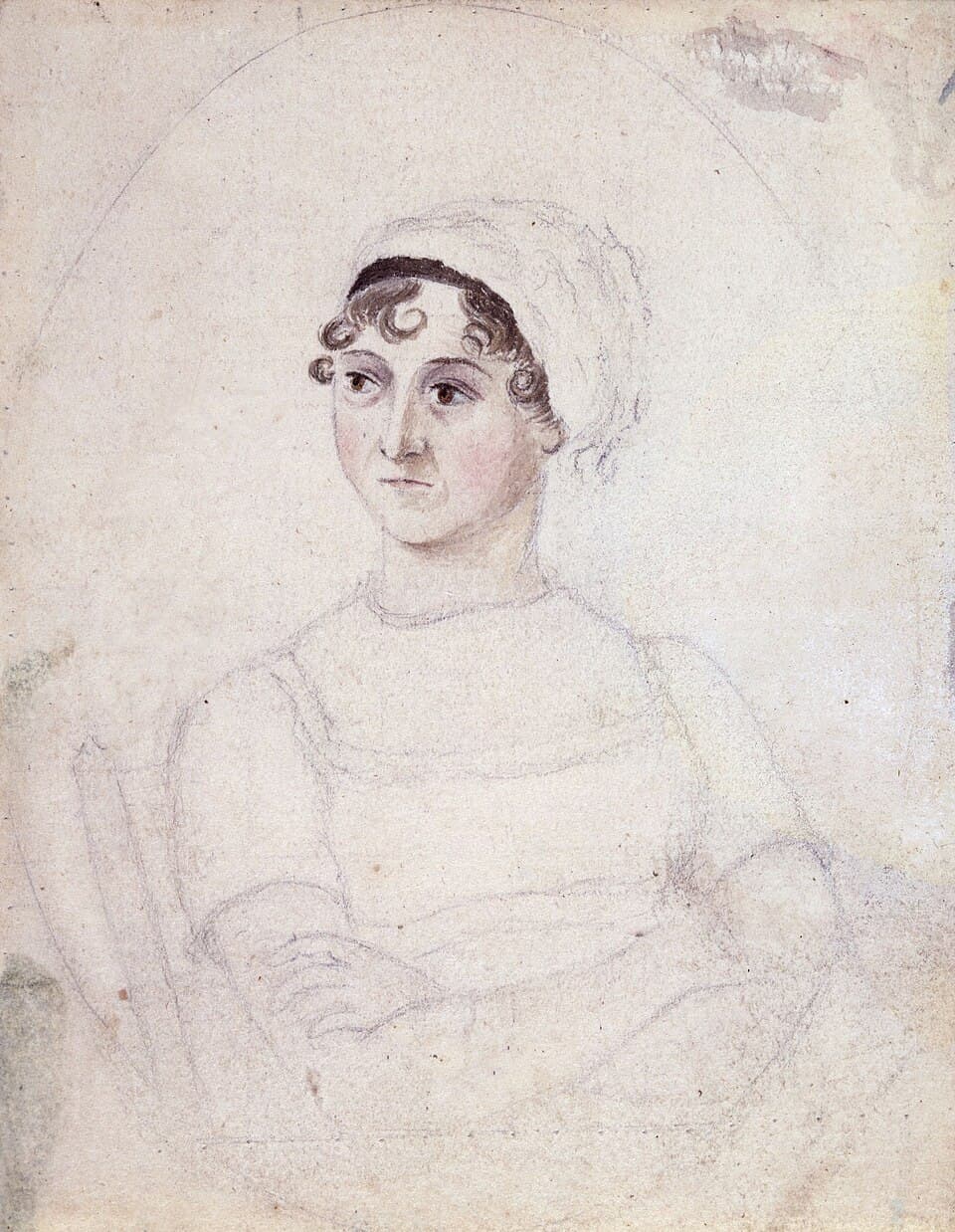
Jane Austen
1775–1817
English novelist
Jane Austen grew up in a Hampshire clerical family, reading widely and writing comic stories while still young. Her adult life included stays in Bath and Southampton before she settled at Chawton. Family relationships and the practical limits placed on women helped shape the world in which she wrote her novels.1. Jane Austen Society of North America, “Jane Austen: A Brief Biography,” JASNA, undated; accessed 21 October 2026, Education and Influences; Early Works; Publication and Later Life.
Her fiction follows courtship through the workings of money, rank, conversation, and mistaken judgment. Irony lets readers see both a character’s understanding and what escapes it. Six completed novels appeared between 1811 and 1818, the last two after her death. Earlier stories, unfinished novels, surviving letters, poems, and prayers reveal a broader range of experiments and private occasions.2. Jane Austen Society of North America, “Jane Austen’s Works,” JASNA, undated; accessed 21 October 2026, Six novels; chronology; collected letters. Kathryn Sutherland, editor, “Jane Austen’s Fiction Manuscripts: Manuscripts index,” University of Oxford / King’s College London digital edition, 2010; accessed 21 October 2026, Juvenilia; fiction drafts; ancillary manuscripts. Janet Todd and Linda Bree, editors, “Later Manuscripts,” Cambridge University Press, 2008, Contents; poems and charades; appendix of ascribed works and prayers.
How to read Jane Austen
Read for the distance between what people say, what they think, and what their circumstances allow. Courtship matters, but so do income, housing, inheritance, and the confidence with which someone judges a neighbor.3. Jane Austen Society of North America, “Jane Austen’s Works,” JASNA, undated; accessed 21 October 2026, Six novels; chronology; collected letters.
The bibliography maps all six completed novels, the surviving unfinished fiction and juvenile notebooks, and coherent groups of letters, poems, prayers, and minor manuscripts. Earlier draft titles are not duplicate novels; a modern editor’s additions or a later completion are not Austen’s text.4. Jane Austen Society of North America, “Jane Austen’s Works,” JASNA, undated; accessed 21 October 2026, Six novels; chronology; collected letters. Kathryn Sutherland, editor, “Jane Austen’s Fiction Manuscripts: Manuscripts index,” University of Oxford / King’s College London digital edition, 2010; accessed 21 October 2026, Juvenilia; fiction drafts; ancillary manuscripts.
The six completed novels
Pride and Prejudice is a clear starting point; follow it with Emma to watch a narrator closely tied to a mistaken observer. Mansfield Park and Persuasion bring different pressures of dependence, duty, and regret.5. Jane Austen Society of North America, “Jane Austen’s Works,” JASNA, undated; accessed 21 October 2026, Six novels; chronology; collected letters.
Early fiction and unfinished novels
Lady Susan tells its story through letters. The Watsons and Sanditon remain fragments; later continuations by other writers are separate works and are outside this map.6. Kathryn Sutherland, editor, “Jane Austen’s Fiction Manuscripts: Manuscripts index,” University of Oxford / King’s College London digital edition, 2010; accessed 21 October 2026, Juvenilia; fiction drafts; ancillary manuscripts.
The juvenile notebooks
Keep Austen’s three manuscript volumes together as distinct collections. They include stories, plays, verses, and comic fragments, including Love and Freindship and The History of England; their youthful exaggeration differs from the later novels.7. Kathryn Sutherland, editor, “Jane Austen’s Fiction Manuscripts: Manuscripts index,” University of Oxford / King’s College London digital edition, 2010; accessed 21 October 2026, Juvenilia; fiction drafts; ancillary manuscripts.
Other surviving writings
These units preserve letters, occasional verse, devotional writing, and small documents about authorship. They name the surviving material, without implying that every letter Austen wrote has been preserved. Sir Charles Grandison is retained as an attributed play with disputed authorship; the marginalia and mock marriage entries preserve further surviving writing.8. Kathryn Sutherland, editor, “Jane Austen’s Fiction Manuscripts: Manuscripts index,” University of Oxford / King’s College London digital edition, 2010; accessed 21 October 2026, Juvenilia; fiction drafts; ancillary manuscripts. Janet Todd and Linda Bree, editors, “Later Manuscripts,” Cambridge University Press, 2008, Contents; poems and charades; appendix of ascribed works and prayers. Peter Sabor, editor, “Juvenilia,” Cambridge University Press, 2006, Editorial introduction; marginalia and mock marriage entries.
Reading guide sources
- Jane Austen Society of North America, “Jane Austen’s Works,” JASNA, undated; accessed 21 October 2026, Six novels; chronology; collected letters.
- Jane Austen Society of North America, “Jane Austen’s Works,” JASNA, undated; accessed 21 October 2026, Six novels; chronology; collected letters. Kathryn Sutherland, editor, “Jane Austen’s Fiction Manuscripts: Manuscripts index,” University of Oxford / King’s College London digital edition, 2010; accessed 21 October 2026, Juvenilia; fiction drafts; ancillary manuscripts.
- Jane Austen Society of North America, “Jane Austen’s Works,” JASNA, undated; accessed 21 October 2026, Six novels; chronology; collected letters.
- Kathryn Sutherland, editor, “Jane Austen’s Fiction Manuscripts: Manuscripts index,” University of Oxford / King’s College London digital edition, 2010; accessed 21 October 2026, Juvenilia; fiction drafts; ancillary manuscripts.
- Kathryn Sutherland, editor, “Jane Austen’s Fiction Manuscripts: Manuscripts index,” University of Oxford / King’s College London digital edition, 2010; accessed 21 October 2026, Juvenilia; fiction drafts; ancillary manuscripts.
- Kathryn Sutherland, editor, “Jane Austen’s Fiction Manuscripts: Manuscripts index,” University of Oxford / King’s College London digital edition, 2010; accessed 21 October 2026, Juvenilia; fiction drafts; ancillary manuscripts. Janet Todd and Linda Bree, editors, “Later Manuscripts,” Cambridge University Press, 2008, Contents; poems and charades; appendix of ascribed works and prayers. Peter Sabor, editor, “Juvenilia,” Cambridge University Press, 2006, Editorial introduction; marginalia and mock marriage entries.
Works in the library
20 under developmentSense and Sensibility
Two sisters navigate feeling, restraint, and uncertain prospects.
Under developmentPride and Prejudice
Elizabeth Bennet revises judgments about pride, money, and marriage.
Under developmentMansfield Park
A dependent young woman tests the values of a wealthy household.
Under developmentEmma
A confident matchmaker misunderstands the people around her.
Under developmentNorthanger Abbey
Gothic reading shapes a young visitor’s suspicions.
Under developmentPersuasion
Former lovers meet again after years of separation.
Under developmentLady Susan
A resourceful widow pursues advantage through correspondence.
Under developmentThe Watsons
An unfinished novel about a young woman returning to her family.
Under developmentSanditon
An unfinished novel set around a developing seaside resort.
Under developmentJuvenilia: Volume the First
The first manuscript notebook, collecting sixteen early works across several forms.
Under developmentJuvenilia: Volume the Second
The second notebook, including Love and Freindship and The History of England.
Under developmentJuvenilia: Volume the Third
The third notebook, containing Evelyn and Catharine, or the Bower.
Under developmentSurviving Letters
Correspondence preserved from Austen’s life, with gaps caused partly by later destruction.
Under developmentPoems outside the Juvenilia
Occasional and family verse not already contained in the three juvenile notebooks.
Under developmentPrayers
Three evening prayers traditionally ascribed to Austen; the evidence for authorship has been debated.
Under development · Disputed attributionPlan of a Novel, According to Hints from Various Quarters
A comic plan assembled from suggestions about what a novel should contain.
Under developmentOpinions of Mansfield Park and Emma
Notes recording responses to the two novels from Austen’s acquaintances.
Under developmentCancelled Chapters and Other Manuscript Notes
The cancelled ending of Persuasion, the Susan title page, and Profits of my Novels.
Under developmentSir Charles Grandison
A dramatic adaptation traditionally associated with Austen; her contribution and the surviving text’s authorship are disputed.
Under development · Disputed attributionMarginalia and Mock Marriage Entries
Annotations in Goldsmith and Knox and the youthful imaginary entries in the Steventon marriage register.
Under development
Sources & portrait
- Jane Austen Society of North America, “Jane Austen: A Brief Biography,” JASNA, undated; accessed 21 October 2026, Education and Influences; Early Works; Publication and Later Life.
- Jane Austen Society of North America, “Jane Austen’s Works,” JASNA, undated; accessed 21 October 2026, Six novels; chronology; collected letters. Kathryn Sutherland, editor, “Jane Austen’s Fiction Manuscripts: Manuscripts index,” University of Oxford / King’s College London digital edition, 2010; accessed 21 October 2026, Juvenilia; fiction drafts; ancillary manuscripts. Janet Todd and Linda Bree, editors, “Later Manuscripts,” Cambridge University Press, 2008, Contents; poems and charades; appendix of ascribed works and prayers.
Portrait: Cassandra Austen, pencil and watercolor portrait, c. 1810. National Portrait Gallery, London, NPG 3630. Displayed in monochrome. Image source. Collection record. Public-domain historical work and faithful reproduction. Displayed in monochrome with a circular crop.

