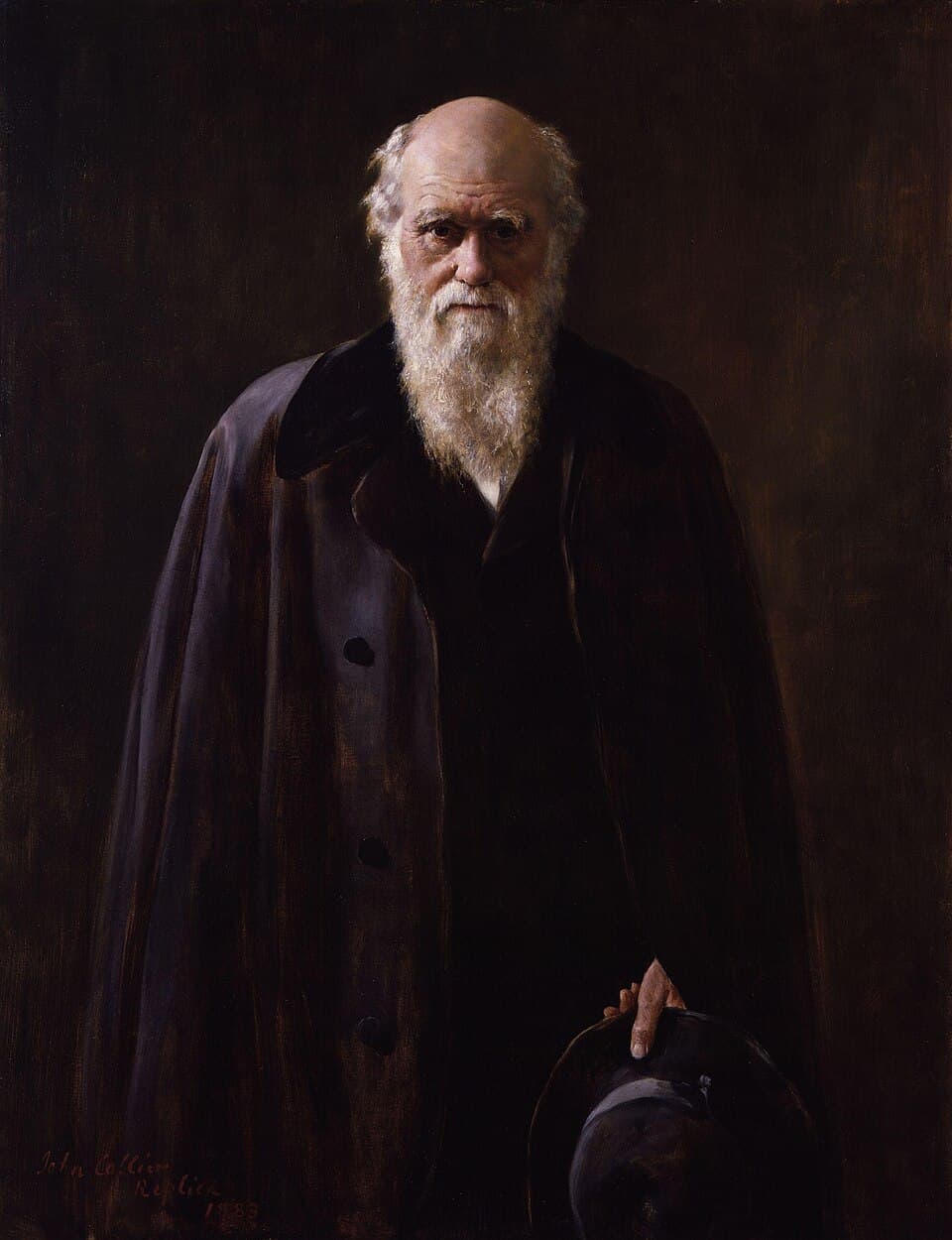
Charles Darwin
1809–1882
English naturalist and geologist
Charles Darwin studied medicine in Edinburgh and then attended Cambridge before joining HMS Beagle in 1831. Five years of travel supplied observations and specimens that shaped his later inquiries. He married Emma Wedgwood in 1839 and pursued much of his research from home, exchanging evidence with naturalists, breeders, and other correspondents.1. Darwin Correspondence Project editors, “Charles Robert Darwin,” University of Cambridge, Darwin Correspondence Project, undated; accessed October 21, 2026, Biographical register entry.
Darwin explained the diversity of life through common descent and natural selection, a mechanism also independently proposed by Alfred Russel Wallace. His books follow this argument into human origins and expression, while detailed studies of barnacles, flowers, climbing plants, and earthworms show how small observations could support explanations extending across long periods of time.2. James Lennox and Charles H. Pence, “Darwinism,” Stanford Encyclopedia of Philosophy, Summer 2026 edition, revised May 6, 2024, secs. 2.1–2.3. John van Wyhe, editor, “Darwin’s Publications,” Darwin Online, undated; accessed October 21, 2026, Books, Articles, and Published Manuscripts; editions grouped by original work.
How to read Charles Darwin
The Voyage of the Beagle is an approachable starting point; Origin then shows how Darwin builds an explanation from many kinds of evidence. Compare claims with the observations offered for them, and distinguish the argument of a particular edition from revisions made later.3. John van Wyhe, editor, “Darwin’s Publications,” Darwin Online, undated; accessed October 21, 2026, Books, Articles, and Published Manuscripts; editions grouped by original work.
Voyage, geology, and classification
The voyage narrative supplies a readable encounter with Darwin’s observations. The geological books and four barnacle monographs reveal the patient descriptive work behind his later arguments. Zoology is an edited collaborative work: Darwin’s own introductions must remain distinct from the specialist authors’ contributions.4. John van Wyhe, editor, “Darwin’s Publications,” Darwin Online, undated; accessed October 21, 2026, Books, Articles, and Published Manuscripts; editions grouped by original work.
- Extracts from Letters Addressed to Professor Henslow
- The Zoology of the Voyage of H.M.S. Beagle
- Journal of Researches (The Voyage of the Beagle)
- The Structure and Distribution of Coral Reefs
- Geological Observations on the Volcanic Islands
- Geological Observations on South America
- A Monograph of the Sub-class Cirripedia: The Lepadidae
- A Monograph of the Sub-class Cirripedia: The Balanidae and Verrucidae
- A Monograph on the Fossil Lepadidae of Great Britain
- A Monograph on the Fossil Balanidae and Verrucidae of Great Britain
Evolution and human life
Origin gives the central argument; Variation develops the evidence from domestication, while Descent and Expression extend the inquiry to human life. The early sketches remain drafts with their own history, rather than earlier editions of the finished Origin.5. James Lennox and Charles H. Pence, “Darwinism,” Stanford Encyclopedia of Philosophy, Summer 2026 edition, revised May 6, 2024, secs. 2.1–2.3.
Experiments with plants and soil
These books follow particular processes closely: pollination, movement, digestion, and the cumulative work of worms. Movement in Plants was written with the assistance of Francis Darwin; that collaboration belongs in any eventual edition’s credits.6. John van Wyhe, editor, “Darwin’s Publications,” Darwin Online, undated; accessed October 21, 2026, Books, Articles, and Published Manuscripts; editions grouped by original work.
- On the Various Contrivances by Which Orchids Are Fertilised by Insects
- On the Movements and Habits of Climbing Plants
- Insectivorous Plants
- The Effects of Cross and Self Fertilisation in the Vegetable Kingdom
- The Different Forms of Flowers on Plants of the Same Species
- The Power of Movement in Plants
- The Formation of Vegetable Mould through the Action of Worms
Life, papers, and working records
The remaining writing is represented through explicit collections. Articles, book contributions, questionnaires, correspondence, and notebooks are not treated as though each were a finished book; their eventual contents must be checked against the scholarly catalogs.7. John van Wyhe, editor, “Introduction to Darwin Online,” Darwin Online, undated; accessed October 21, 2026, Publications, manuscripts and private papers.
This bibliography covers the independently titled books, the separate barnacle monographs, and coherent collections of shorter and unpublished writing. Revised editions and translated titles belong to those works. Everything listed is preparatory: no text, translation, or downloadable edition is activated.8. John van Wyhe, editor, “Darwin’s Publications,” Darwin Online, undated; accessed October 21, 2026, Books, Articles, and Published Manuscripts; editions grouped by original work. John van Wyhe, editor, “Introduction to Darwin Online,” Darwin Online, undated; accessed October 21, 2026, Publications, manuscripts and private papers.
Reading guide sources
- John van Wyhe, editor, “Darwin’s Publications,” Darwin Online, undated; accessed October 21, 2026, Books, Articles, and Published Manuscripts; editions grouped by original work.
- John van Wyhe, editor, “Darwin’s Publications,” Darwin Online, undated; accessed October 21, 2026, Books, Articles, and Published Manuscripts; editions grouped by original work.
- James Lennox and Charles H. Pence, “Darwinism,” Stanford Encyclopedia of Philosophy, Summer 2026 edition, revised May 6, 2024, secs. 2.1–2.3.
- John van Wyhe, editor, “Darwin’s Publications,” Darwin Online, undated; accessed October 21, 2026, Books, Articles, and Published Manuscripts; editions grouped by original work.
- John van Wyhe, editor, “Introduction to Darwin Online,” Darwin Online, undated; accessed October 21, 2026, Publications, manuscripts and private papers.
- John van Wyhe, editor, “Darwin’s Publications,” Darwin Online, undated; accessed October 21, 2026, Books, Articles, and Published Manuscripts; editions grouped by original work. John van Wyhe, editor, “Introduction to Darwin Online,” Darwin Online, undated; accessed October 21, 2026, Publications, manuscripts and private papers.
Works in the library
28 under developmentExtracts from Letters Addressed to Professor Henslow
Early reports of geological observations sent home during the Beagle voyage.
Under developmentThe Zoology of the Voyage of H.M.S. Beagle
Five-part collaborative zoology, edited by Darwin, with his geological and geographical introductions.
Under developmentJournal of Researches (The Voyage of the Beagle)
A naturalist’s travel narrative connecting landscapes, fossils, animals, and human encounters.
Under developmentThe Structure and Distribution of Coral Reefs
An explanation of reef formation through coral growth and changes in land level.
Under developmentGeological Observations on the Volcanic Islands
Observations of volcanic rocks and islands encountered on the Beagle voyage.
Under developmentGeological Observations on South America
Field evidence concerning the continent’s formations, fossils, uplift, and geological history.
Under developmentA Monograph of the Sub-class Cirripedia: The Lepadidae
The first living-barnacle volume, treating stalked forms and their classification.
Under developmentA Monograph of the Sub-class Cirripedia: The Balanidae and Verrucidae
The second living-barnacle volume, treating sessile forms and anatomical variation.
Under developmentA Monograph on the Fossil Lepadidae of Great Britain
A separate monograph identifying and comparing fossil stalked barnacles.
Under developmentA Monograph on the Fossil Balanidae and Verrucidae of Great Britain
A separate study of Britain’s fossil sessile barnacles.
Under developmentOn the Origin of Species
An argument for descent with modification through natural selection.
Under developmentThe Variation of Animals and Plants under Domestication
Two volumes investigating inheritance, variation, breeding, and Darwin’s proposed pangenesis.
Under developmentThe Descent of Man, and Selection in Relation to Sex
Human origins and sexual selection examined through comparative evidence.
Under developmentThe Expression of the Emotions in Man and Animals
A comparative investigation of bodily expressions and their possible evolutionary history.
Under developmentSpecies Sketches of 1842 and 1844
Two early, unpublished-in-life drafts of Darwin’s evolutionary argument.
Under developmentEssay on Instinct
An unpublished chapter from Darwin’s larger species manuscript, issued posthumously.
Under developmentOn the Various Contrivances by Which Orchids Are Fertilised by Insects
Orchid structures explained through their relations with pollinating insects.
Under developmentOn the Movements and Habits of Climbing Plants
Experiments on the movements through which plants climb and attach themselves.
Under developmentInsectivorous Plants
Experiments examining how certain plants respond to and digest captured material.
Under developmentThe Effects of Cross and Self Fertilisation in the Vegetable Kingdom
Comparisons of plant offspring produced through crossing and self-fertilisation.
Under developmentThe Different Forms of Flowers on Plants of the Same Species
Flower variation studied in relation to reproduction and crossing.
Under developmentThe Power of Movement in Plants
Plant movements studied through experiments, with assistance from Francis Darwin.
Under developmentThe Formation of Vegetable Mould through the Action of Worms
An account of earthworms’ gradual transformation of soil and buried objects.
Under developmentErasmus Darwin: Preliminary Notice
Darwin’s biographical notice of his grandfather, published with Ernst Krause’s essay.
Under developmentAutobiography
A family-directed account of Darwin’s life, research, and changing beliefs.
Under developmentCollected Short Papers and Contributions
Articles, notices, questionnaires, testimony, prefaces, and contributions to other authors’ books.
Under developmentCorrespondence
Letters written by Darwin; incoming letters provide context and require separate attribution.
Under developmentNotebooks, Journals, and Unpublished Manuscripts
Field notebooks, the Beagle diary, research notes, and unfinished manuscripts, grouped by archival provenance.
Under development
Sources & portrait
- Darwin Correspondence Project editors, “Charles Robert Darwin,” University of Cambridge, Darwin Correspondence Project, undated; accessed October 21, 2026, Biographical register entry.
- James Lennox and Charles H. Pence, “Darwinism,” Stanford Encyclopedia of Philosophy, Summer 2026 edition, revised May 6, 2024, secs. 2.1–2.3. John van Wyhe, editor, “Darwin’s Publications,” Darwin Online, undated; accessed October 21, 2026, Books, Articles, and Published Manuscripts; editions grouped by original work.
Portrait: John Collier, Charles Darwin, 1883 replica of his 1881 portrait. National Portrait Gallery, London. Displayed in monochrome and cropped in a circular frame. Image source. Public domain; faithful reproduction of a painting by John Collier (1850–1934).. Displayed in monochrome with a circular crop.

