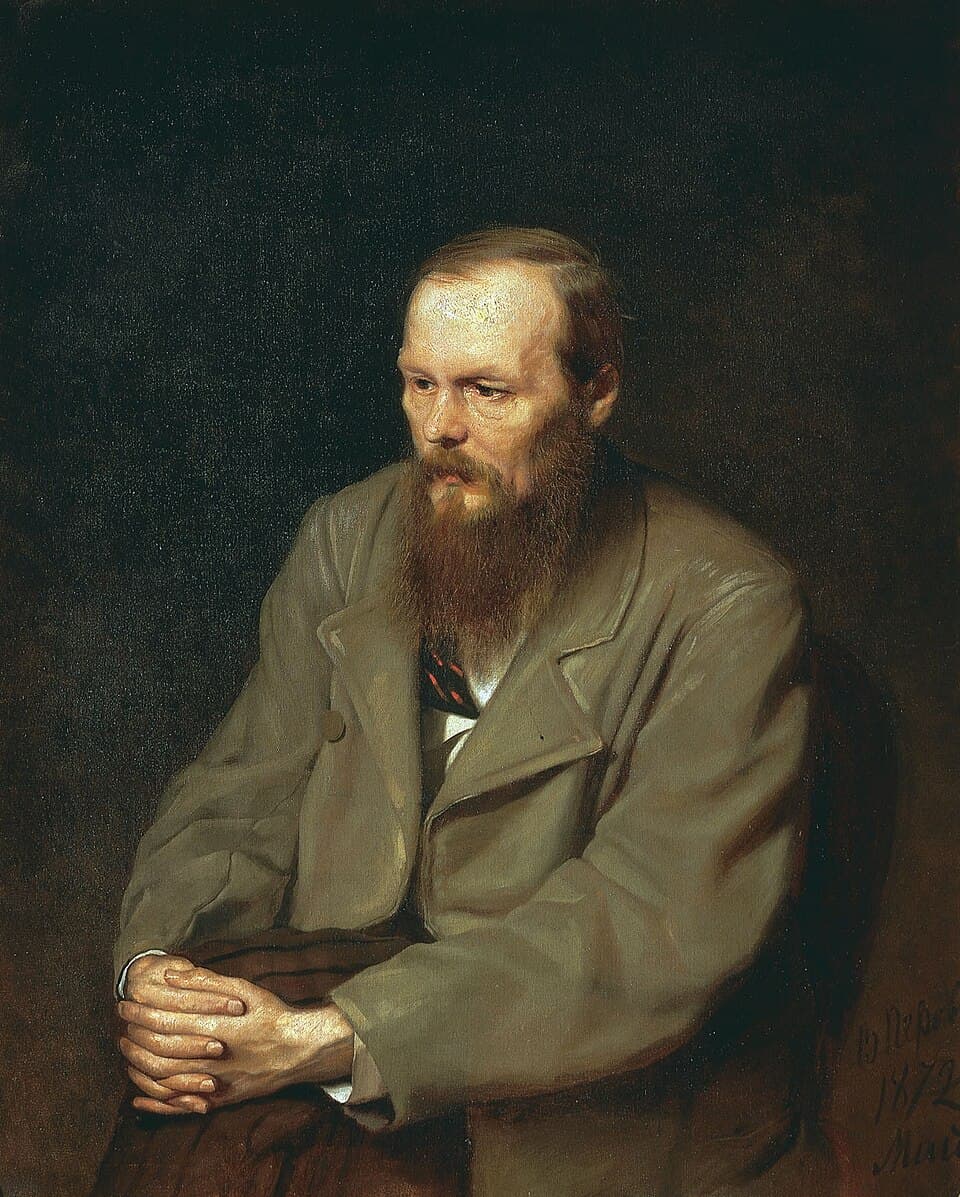
Fyodor Dostoevsky
1821–1881
Russian novelist and essayist
Fyodor Dostoevsky was born in Moscow and trained as a military engineer before turning to literature. Arrested for his involvement in the Petrashevsky circle, he endured a staged execution, imprisonment in Siberia, and military service. On returning to literary life, he combined fiction with the demanding work of editing journals.1. I. P., signed Russian Virtual Library editorial overview, “Fyodor Mikhailovich Dostoevsky,” Russian Virtual Library, digital edition revised 27 January 2017; accessed 21 October 2026, Biographical and critical overview.
His novels place ideas inside arguments among people under social and emotional pressure. Poverty, pride, religious belief, and the wish for freedom become lived conflicts rather than settled positions. Short fiction and A Writer’s Diary extend these concerns into satire and public controversy. His journalism also expresses political and religious commitments that require historical scrutiny alongside his sympathy for suffering individuals.2. I. P., signed Russian Virtual Library editorial overview, “Fyodor Mikhailovich Dostoevsky,” Russian Virtual Library, digital edition revised 27 January 2017; accessed 21 October 2026, Biographical and critical overview.
How to read Fyodor Dostoevsky
White Nights offers a short first encounter; Crime and Punishment supplies a longer narrative center. Keep track of speakers and motives: an argument may reveal a character’s predicament without providing the novel’s final judgment.3. Russian Virtual Library editorial team, “Fyodor Mikhailovich Dostoevsky,” Russian Virtual Library, undated; accessed 21 October 2026, Biographical and critical overview.
The map uses Nauka’s fifteen-volume collected edition as a named boundary for fiction, journalism, unfinished writing, verse, and surviving letters, with the early Balzac translation added separately. It does not claim to reproduce every draft in the thirty-volume academic edition. English titles identify works; no translation has been activated.4. Fyodor Dostoevsky; G. M. Fridlender and scholarly editorial board, “Collected Works in Fifteen Volumes, volume 1,” Nauka; Russian Virtual Library, 1988–1996; digital edition revised 27 January 2017, Table of contents. Fyodor Dostoevsky; G. M. Fridlender and scholarly editorial board, “Collected Works in Fifteen Volumes, volume 10,” Nauka; Russian Virtual Library, 1988–1996; digital edition revised 27 January 2017, Table of contents. Fyodor Dostoevsky; G. M. Fridlender and scholarly editorial board, “Collected Works in Fifteen Volumes, volume 15,” Nauka; Russian Virtual Library, 1988–1996; digital edition revised 27 January 2017, Table of contents.
The early Petersburg writings
Poor Folk and White Nights offer compact entrances to voices shaped by loneliness and social rank. The Double turns insecurity into an unstable encounter with a rival self.5. Fyodor Dostoevsky; G. M. Fridlender and scholarly editorial board, “Collected Works in Fifteen Volumes, volume 1,” Nauka; Russian Virtual Library, 1988–1996; digital edition revised 27 January 2017, Table of contents. Fyodor Dostoevsky; G. M. Fridlender and scholarly editorial board, “Collected Works in Fifteen Volumes, volume 2,” Nauka; Russian Virtual Library, 1988–1996; digital edition revised 27 January 2017, Table of contents.
Return from Siberia
The House of the Dead draws on imprisonment through a fictional narrator. Read Notes from Underground as a deliberately difficult voice, rather than a transparent statement of the author’s views.6. Fyodor Dostoevsky; G. M. Fridlender and scholarly editorial board, “Collected Works in Fifteen Volumes, volume 3,” Nauka; Russian Virtual Library, 1988–1996; digital edition revised 27 January 2017, Table of contents. Fyodor Dostoevsky; G. M. Fridlender and scholarly editorial board, “Collected Works in Fifteen Volumes, volume 4,” Nauka; Russian Virtual Library, 1988–1996; digital edition revised 27 January 2017, Table of contents.
The later novels
Crime and Punishment gives a sustained route into moral action and self-justification. The Idiot, Demons, The Adolescent, and The Brothers Karamazov broaden the conflicts through families and social groups.7. Fyodor Dostoevsky; G. M. Fridlender and scholarly editorial board, “Collected Works in Fifteen Volumes, volume 4,” Nauka; Russian Virtual Library, 1988–1996; digital edition revised 27 January 2017, Table of contents. Fyodor Dostoevsky; G. M. Fridlender and scholarly editorial board, “Collected Works in Fifteen Volumes, volume 8,” Nauka; Russian Virtual Library, 1988–1996; digital edition revised 27 January 2017, Table of contents. Fyodor Dostoevsky; G. M. Fridlender and scholarly editorial board, “Collected Works in Fifteen Volumes, volume 10,” Nauka; Russian Virtual Library, 1988–1996; digital edition revised 27 January 2017, Table of contents.
Travel, journalism, and the remaining corpus
A Writer’s Diary combines polemic, recollection, reportage, and fiction, including Bobok, The Meek One, The Peasant Marey, and The Dream of a Ridiculous Man. Its public claims should be distinguished from the many voices of the novels.8. Fyodor Dostoevsky; G. M. Fridlender and scholarly editorial board, “Collected Works in Fifteen Volumes, volume 11,” Nauka; Russian Virtual Library, 1988–1996; digital edition revised 27 January 2017, Table of contents. Fyodor Dostoevsky; G. M. Fridlender and scholarly editorial board, “Collected Works in Fifteen Volumes, volume 12,” Nauka; Russian Virtual Library, 1988–1996; digital edition revised 27 January 2017, Table of contents. Fyodor Dostoevsky; G. M. Fridlender and scholarly editorial board, “Collected Works in Fifteen Volumes, volume 15,” Nauka; Russian Virtual Library, 1988–1996; digital edition revised 27 January 2017, Table of contents.
Reading guide sources
- Russian Virtual Library editorial team, “Fyodor Mikhailovich Dostoevsky,” Russian Virtual Library, undated; accessed 21 October 2026, Biographical and critical overview.
- Fyodor Dostoevsky; G. M. Fridlender and scholarly editorial board, “Collected Works in Fifteen Volumes, volume 1,” Nauka; Russian Virtual Library, 1988–1996; digital edition revised 27 January 2017, Table of contents. Fyodor Dostoevsky; G. M. Fridlender and scholarly editorial board, “Collected Works in Fifteen Volumes, volume 10,” Nauka; Russian Virtual Library, 1988–1996; digital edition revised 27 January 2017, Table of contents. Fyodor Dostoevsky; G. M. Fridlender and scholarly editorial board, “Collected Works in Fifteen Volumes, volume 15,” Nauka; Russian Virtual Library, 1988–1996; digital edition revised 27 January 2017, Table of contents.
- Fyodor Dostoevsky; G. M. Fridlender and scholarly editorial board, “Collected Works in Fifteen Volumes, volume 1,” Nauka; Russian Virtual Library, 1988–1996; digital edition revised 27 January 2017, Table of contents. Fyodor Dostoevsky; G. M. Fridlender and scholarly editorial board, “Collected Works in Fifteen Volumes, volume 2,” Nauka; Russian Virtual Library, 1988–1996; digital edition revised 27 January 2017, Table of contents.
- Fyodor Dostoevsky; G. M. Fridlender and scholarly editorial board, “Collected Works in Fifteen Volumes, volume 3,” Nauka; Russian Virtual Library, 1988–1996; digital edition revised 27 January 2017, Table of contents. Fyodor Dostoevsky; G. M. Fridlender and scholarly editorial board, “Collected Works in Fifteen Volumes, volume 4,” Nauka; Russian Virtual Library, 1988–1996; digital edition revised 27 January 2017, Table of contents.
- Fyodor Dostoevsky; G. M. Fridlender and scholarly editorial board, “Collected Works in Fifteen Volumes, volume 4,” Nauka; Russian Virtual Library, 1988–1996; digital edition revised 27 January 2017, Table of contents. Fyodor Dostoevsky; G. M. Fridlender and scholarly editorial board, “Collected Works in Fifteen Volumes, volume 8,” Nauka; Russian Virtual Library, 1988–1996; digital edition revised 27 January 2017, Table of contents. Fyodor Dostoevsky; G. M. Fridlender and scholarly editorial board, “Collected Works in Fifteen Volumes, volume 10,” Nauka; Russian Virtual Library, 1988–1996; digital edition revised 27 January 2017, Table of contents.
- Fyodor Dostoevsky; G. M. Fridlender and scholarly editorial board, “Collected Works in Fifteen Volumes, volume 11,” Nauka; Russian Virtual Library, 1988–1996; digital edition revised 27 January 2017, Table of contents. Fyodor Dostoevsky; G. M. Fridlender and scholarly editorial board, “Collected Works in Fifteen Volumes, volume 12,” Nauka; Russian Virtual Library, 1988–1996; digital edition revised 27 January 2017, Table of contents. Fyodor Dostoevsky; G. M. Fridlender and scholarly editorial board, “Collected Works in Fifteen Volumes, volume 15,” Nauka; Russian Virtual Library, 1988–1996; digital edition revised 27 January 2017, Table of contents.
Works in the library
35 under developmentPoor Folk
An exchange of letters reveals poverty, care, and wounded dignity.
Under developmentThe Double
A clerk’s encounters with his double unsettle his identity.
Under developmentA Novel in Nine Letters
Correspondence turns polite business relations into a comic struggle.
Under developmentMr. Prokharchin
A withdrawn lodger’s guarded life puzzles those around him.
Under developmentThe Landlady
A young man enters a household marked by dependence and fear.
Under developmentPolzunkov
A humiliated official recounts his involvement in a practical joke.
Under developmentA Faint Heart
An anxious clerk cannot accept the happiness offered to him.
Under developmentAnother Man’s Wife and a Husband under the Bed
Jealous suspicion produces a farcical pursuit.
Under developmentAn Honest Thief
A theft tests a poor man’s loyalty to his companion.
Under developmentA Christmas Tree and a Wedding
A festive gathering exposes calculations about a child’s inheritance.
Under developmentWhite Nights
A solitary dreamer meets a woman over four Petersburg nights.
Under developmentNetochka Nezvanova
An unfinished novel follows a girl through troubled households.
Under developmentA Little Hero
A child observes desire and secrecy among adults.
Under developmentHow Dangerous It Is to Indulge in Ambitious Dreams
A collaborative comic narrative printed as an appendix to the early fiction.
Under developmentUncle’s Dream
Marriage schemes unsettle the society of a provincial town.
Under developmentThe Village of Stepanchikovo and Its Inhabitants
A household submits to the moral pretensions of a dependent guest.
Under developmentThe House of the Dead
A fictional prisoner records life in a Siberian penal settlement.
Under developmentHumiliated and Insulted
Entangled families endure manipulation, abandonment, and social injury.
Under developmentA Nasty Story
A superior’s attempt at benevolence becomes a disastrous intrusion.
Under developmentNotes from Underground
A resentful narrator disputes rational self-interest and recalls his humiliations.
Under developmentThe Crocodile
An official swallowed by a crocodile becomes a public curiosity.
Under developmentCrime and Punishment
A murder draws its perpetrator into conflict with his own reasoning.
Under developmentThe Gambler
A tutor becomes entangled in roulette, dependence, and desire.
Under developmentThe Idiot
Prince Myshkin’s compassion unsettles a society driven by pride and possession.
Under developmentThe Eternal Husband
A widower confronts a man connected with his dead wife.
Under developmentDemons
Revolutionary plotting turns a provincial community toward catastrophe.
Under developmentThe Adolescent
An illegitimate son tests ambitions of wealth and independence.
Under developmentThe Brothers Karamazov
A father’s murder exposes conflicts of belief, responsibility, and love.
Under developmentWinter Notes on Summer Impressions
A travel essay questions European society and Russian admiration for it.
Under developmentPetersburg Chronicle and Petersburg Dreams
The 1847 city feuilletons and the 1861 prose-and-verse sketch.
Under developmentA Writer’s Diary
The collected issues of 1873, 1876–1877, 1880, and 1881, including their short fiction.
Under developmentOther Articles, Reviews, and Public Writings
Journalism in volumes 11–12 and other public prose in the fifteen-volume collection, including the introductory speech before reading The Grand Inquisitor.
Under developmentUnfinished Narratives, Plans, and Poems
The unfinished narrative projects, literary plans, and verse collected in volume 10.
Under developmentSurviving Letters
Correspondence from 1834–1881 in the fifteen-volume collected edition.
Under developmentEugénie Grandet: Russian Translation
Dostoevsky’s published Russian translation of Balzac’s novel; Balzac remains its original author.
Under development
Sources & portrait
- I. P., signed Russian Virtual Library editorial overview, “Fyodor Mikhailovich Dostoevsky,” Russian Virtual Library, digital edition revised 27 January 2017; accessed 21 October 2026, Biographical and critical overview.
- I. P., signed Russian Virtual Library editorial overview, “Fyodor Mikhailovich Dostoevsky,” Russian Virtual Library, digital edition revised 27 January 2017; accessed 21 October 2026, Biographical and critical overview.
Portrait: Vasily Perov, Portrait of Fyodor Dostoevsky, oil on canvas, 1872. State Tretyakov Gallery, Moscow. Displayed in monochrome. Image source. Public-domain historical work and faithful reproduction. Displayed in monochrome with a circular crop.

