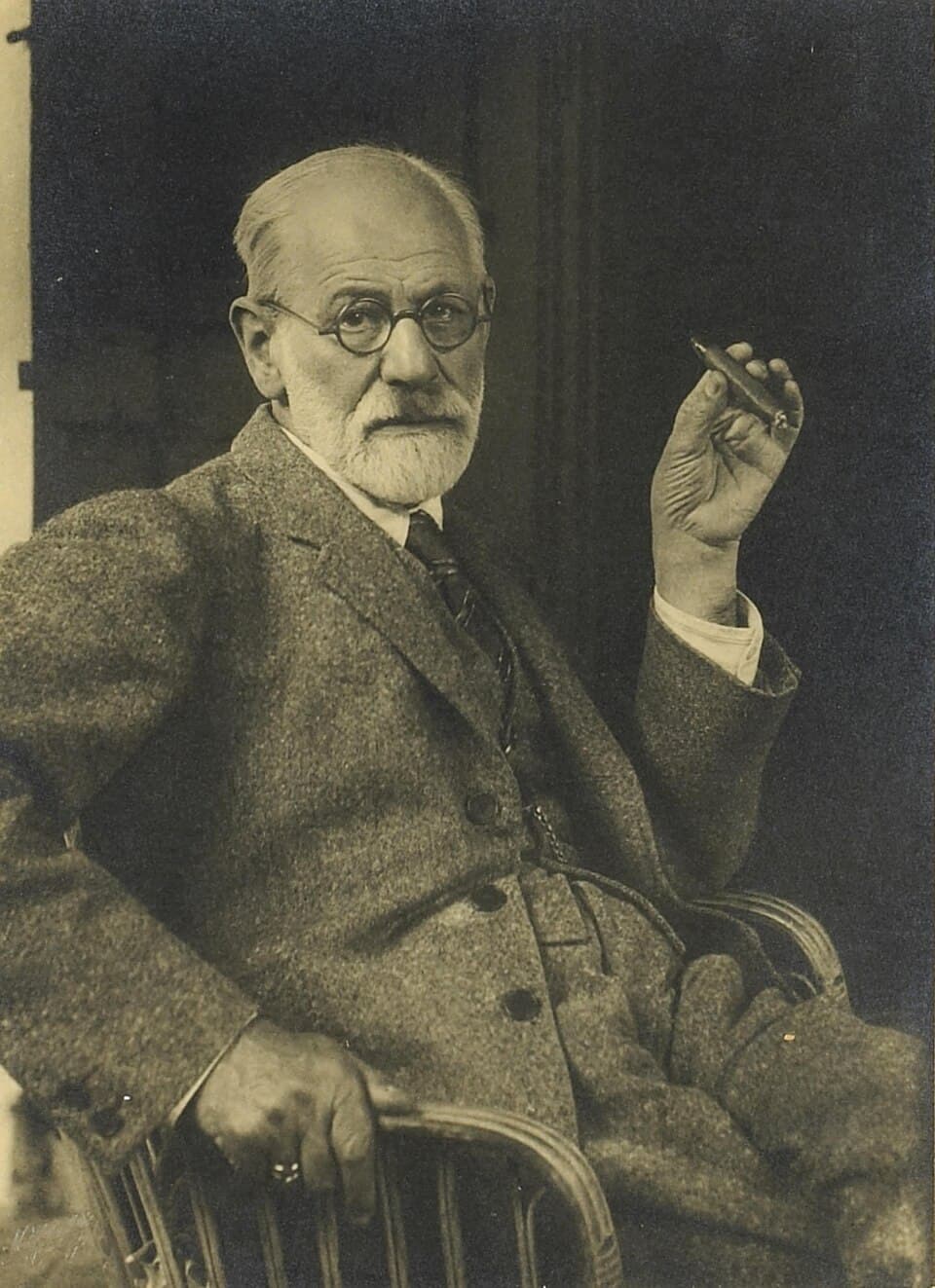
Sigmund Freud
1856–1939
Austrian neurologist and founder of psychoanalysis
Sigmund Freud trained in medicine and physiology in Vienna before specialising in nervous disorders. Work with Jean-Martin Charcot and Josef Breuer helped turn his attention toward psychological explanations of symptoms. He developed psychoanalysis through clinical practice, self-examination, and writing. Nazi persecution forced him to leave Vienna for London in 1938.1. Stephen P. Thornton, “Sigmund Freud (1856–1939),” Internet Encyclopedia of Philosophy, undated; accessed October 21, 2026, secs. 1–7.
Dreams, slips, memories, and symptoms became evidence in Freud’s account of unconscious conflict. He repeatedly revised his explanations of sexuality, anxiety, and the structure of the mind, extending them into studies of art, religion, and social life. His influence reaches well beyond clinical psychology, while his methods and claims to scientific authority remain subjects of sustained disagreement.2. Stephen P. Thornton, “Sigmund Freud (1856–1939),” Internet Encyclopedia of Philosophy, undated; accessed October 21, 2026, secs. 1–7.
How to read Sigmund Freud
Five Lectures provides a concise entrance before the dream book or Introductory Lectures. Read Freud chronologically when comparing theories, because he changed his explanations. Historical case labels preserve how the writings are known; they should not imply an endorsement of his diagnoses or reconstructions.3. Stephen P. Thornton, “Sigmund Freud (1856–1939),” Internet Encyclopedia of Philosophy, undated; accessed October 21, 2026, secs. 1–7. Sigmund Freud; James Strachey, Anna Freud and collaborators, editors, “The Standard Edition of the Complete Psychological Works of Sigmund Freud,” Hogarth Press and Institute of Psycho-Analysis; Wellcome Collection catalog, 1953–1974, Contents, vols. I–XXIV; bibliography records original works, not permission to reuse translations.
Early medicine and the beginnings of analysis
The medical books prevent a retrospective picture in which Freud was always writing psychoanalysis. Studies on Hysteria was written with Josef Breuer; the Project is an unpublished draft. The shorter medical corpus extends beyond what the Standard Edition collects.4. Freud Museum London, “From Medicine to Psychoanalysis,” Freud Museum London, undated; accessed October 21, 2026, From brain to mind; Paediatric work.
Dreams, everyday life, and introductory lectures
The shorter On Dreams and Five Lectures offer compact introductions before the longer dream book and Introductory Lectures. Their claims belong to the development of Freud’s theory; they are not substitutes for current clinical evidence.5. Sigmund Freud; James Strachey, Anna Freud and collaborators, editors, “The Standard Edition of the Complete Psychological Works of Sigmund Freud,” Hogarth Press and Institute of Psycho-Analysis; Wellcome Collection catalog, 1953–1974, Contents, vols. I–XXIV; bibliography records original works, not permission to reuse translations.
Case histories and interpretations of art
The case histories present Freud’s interpretations of particular lives and reports, including cases he did not treat personally. Gradiva and Leonardo move the method toward literature and art. Their status as interpretations should remain visible.6. Sigmund Freud; James Strachey, Anna Freud and collaborators, editors, “The Standard Edition of the Complete Psychological Works of Sigmund Freud,” Hogarth Press and Institute of Psycho-Analysis; Wellcome Collection catalog, 1953–1974, Contents, vols. I–XXIV; bibliography records original works, not permission to reuse translations.
- Fragment of an Analysis of a Case of Hysteria (Dora)
- Analysis of a Phobia in a Five-Year-Old Boy (Little Hans)
- Notes upon a Case of Obsessional Neurosis (Rat Man)
- Psycho-Analytic Notes on an Autobiographical Account of a Case of Paranoia (Schreber)
- From the History of an Infantile Neurosis (Wolf Man)
- Delusions and Dreams in Jensen’s Gradiva
- Leonardo da Vinci and a Memory of His Childhood
Theory, culture, and religion
Follow the changes between Three Essays, Beyond the Pleasure Principle, and The Ego and the Id. The books about religion and civilisation extend clinical concepts into contested historical and cultural arguments, rather than establishing neutral histories of the traditions they discuss.7. Stephen P. Thornton, “Sigmund Freud: Religion,” Internet Encyclopedia of Philosophy, undated; accessed October 21, 2026, Introduction and sections on Totem and Taboo, The Future of an Illusion, Civilization and Its Discontents, and Moses and Monotheism.
- Three Essays on the Theory of Sexuality
- Totem and Taboo
- On the History of the Psycho-Analytic Movement
- Beyond the Pleasure Principle
- Group Psychology and the Analysis of the Ego
- The Ego and the Id
- An Autobiographical Study
- Inhibitions, Symptoms and Anxiety
- The Question of Lay Analysis
- The Future of an Illusion
- Civilization and Its Discontents
- Why War?
- Moses and Monotheism
- An Outline of Psycho-Analysis
The remaining papers and private writing
The large shorter-writing corpus remains explicit rather than disappearing behind a list of famous books. Thematic and chronological distinctions must be preserved when its contents are prepared. Published correspondence is grouped separately from clinical and theoretical papers.8. Sigmund Freud; James Strachey, Anna Freud and collaborators, editors, “The Standard Edition of the Complete Psychological Works of Sigmund Freud,” Hogarth Press and Institute of Psycho-Analysis; Wellcome Collection catalog, 1953–1974, Contents, vols. I–XXIV; bibliography records original works, not permission to reuse translations.
Independent books, medical monographs, major case histories, and the Project are listed separately; other psychological papers and medical writings are grouped, as are correspondence and private notes. The Standard Edition is a bibliographic map, not a reuse licence for its English translation. No text is activated here.9. Sigmund Freud; James Strachey, Anna Freud and collaborators, editors, “The Standard Edition of the Complete Psychological Works of Sigmund Freud,” Hogarth Press and Institute of Psycho-Analysis; Wellcome Collection catalog, 1953–1974, Contents, vols. I–XXIV; bibliography records original works, not permission to reuse translations. Sigmund Freud Museum, “Library of Psychoanalysis,” Sigmund Freud Museum, Vienna, undated; accessed October 21, 2026, Collection description: pre-analytic works excluded from Gesammelte Werke and Standard Edition.
Reading guide sources
- Stephen P. Thornton, “Sigmund Freud (1856–1939),” Internet Encyclopedia of Philosophy, undated; accessed October 21, 2026, secs. 1–7. Sigmund Freud; James Strachey, Anna Freud and collaborators, editors, “The Standard Edition of the Complete Psychological Works of Sigmund Freud,” Hogarth Press and Institute of Psycho-Analysis; Wellcome Collection catalog, 1953–1974, Contents, vols. I–XXIV; bibliography records original works, not permission to reuse translations.
- Freud Museum London, “From Medicine to Psychoanalysis,” Freud Museum London, undated; accessed October 21, 2026, From brain to mind; Paediatric work.
- Sigmund Freud; James Strachey, Anna Freud and collaborators, editors, “The Standard Edition of the Complete Psychological Works of Sigmund Freud,” Hogarth Press and Institute of Psycho-Analysis; Wellcome Collection catalog, 1953–1974, Contents, vols. I–XXIV; bibliography records original works, not permission to reuse translations.
- Sigmund Freud; James Strachey, Anna Freud and collaborators, editors, “The Standard Edition of the Complete Psychological Works of Sigmund Freud,” Hogarth Press and Institute of Psycho-Analysis; Wellcome Collection catalog, 1953–1974, Contents, vols. I–XXIV; bibliography records original works, not permission to reuse translations.
- Stephen P. Thornton, “Sigmund Freud: Religion,” Internet Encyclopedia of Philosophy, undated; accessed October 21, 2026, Introduction and sections on Totem and Taboo, The Future of an Illusion, Civilization and Its Discontents, and Moses and Monotheism.
- Sigmund Freud; James Strachey, Anna Freud and collaborators, editors, “The Standard Edition of the Complete Psychological Works of Sigmund Freud,” Hogarth Press and Institute of Psycho-Analysis; Wellcome Collection catalog, 1953–1974, Contents, vols. I–XXIV; bibliography records original works, not permission to reuse translations.
- Sigmund Freud; James Strachey, Anna Freud and collaborators, editors, “The Standard Edition of the Complete Psychological Works of Sigmund Freud,” Hogarth Press and Institute of Psycho-Analysis; Wellcome Collection catalog, 1953–1974, Contents, vols. I–XXIV; bibliography records original works, not permission to reuse translations. Sigmund Freud Museum, “Library of Psychoanalysis,” Sigmund Freud Museum, Vienna, undated; accessed October 21, 2026, Collection description: pre-analytic works excluded from Gesammelte Werke and Standard Edition.
Works in the library
37 under developmentOn Aphasia
A critical neurological study of language disorders, originally Zur Auffassung der Aphasien.
Under developmentClinical Study of Unilateral Cerebral Paralysis in Children
A neurological monograph written with Oscar Rie in 1891.
Under developmentOn the Cerebral Diplegias of Childhood
Freud’s 1893 monograph on bilateral childhood movement disorders.
Under developmentInfantile Cerebral Palsy
A substantial 1897 neurological treatise, originally Die infantile Cerebrallähmung.
Under developmentMedical and Pre-Analytic Papers
Physiological, anatomical, neurological, cocaine, and hypnosis papers outside the independent medical books.
Under developmentStudies on Hysteria
Clinical studies and theoretical arguments jointly authored with Josef Breuer.
Under developmentProject for a Scientific Psychology
An unfinished 1895 attempt to explain mental processes through a neuronal model.
Under developmentThe Interpretation of Dreams
An argument concerning dream formation, disguised wishes, and interpretation.
Under developmentOn Dreams
A shorter presentation of Freud’s account of dreaming.
Under developmentThe Psychopathology of Everyday Life
An investigation of slips, forgetting, and apparently accidental actions.
Under developmentJokes and Their Relation to the Unconscious
A study of joking, pleasure, and unconscious mental processes.
Under developmentFive Lectures on Psycho-Analysis
An introductory account based on Freud’s Clark University lectures.
Under developmentIntroductory Lectures on Psycho-Analysis
Lectures moving from slips and dreams to psychoanalytic accounts of neurosis.
Under developmentNew Introductory Lectures on Psycho-Analysis
Later lectures revisiting and extending Freud’s theoretical positions.
Under developmentFragment of an Analysis of a Case of Hysteria (Dora)
A case history examining symptoms, dreams, and the course of an interrupted analysis.
Under developmentAnalysis of a Phobia in a Five-Year-Old Boy (Little Hans)
An interpretation of childhood phobia based largely on reports from the child’s father.
Under developmentNotes upon a Case of Obsessional Neurosis (Rat Man)
A case history concerning obsession, fear, and ambivalent attachment.
Under developmentPsycho-Analytic Notes on an Autobiographical Account of a Case of Paranoia (Schreber)
An interpretation of Daniel Paul Schreber’s published memoir, without personal treatment.
Under developmentFrom the History of an Infantile Neurosis (Wolf Man)
A retrospective case history connecting childhood experiences, dreams, and later symptoms.
Under developmentDelusions and Dreams in Jensen’s Gradiva
A psychoanalytic reading of Wilhelm Jensen’s novella.
Under developmentLeonardo da Vinci and a Memory of His Childhood
An interpretive study of Leonardo’s development and creative life.
Under developmentThree Essays on the Theory of Sexuality
Essays developing Freud’s account of sexuality and its development.
Under developmentTotem and Taboo
Speculative comparisons between psychoanalysis, kinship, prohibition, and religious origins.
Under developmentOn the History of the Psycho-Analytic Movement
Freud’s account of the development and disputes of his movement.
Under developmentBeyond the Pleasure Principle
An inquiry into repetition, trauma, and the limits of pleasure as an explanation.
Under developmentGroup Psychology and the Analysis of the Ego
A study of identification, leadership, and emotional bonds within groups.
Under developmentThe Ego and the Id
A revision of Freud’s model of mental organisation and conflict.
Under developmentAn Autobiographical Study
Freud’s retrospective account of his intellectual and professional development.
Under developmentInhibitions, Symptoms and Anxiety
A reassessment of anxiety, defence, and symptom formation.
Under developmentThe Question of Lay Analysis
A defence of psychoanalytic practice by appropriately trained non-physicians.
Under developmentThe Future of an Illusion
An argument about the psychological sources and prospects of religious belief.
Under developmentCivilization and Its Discontents
An examination of the conflicts between individual desire and social life.
Under developmentWhy War?
Freud’s contribution to the published correspondence with Albert Einstein.
Under developmentMoses and Monotheism
A speculative reconstruction of Jewish origins and religious memory.
Under developmentAn Outline of Psycho-Analysis
An unfinished late synthesis of Freud’s psychoanalytic theory.
Under developmentCollected Psychological Papers and Shorter Writings
The remaining essays, case reports, metapsychology, technique papers, reviews, prefaces, and public statements.
Under developmentCorrespondence and Private Notes
Letters, travel records, and private notes, with restrictions and editorial contributions assessed individually.
Under development
Sources & portrait
- Stephen P. Thornton, “Sigmund Freud (1856–1939),” Internet Encyclopedia of Philosophy, undated; accessed October 21, 2026, secs. 1–7.
- Stephen P. Thornton, “Sigmund Freud (1856–1939),” Internet Encyclopedia of Philosophy, undated; accessed October 21, 2026, secs. 1–7.
Portrait: Max Halberstadt, Sigmund Freud, c. 1921, silver gelatin print. Source: Bonhams, via Wikimedia Commons. Displayed in monochrome and cropped in a circular frame. Image source. Public domain; photographer Max Halberstadt died in 1940; the photograph dates to c. 1921.. Displayed in monochrome with a circular crop.

