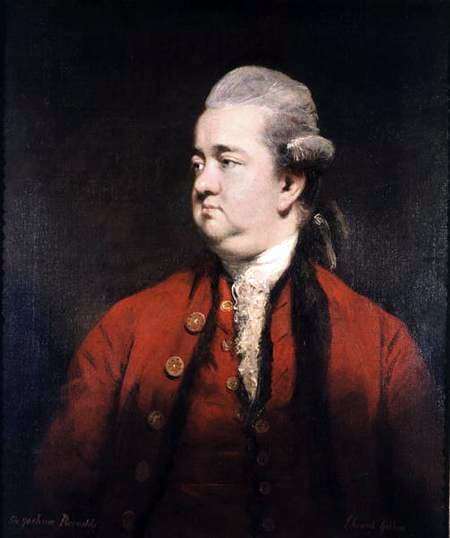
Edward Gibbon
1737–1794
English historian and essayist
Edward Gibbon combined historical writing with a career in Parliament and membership of London’s literary society. His intellectual life also developed in continental Europe, particularly Lausanne. The six volumes of The Decline and Fall of the Roman Empire appeared between 1776 and 1788, bringing a long historical undertaking to completion before the French Revolution.1. Penguin Random House editors, “Edward Gibbon,” Penguin Random House, undated; accessed October 21, 2026, Author biography. J. G. A. Pocock, “Gibbon’s Decline and Fall and the World View of the Late Enlightenment,” Virtue, Commerce, and History, Cambridge University Press, 1985; published online May 5, 2010, pp. 143–156; opening summary.
Gibbon followed political and religious transformations far beyond the fall of the western empire, through Byzantium, Islam, and the later medieval world. His sceptical prose and extensive use of sources give narrative and commentary distinct voices. Shorter essays, reading journals, letters, and several autobiographical drafts reveal the habits of inquiry behind the finished history.2. Edward Gibbon; J. B. Bury, editor, “The History of the Decline and Fall of the Roman Empire, volume 1,” Cambridge Library Collection, Cambridge University Press, 1896; reissued February 14, 2013, Book description; original six volumes, 1776–1788. Edward Gibbon; John Baker Holroyd, Lord Sheffield, editor, “Miscellaneous Works of Edward Gibbon, Esquire, volume 1,” Cambridge Library Collection, Cambridge University Press, 1796; reissued April 17, 2014, Book description and contents, memoirs and correspondence. Edward Gibbon; John Baker Holroyd, Lord Sheffield, editor, “Miscellaneous Works of Edward Gibbon, Esquire, volume 2,” Cambridge Library Collection, Cambridge University Press, 1796; reissued April 17, 2014, Contents, sections I–XI.
How to read Edward Gibbon
The memoirs offer a compact introduction to Gibbon’s habits before the long history. In The Decline and Fall, notice how the explanation changes as the narrative moves from the western empire to Byzantium and its neighbours. Read the footnotes as part of the argument, not merely as a list of authorities.3. Edward Gibbon; John Baker Holroyd, Lord Sheffield, editor, “Miscellaneous Works of Edward Gibbon, Esquire, volume 1,” Cambridge Library Collection, Cambridge University Press, 1796; reissued April 17, 2014, Book description and contents, memoirs and correspondence. J. G. A. Pocock, “Gibbon’s Decline and Fall and the World View of the Late Enlightenment,” Virtue, Commerce, and History, Cambridge University Press, 1985; published online May 5, 2010, pp. 143–156; opening summary.
The Roman history and its defence
The Decline and Fall is one six-volume work, although later editors divide it differently. Read the notes alongside the narrative: they expose sources, disputes, and changes of tone. The Vindication responds to attacks on Gibbon’s treatment of early Christianity.4. Edward Gibbon; J. B. Bury, editor, “The History of the Decline and Fall of the Roman Empire, volume 1,” Cambridge Library Collection, Cambridge University Press, 1896; reissued February 14, 2013, Book description; original six volumes, 1776–1788.
Literary criticism and political history
These shorter works show Gibbon testing evidence beyond the main history. Several were written in French. Historical English translations should remain distinct from Gibbon’s originals when a text is eventually prepared.5. Edward Gibbon; John Baker Holroyd, Lord Sheffield, editor, “Miscellaneous Works of Edward Gibbon, Esquire, volume 2,” Cambridge Library Collection, Cambridge University Press, 1796; reissued April 17, 2014, Contents, sections I–XI.
The historian at work
The autobiographies survive in multiple drafts; Sheffield combined material when producing the first memoir. Letters, journals, abstracts, and detached pieces are grouped by their documentary form, preserving their difference from completed books.6. Edward Gibbon; John Baker Holroyd, Lord Sheffield, editor, “Miscellaneous Works of Edward Gibbon, Esquire, volume 1,” Cambridge Library Collection, Cambridge University Press, 1796; reissued April 17, 2014, Book description and contents, memoirs and correspondence.
The bibliography maps the completed history, independently titled essays and political pieces, and collections of autobiographical drafts, letters, journals, reading notes, and detached writings. Minor and unfinished writings remain within these collections. This is a work map; no historical or modern edition is activated.7. Edward Gibbon; John Baker Holroyd, Lord Sheffield, editor, “Miscellaneous Works of Edward Gibbon, Esquire, volume 1,” Cambridge Library Collection, Cambridge University Press, 1796; reissued April 17, 2014, Book description and contents, memoirs and correspondence. Edward Gibbon; John Baker Holroyd, Lord Sheffield, editor, “Miscellaneous Works of Edward Gibbon, Esquire, volume 2,” Cambridge Library Collection, Cambridge University Press, 1796; reissued April 17, 2014, Contents, sections I–XI.
Reading guide sources
- Edward Gibbon; John Baker Holroyd, Lord Sheffield, editor, “Miscellaneous Works of Edward Gibbon, Esquire, volume 1,” Cambridge Library Collection, Cambridge University Press, 1796; reissued April 17, 2014, Book description and contents, memoirs and correspondence. J. G. A. Pocock, “Gibbon’s Decline and Fall and the World View of the Late Enlightenment,” Virtue, Commerce, and History, Cambridge University Press, 1985; published online May 5, 2010, pp. 143–156; opening summary.
- Edward Gibbon; J. B. Bury, editor, “The History of the Decline and Fall of the Roman Empire, volume 1,” Cambridge Library Collection, Cambridge University Press, 1896; reissued February 14, 2013, Book description; original six volumes, 1776–1788.
- Edward Gibbon; John Baker Holroyd, Lord Sheffield, editor, “Miscellaneous Works of Edward Gibbon, Esquire, volume 2,” Cambridge Library Collection, Cambridge University Press, 1796; reissued April 17, 2014, Contents, sections I–XI.
- Edward Gibbon; John Baker Holroyd, Lord Sheffield, editor, “Miscellaneous Works of Edward Gibbon, Esquire, volume 1,” Cambridge Library Collection, Cambridge University Press, 1796; reissued April 17, 2014, Book description and contents, memoirs and correspondence.
- Edward Gibbon; John Baker Holroyd, Lord Sheffield, editor, “Miscellaneous Works of Edward Gibbon, Esquire, volume 1,” Cambridge Library Collection, Cambridge University Press, 1796; reissued April 17, 2014, Book description and contents, memoirs and correspondence. Edward Gibbon; John Baker Holroyd, Lord Sheffield, editor, “Miscellaneous Works of Edward Gibbon, Esquire, volume 2,” Cambridge Library Collection, Cambridge University Press, 1796; reissued April 17, 2014, Contents, sections I–XI.
Works in the library
14 under developmentThe History of the Decline and Fall of the Roman Empire
A six-volume history tracing Roman power, religion, and their long transformations.
Under developmentA Vindication of Some Passages in the Fifteenth and Sixteenth Chapters
Gibbon’s defence of his account of early Christianity and his use of evidence.
Under developmentEssai sur l’étude de la littérature
An early French essay defending historical and literary learning.
Under developmentCritical Observations on the Design of the Sixth Book of the Aeneid
An argument concerning the interpretation of Virgil’s underworld narrative.
Under developmentA Dissertation on the Subject of L’Homme au Masque de Fer
A brief historical inquiry into the identity of the man in the iron mask.
Under developmentMémoire justificatif
A political defence of Britain’s position in its conflict with France.
Under developmentAntiquities of the House of Brunswick
An unfinished historical account of the dynasty’s origins.
Under developmentAn Address, &c.
A separately preserved political address in Sheffield’s collected edition.
Under developmentOutlines of the History of the World
Plans for a medieval world history that Gibbon did not complete.
Under developmentAutobiographies (Memoirs of My Life and Writings)
Gibbon’s surviving autobiographical drafts, later assembled and edited as memoirs.
Under developmentCorrespondence
Letters documenting Gibbon’s scholarship, friendships, travel, and public life.
Under developmentAbstracts of Reading with Reflections
Notes on books read, with Gibbon’s historical and critical reflections.
Under developmentJournals
Records of reading, travel, and daily intellectual work.
Under developmentCollected Remarks and Detached Pieces
Other historical, critical, and political pieces, including material preserved among the manuscript papers.
Under development
Sources & portrait
- Penguin Random House editors, “Edward Gibbon,” Penguin Random House, undated; accessed October 21, 2026, Author biography. J. G. A. Pocock, “Gibbon’s Decline and Fall and the World View of the Late Enlightenment,” Virtue, Commerce, and History, Cambridge University Press, 1985; published online May 5, 2010, pp. 143–156; opening summary.
- Edward Gibbon; J. B. Bury, editor, “The History of the Decline and Fall of the Roman Empire, volume 1,” Cambridge Library Collection, Cambridge University Press, 1896; reissued February 14, 2013, Book description; original six volumes, 1776–1788. Edward Gibbon; John Baker Holroyd, Lord Sheffield, editor, “Miscellaneous Works of Edward Gibbon, Esquire, volume 1,” Cambridge Library Collection, Cambridge University Press, 1796; reissued April 17, 2014, Book description and contents, memoirs and correspondence. Edward Gibbon; John Baker Holroyd, Lord Sheffield, editor, “Miscellaneous Works of Edward Gibbon, Esquire, volume 2,” Cambridge Library Collection, Cambridge University Press, 1796; reissued April 17, 2014, Contents, sections I–XI.
Portrait: Joshua Reynolds, Edward Gibbon, 1779, oil on canvas, private collection. Displayed in monochrome and cropped in a circular frame. Image source. Public domain; faithful reproduction of a painting by Joshua Reynolds (1723–1792).. Displayed in monochrome with a circular crop.

