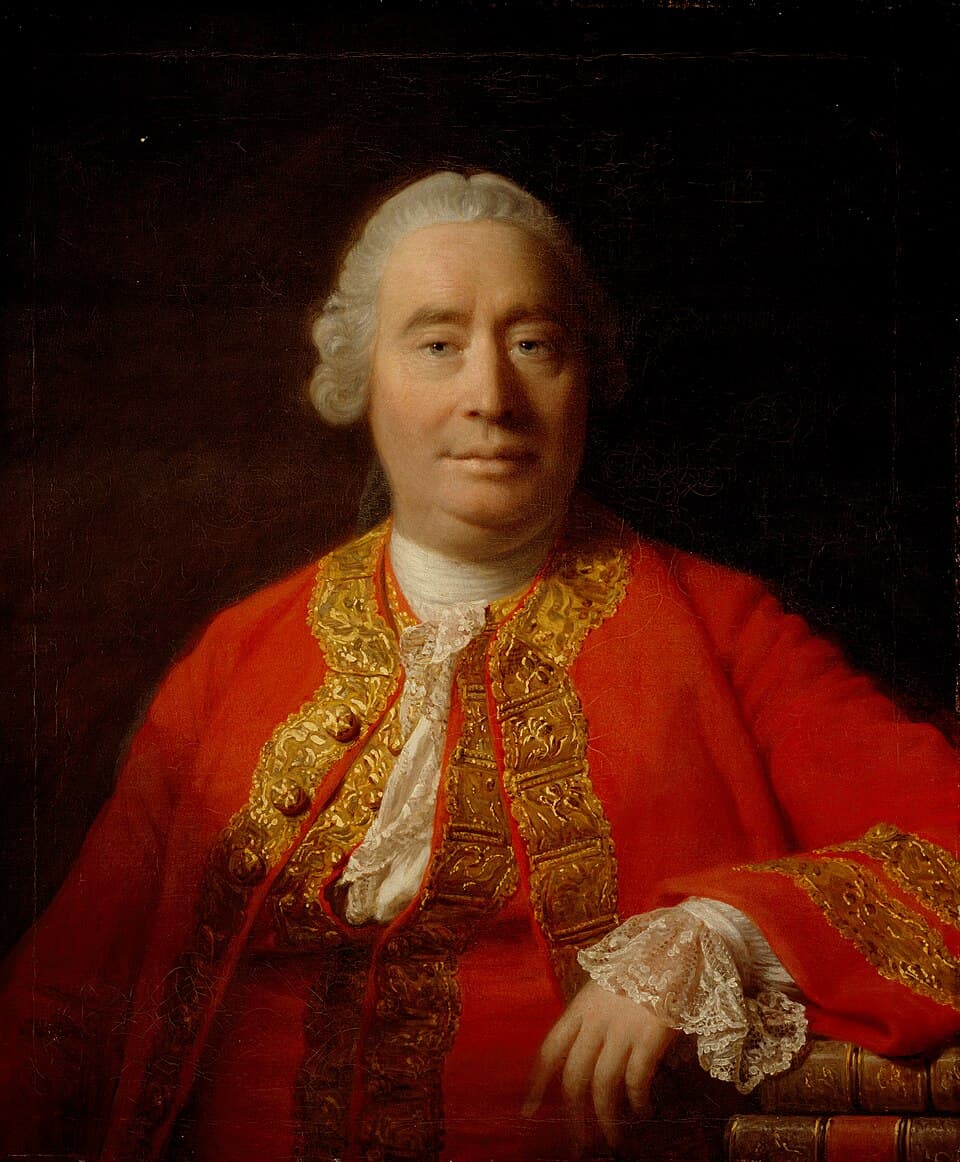
David Hume
1711–1776
Scottish philosopher and historian
David Hume belonged to the Scottish Enlightenment, but his reputation for religious scepticism helped keep him out of university posts. He instead worked as a writer and librarian, becoming widely known for his essays and histories. His philosophical project placed human nature itself under examination: how do people think, feel, believe, and live together?1. Hsueh Qu and Elizabeth S. Radcliffe, “David Hume,” Stanford Encyclopedia of Philosophy, Summer 2026 edition, published June 16, 2026, introduction and sec. 1.
Hume traces our expectation of causes and effects to repeated experience and the habits it forms. Reason cannot establish every connection we confidently rely on. In ethics, he gives feeling and sympathy a central role in moral judgement. His sceptical arguments sit alongside an effort to understand the ordinary practices that make human life possible.2. Hsueh Qu and Elizabeth S. Radcliffe, “David Hume,” Stanford Encyclopedia of Philosophy, Summer 2026 edition, published June 16, 2026, secs. 2.2–2.3 and 4.1–4.2.
How to read David Hume
Hume’s later Enquiries offer a manageable entrance to questions pursued at greater length in the Treatise. The route here is our editorial recommendation: a selection of major writings, not a complete catalogue. Later publication does not make a book merely a summary of an earlier one.3. Hsueh Qu and Elizabeth S. Radcliffe, “David Hume,” Stanford Encyclopedia of Philosophy, Summer 2026 edition, published June 16, 2026, sec. 1.
Two shorter investigations
Try An Enquiry Concerning Human Understanding for experience, causal inference and the limits of reason. If moral judgement interests you more, start with An Enquiry Concerning the Principles of Morals. Keep examples beside conclusions: Hume asks how human beings actually think and respond, as well as what they can justify.4. Hsueh Qu and Elizabeth S. Radcliffe, “David Hume,” Stanford Encyclopedia of Philosophy, Summer 2026 edition, published June 16, 2026, secs. 1, 2 and 4.3.
The longer experiment
Return to A Treatise of Human Nature for the connections between understanding, passions and morals across its three books. Track how Book I supplies terms used later. A Dissertation on the Passions offers a shorter comparison with Book II. The relationship between Hume’s earlier and later positions remains debated.5. Hsueh Qu and Elizabeth S. Radcliffe, “David Hume,” Stanford Encyclopedia of Philosophy, Summer 2026 edition, published June 16, 2026, secs. 1 and 3.
Religion as argument and human practice
Read Dialogues Concerning Natural Religion by following the competing speakers, without assuming one character simply voices Hume. The Natural History of Religion changes the question: it examines the human origins of religious belief. Its speculative history deserves scrutiny alongside its psychological explanations, rather than automatic acceptance as historical fact.6. Hsueh Qu and Elizabeth S. Radcliffe, “David Hume,” Stanford Encyclopedia of Philosophy, Summer 2026 edition, published June 16, 2026, secs. 5.2–5.3. Paul Russell and Anders Kraal, “Hume on Religion,” Stanford Encyclopedia of Philosophy, Winter 2024 edition, revised November 15, 2024, secs. 4–5 and 8.
Essays and historical judgement
The Essays, Moral, Political, and Literary allow shorter excursions into politics, commerce and taste. For aesthetics, compare Of the Standard of Taste with Of Tragedy inside that collection. The History of England offers a longer view of Hume as a historical writer; approach its judgements with the same attention to evidence as his philosophical arguments.7. Theodore Gracyk, “Hume’s Aesthetics,” Stanford Encyclopedia of Philosophy, revised April 21, 2020, introduction and secs. 1, 4–5. Hsueh Qu and Elizabeth S. Radcliffe, “David Hume,” Stanford Encyclopedia of Philosophy, Summer 2026 edition, published June 16, 2026, sec. 1.
Reading guide sources
- Hsueh Qu and Elizabeth S. Radcliffe, “David Hume,” Stanford Encyclopedia of Philosophy, Summer 2026 edition, published June 16, 2026, sec. 1.
- Hsueh Qu and Elizabeth S. Radcliffe, “David Hume,” Stanford Encyclopedia of Philosophy, Summer 2026 edition, published June 16, 2026, secs. 1, 2 and 4.3.
- Hsueh Qu and Elizabeth S. Radcliffe, “David Hume,” Stanford Encyclopedia of Philosophy, Summer 2026 edition, published June 16, 2026, secs. 1 and 3.
- Hsueh Qu and Elizabeth S. Radcliffe, “David Hume,” Stanford Encyclopedia of Philosophy, Summer 2026 edition, published June 16, 2026, secs. 5.2–5.3. Paul Russell and Anders Kraal, “Hume on Religion,” Stanford Encyclopedia of Philosophy, Winter 2024 edition, revised November 15, 2024, secs. 4–5 and 8.
- Theodore Gracyk, “Hume’s Aesthetics,” Stanford Encyclopedia of Philosophy, revised April 21, 2020, introduction and secs. 1, 4–5. Hsueh Qu and Elizabeth S. Radcliffe, “David Hume,” Stanford Encyclopedia of Philosophy, Summer 2026 edition, published June 16, 2026, sec. 1.
Works in the library
2 available · 6 under developmentAn Enquiry Concerning Human Understanding
A concise examination of experience, causation, belief and scepticism.
English · original textAn Enquiry Concerning the Principles of Morals
An investigation of moral judgement, virtue, usefulness and human feeling.
Under developmentA Treatise of Human Nature
A three-book investigation of understanding, passions and morals.
Under developmentA Dissertation on the Passions
A shorter treatment of emotions and their connections with human motivation.
Under developmentDialogues Concerning Natural Religion
A conversation testing arguments about God, design and the limits of inference.
English · original textThe Natural History of Religion
A speculative account of the psychological origins and development of religious belief.
Under developmentEssays, Moral, Political, and Literary
A collection ranging across political life, commerce, taste and literary culture.
Under developmentThe History of England
A six-volume history examining England’s institutions, conflicts and political change.
Under development
Sources & portrait
- Hsueh Qu and Elizabeth S. Radcliffe, “David Hume,” Stanford Encyclopedia of Philosophy, Summer 2026 edition, published June 16, 2026, introduction and sec. 1.
- Hsueh Qu and Elizabeth S. Radcliffe, “David Hume,” Stanford Encyclopedia of Philosophy, Summer 2026 edition, published June 16, 2026, secs. 2.2–2.3 and 4.1–4.2.
Portrait: Allan Ramsay, David Hume, 1766. Scottish National Portrait Gallery, National Galleries of Scotland. Image source. Public domain faithful reproduction of a public domain painting (PD-Art, PD-old-100-expired). Displayed in monochrome with a circular crop.
