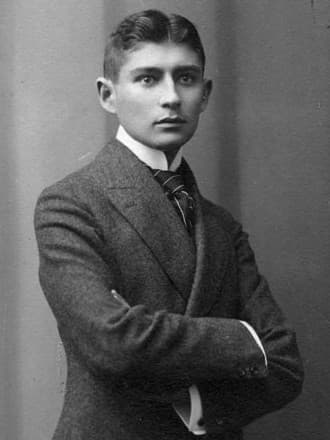
Franz Kafka
1883–1924
German-language writer from Prague
Franz Kafka was born into a German-speaking Jewish family in Prague, then part of the Habsburg Empire. After studying law, he worked in insurance administration while pursuing his writing. Relationships with family, friends, and partners appear throughout his correspondence. Tuberculosis increasingly interrupted his working life before his death at forty.1. S. Fischer Verlag editorial team, “Franz Kafka: Chronik,” Franzkafka.de / S. Fischer Verlage, undated; accessed 21 October 2026, Chronology, 1883–1924.
His stories give precise language to situations whose rules remain difficult to grasp: an unexplained accusation, a transformed body, or a task that cannot be completed. Humor persists alongside fear and exclusion. He published relatively little during his lifetime. Much of the surviving work, including three unfinished novels, reached readers through Max Brod’s posthumous editing, making manuscript order and editorial intervention central questions.2. S. Fischer Verlag editorial team, “Einführung,” Franzkafka.de / S. Fischer Verlage, undated; accessed 21 October 2026, Introduction to Kafka’s writing and publication history. Bodleian Libraries, “Franz Kafka’s papers and the Bodleian Libraries,” University of Oxford, 2024; accessed 21 October 2026, Kafka’s manuscripts, Max Brod, and posthumous publication.
How to read Franz Kafka
Read The Metamorphosis without rushing to translate its central event into a single symbol. Notice the practical responses of the household, then try the shorter pieces in A Country Doctor. Kafka’s precise tone can hold comedy and distress together.3. S. Fischer Verlag editorial team, “Einführung,” Franzkafka.de / S. Fischer Verlage, undated; accessed 21 October 2026, Introduction to Kafka’s writing and publication history.
This map covers the author-prepared publications, three unfinished novels, and scoped collections of the literary remains, diaries, surviving letters, and official writings. English titles identify works; German remains the fallback for future intake when a lawful English translation is unavailable. Posthumous editorial titles and arrangements are identified rather than treated as Kafka’s completed books.4. S. Fischer Verlag editorial team, “Das Werk,” Franzkafka.de / S. Fischer Verlage, undated; accessed 21 October 2026, Work categories and critical-edition bibliography. Roland Reuß and Peter Staengle, “Franz Kafka-Ausgabe: Findbuch,” Institut für Textkritik, Heidelberg, updated 31 July 2010, Editorial principles and concordance of manuscript and printed units.
The author-prepared publications
The Metamorphosis offers a sustained first encounter. Contemplation and A Country Doctor present shorter pieces as collections; their internal stories and parables remain within those units. A Hunger Artist was prepared by Kafka and appeared around the time of his death.5. Wolf Kittler, Hans-Gerd Koch, and Gerhard Neumann, editors, “Drucke zu Lebzeiten,” S. Fischer Verlage, 1 October 1994, Critical-edition description: author-prepared publications. S. Fischer Verlag editorial team, “Das Werk,” Franzkafka.de / S. Fischer Verlage, undated; accessed 21 October 2026, Work categories and critical-edition bibliography.
The three unfinished novels
The Trial and The Castle follow attempts to find a place within elusive systems of authority. The Man Who Disappeared, first issued as Amerika, is a different unfinished novel. Their chapter order and wording must be tied to a documented edition.6. S. Fischer Verlag editorial team, “Das Werk,” Franzkafka.de / S. Fischer Verlage, undated; accessed 21 October 2026, Work categories and critical-edition bibliography. Bodleian Libraries, “Franz Kafka’s papers and the Bodleian Libraries,” University of Oxford, 2024; accessed 21 October 2026, Kafka’s manuscripts, Max Brod, and posthumous publication.
The literary remains
Many familiar posthumous titles are editorial labels for unfinished manuscripts. The grouped remains preserve those contexts rather than pretending that every fragment was a completed story. Letter to His Father is listed separately because of its distinct sustained argument.7. Malcolm Pasley; Jost Schillemeit, editor, “Nachgelassene Schriften und Fragmente I,” S. Fischer Verlage, 1 October 1993, Publisher description: manuscripts before autumn 1917; original material contexts. Roland Reuß and Peter Staengle, “Franz Kafka-Ausgabe: Findbuch,” Institut für Textkritik, Heidelberg, updated 31 July 2010, Editorial principles and concordance of manuscript and printed units. S. Fischer Verlag editorial team, “Das Werk,” Franzkafka.de / S. Fischer Verlage, undated; accessed 21 October 2026, Work categories and critical-edition bibliography.
Diaries, letters, and official writing
The diaries mix personal observation with literary drafting. Correspondence remains one collection here, including letters to Felice, Milena, Ottla, Brod, and others; modern recipient-based selections are not separate works by Kafka. His official insurance writings record a different sphere of authorship.8. S. Fischer Verlag editorial team, “Das Werk,” Franzkafka.de / S. Fischer Verlage, undated; accessed 21 October 2026, Work categories and critical-edition bibliography. Roland Reuß and Peter Staengle, “Franz Kafka-Ausgabe: Findbuch,” Institut für Textkritik, Heidelberg, updated 31 July 2010, Editorial principles and concordance of manuscript and printed units.
Reading guide sources
- S. Fischer Verlag editorial team, “Einführung,” Franzkafka.de / S. Fischer Verlage, undated; accessed 21 October 2026, Introduction to Kafka’s writing and publication history.
- S. Fischer Verlag editorial team, “Das Werk,” Franzkafka.de / S. Fischer Verlage, undated; accessed 21 October 2026, Work categories and critical-edition bibliography. Roland Reuß and Peter Staengle, “Franz Kafka-Ausgabe: Findbuch,” Institut für Textkritik, Heidelberg, updated 31 July 2010, Editorial principles and concordance of manuscript and printed units.
- Wolf Kittler, Hans-Gerd Koch, and Gerhard Neumann, editors, “Drucke zu Lebzeiten,” S. Fischer Verlage, 1 October 1994, Critical-edition description: author-prepared publications. S. Fischer Verlag editorial team, “Das Werk,” Franzkafka.de / S. Fischer Verlage, undated; accessed 21 October 2026, Work categories and critical-edition bibliography.
- S. Fischer Verlag editorial team, “Das Werk,” Franzkafka.de / S. Fischer Verlage, undated; accessed 21 October 2026, Work categories and critical-edition bibliography. Bodleian Libraries, “Franz Kafka’s papers and the Bodleian Libraries,” University of Oxford, 2024; accessed 21 October 2026, Kafka’s manuscripts, Max Brod, and posthumous publication.
- Malcolm Pasley; Jost Schillemeit, editor, “Nachgelassene Schriften und Fragmente I,” S. Fischer Verlage, 1 October 1993, Publisher description: manuscripts before autumn 1917; original material contexts. Roland Reuß and Peter Staengle, “Franz Kafka-Ausgabe: Findbuch,” Institut für Textkritik, Heidelberg, updated 31 July 2010, Editorial principles and concordance of manuscript and printed units. S. Fischer Verlag editorial team, “Das Werk,” Franzkafka.de / S. Fischer Verlage, undated; accessed 21 October 2026, Work categories and critical-edition bibliography.
- S. Fischer Verlag editorial team, “Das Werk,” Franzkafka.de / S. Fischer Verlage, undated; accessed 21 October 2026, Work categories and critical-edition bibliography. Roland Reuß and Peter Staengle, “Franz Kafka-Ausgabe: Findbuch,” Institut für Textkritik, Heidelberg, updated 31 July 2010, Editorial principles and concordance of manuscript and printed units.
Works in the library
17 under developmentContemplation (Betrachtung)
The early collection of eighteen brief prose pieces.
Under developmentThe Judgment (Das Urteil)
A conversation between a son and father becomes a sentence.
Under developmentThe Stoker (Der Heizer)
The first chapter of the unfinished American novel, published separately.
Under developmentThe Metamorphosis (Die Verwandlung)
Gregor Samsa wakes transformed and becomes a problem for his household.
Under developmentIn the Penal Colony (In der Strafkolonie)
A visitor is shown an apparatus that joins punishment to writing.
Under developmentA Country Doctor (Ein Landarzt)
A collection of fourteen stories and parables, including Before the Law.
Under developmentA Hunger Artist (Ein Hungerkünstler)
The four-story final collection, including Josephine the Singer.
Under developmentOther Lifetime Publications and Collaborative Prose
Other published pieces, including The Aeroplanes at Brescia and the surviving Richard and Samuel project with Max Brod.
Under developmentThe Trial (Der Process)
Josef K. confronts an accusation whose basis remains inaccessible.
Under developmentThe Castle (Das Schloss)
A surveyor tries to secure recognition from a remote authority.
Under developmentThe Man Who Disappeared (Der Verschollene / Amerika)
Karl Rossmann searches for a place in an unfamiliar America.
Under developmentLetter to His Father (Brief an den Vater)
An unsent account of Kafka’s relationship with his father.
Under developmentOther Posthumous Prose and Fragments, before Autumn 1917
The early literary remains, including Description of a Struggle and Wedding Preparations in the Country, excluding the novels and separately listed publications.
Under developmentOther Posthumous Prose and Fragments, Autumn 1917–1924
Later literary remains, including The Burrow and Investigations of a Dog, excluding the novels, Letter to His Father, and separately listed publications.
Under developmentDiaries and Travel Diaries
The surviving diary notebooks and travel records, with literary passages kept in their manuscript context.
Under developmentSurviving Letters
Kafka’s surviving correspondence, excluding the separately listed Letter to His Father.
Under developmentOfficial Writings (Amtliche Schriften)
Administrative and public writings produced or signed in Kafka’s insurance work, 1908–1922.
Under development
Sources & portrait
- S. Fischer Verlag editorial team, “Franz Kafka: Chronik,” Franzkafka.de / S. Fischer Verlage, undated; accessed 21 October 2026, Chronology, 1883–1924.
- S. Fischer Verlag editorial team, “Einführung,” Franzkafka.de / S. Fischer Verlage, undated; accessed 21 October 2026, Introduction to Kafka’s writing and publication history. Bodleian Libraries, “Franz Kafka’s papers and the Bodleian Libraries,” University of Oxford, 2024; accessed 21 October 2026, Kafka’s manuscripts, Max Brod, and posthumous publication.
Portrait: Atelier Jacobi, attributed to Sigismund Jacobi (1860–1935), c. 1906. Historical photograph, cropped version. Displayed in monochrome. Image source. Public-domain historical work and faithful reproduction. Displayed in monochrome with a circular crop.

