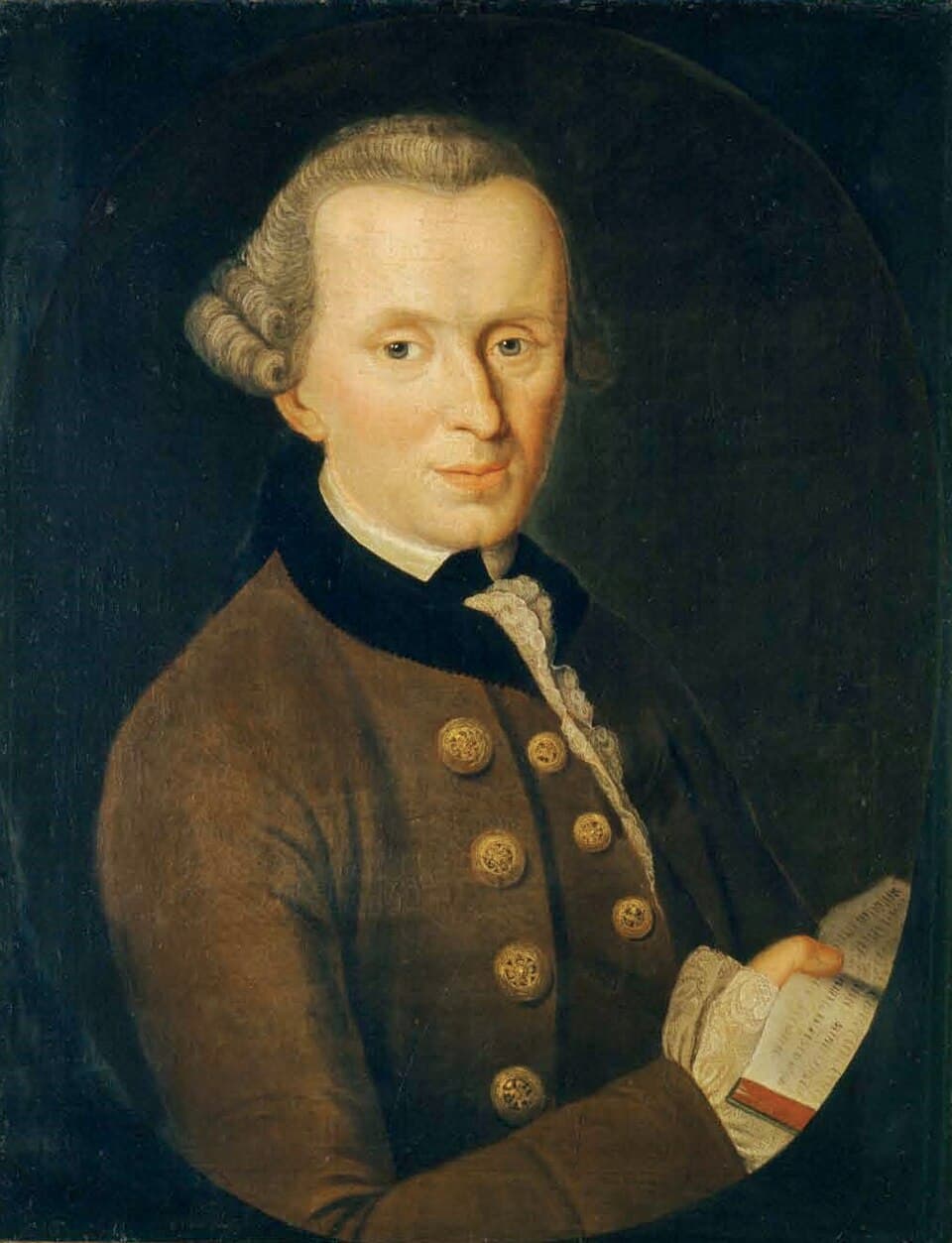
Immanuel Kant
1724–1804
German philosopher
Immanuel Kant spent his academic life in Königsberg, a Baltic university town in East Prussia. Raised in a family of modest means, he worked as a private tutor before beginning decades of university teaching. His early interests included physics and astronomy; the problem of reconciling scientific explanation with human freedom later became central to his philosophy.1. Michael Rohlf, “Immanuel Kant,” Stanford Encyclopedia of Philosophy, Fall 2024 edition, revised July 31, 2024, secs. 1 and 2.1.
Kant argues that experience depends on structures supplied by the mind, while insisting that knowledge has limits. In moral life, autonomy means acting on principles reason can justify for everyone. Duties therefore cannot depend solely on what we happen to want. His account links freedom with responsibility, making the grounds of our choices as important as their results.2. Michael Rohlf, “Immanuel Kant,” Stanford Encyclopedia of Philosophy, Fall 2024 edition, revised July 31, 2024, secs. 2.2–3 and 5.1–5.4.
How to read Immanuel Kant
Our route through Kant moves from shorter arguments to the larger critical project, then branches by subject. It is a selection of major writings, not a chronology. Keep track of his technical vocabulary: terms such as intuition and understanding have specific roles.3. Tim Jankowiak, “Immanuel Kant,” Internet Encyclopedia of Philosophy, Undated; accessed 1 October 2026, §§2–4, Kant’s project and theoretical philosophy; §7, Theory of Art and Beauty; §9a, Primary literature.
A first orientation
Read the Enlightenment essay for Kant’s concern with independent thought. The Prolegomena then introduces his question about the possibility of metaphysics in a more compact form than the first Critique. Treat it as preparation, rather than a substitute.4. Michael Rohlf, “Immanuel Kant,” Stanford Encyclopedia of Philosophy, Substantive revision 31 July 2024; Fall 2024 archive, §§1–2, Life and works; Kant’s project in the Critique of Pure Reason.
What can we know?
Move into the Critique of Pure Reason slowly, keeping its account of experience separate from claims about things beyond experience. The Metaphysical Foundations of Natural Science offers a demanding branch into the philosophical basis of physics.5. Michael Rohlf, “Immanuel Kant,” Stanford Encyclopedia of Philosophy, Substantive revision 31 July 2024; Fall 2024 archive, §§1–2, Life and works; Kant’s project in the Critique of Pure Reason.
Freedom and obligation
For ethics, follow the Groundwork’s argument about moral principles into the Critique of Practical Reason. The Metaphysics of Morals develops duties of right and virtue; compare their different purposes rather than expecting three versions of one book.6. Robert Johnson and Adam Cureton, “Kant’s Moral Philosophy,” Stanford Encyclopedia of Philosophy, Substantive revision 2 October 2025; Winter 2025 archive, §§1–4, Method, good will, duty and imperatives; bibliography, Primary literature.
Judgment and religious life
The third Critique turns to beauty, the sublime and judgments about living nature. Religion within the Boundaries of Mere Reason opens another branch, asking how moral life relates to religious belief and community.7. Tim Jankowiak, “Immanuel Kant,” Internet Encyclopedia of Philosophy, Undated; accessed 1 October 2026, §§2–4, Kant’s project and theoretical philosophy; §7, Theory of Art and Beauty; §9a, Primary literature. Lawrence Pasternack and Courtney Fugate, “Kant’s Philosophy of Religion,” Stanford Encyclopedia of Philosophy, Winter 2025 edition, revised October 13, 2025, secs. 3.7.1–3.7.5.
Living together
The peace, history and theory-and-practice essays connect principles with political life. Anthropology adds observations about human conduct; The Conflict of the Faculties considers intellectual freedom and institutional authority. Read these with their eighteenth-century assumptions in view.8. Frederick Rauscher, “Kant’s Social and Political Philosophy,” Stanford Encyclopedia of Philosophy, Substantive revision 8 June 2026; Summer 2026 archive, Introduction; secs. 1, 4, 8 and 10; bibliography, Primary sources.
Reading guide sources
- Tim Jankowiak, “Immanuel Kant,” Internet Encyclopedia of Philosophy, Undated; accessed 1 October 2026, §§2–4, Kant’s project and theoretical philosophy; §7, Theory of Art and Beauty; §9a, Primary literature.
- Michael Rohlf, “Immanuel Kant,” Stanford Encyclopedia of Philosophy, Substantive revision 31 July 2024; Fall 2024 archive, §§1–2, Life and works; Kant’s project in the Critique of Pure Reason.
- Michael Rohlf, “Immanuel Kant,” Stanford Encyclopedia of Philosophy, Substantive revision 31 July 2024; Fall 2024 archive, §§1–2, Life and works; Kant’s project in the Critique of Pure Reason.
- Robert Johnson and Adam Cureton, “Kant’s Moral Philosophy,” Stanford Encyclopedia of Philosophy, Substantive revision 2 October 2025; Winter 2025 archive, §§1–4, Method, good will, duty and imperatives; bibliography, Primary literature.
- Tim Jankowiak, “Immanuel Kant,” Internet Encyclopedia of Philosophy, Undated; accessed 1 October 2026, §§2–4, Kant’s project and theoretical philosophy; §7, Theory of Art and Beauty; §9a, Primary literature. Lawrence Pasternack and Courtney Fugate, “Kant’s Philosophy of Religion,” Stanford Encyclopedia of Philosophy, Winter 2025 edition, revised October 13, 2025, secs. 3.7.1–3.7.5.
- Frederick Rauscher, “Kant’s Social and Political Philosophy,” Stanford Encyclopedia of Philosophy, Substantive revision 8 June 2026; Summer 2026 archive, Introduction; secs. 1, 4, 8 and 10; bibliography, Primary sources.
Works in the library
1 available · 13 under developmentAn Answer to the Question: What Is Enlightenment?
An essay about intellectual independence and the public use of reason.
Under developmentProlegomena to Any Future Metaphysics
A shorter presentation of the critical inquiry into possible metaphysical knowledge.
Under developmentCritique of Pure Reason
An investigation of human knowledge, experience and the limits of metaphysics.
Under developmentMetaphysical Foundations of Natural Science
A critical account of the philosophical principles underlying natural science.
Under developmentGroundwork of the Metaphysics of Morals
A search for the fundamental principle of moral obligation.
English · Thomas Kingsmill AbbottCritique of Practical Reason
A study of moral reason, freedom and the highest good.
Under developmentThe Metaphysics of Morals
Two parts examining duties of right and duties of virtue.
Under developmentCritique of the Power of Judgment
An inquiry into aesthetic judgment and the purposiveness of nature.
Under developmentReligion within the Boundaries of Mere Reason
A philosophical treatment of evil, moral renewal and religious community.
Under developmentToward Perpetual Peace
A proposal concerning peaceful relations between states and peoples.
Under developmentIdea for a Universal History with a Cosmopolitan Aim
An essay considering human history through a cosmopolitan philosophical perspective.
Under developmentOn the Common Saying: That May Be Correct in Theory, but It Is of No Use in Practice
An essay relating moral and political principles to practical judgment.
Under developmentAnthropology from a Pragmatic Point of View
An account of human capacities and conduct from a pragmatic perspective.
Under developmentThe Conflict of the Faculties
Essays on philosophy, university faculties and intellectual authority.
Under development
Sources & portrait
- Michael Rohlf, “Immanuel Kant,” Stanford Encyclopedia of Philosophy, Fall 2024 edition, revised July 31, 2024, secs. 1 and 2.1.
- Michael Rohlf, “Immanuel Kant,” Stanford Encyclopedia of Philosophy, Fall 2024 edition, revised July 31, 2024, secs. 2.2–3 and 5.1–5.4.
Portrait: Johann Gottlieb Becker, Immanuel Kant, 1768. Schiller-Nationalmuseum, Marbach am Neckar. Image source. Public domain faithful reproduction of a public domain painting (PD-Art, PD-old-100-expired). Displayed in monochrome with a circular crop.
