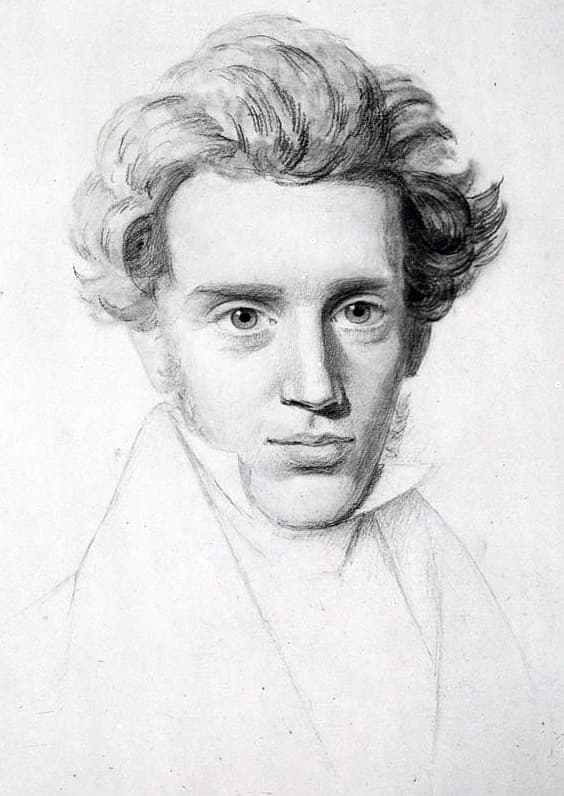
Søren Kierkegaard
1813–1855
Danish philosopher and religious writer
Søren Kierkegaard lived mostly in Copenhagen, where he studied theology and philosophy but never became a pastor. He wrote both under his own name and through invented authors, each presenting a particular outlook. His Christian commitments also led him into a public conflict with Denmark’s state church, which he accused of making faith too comfortable.1. John Lippitt and C. Stephen Evans, “Søren Kierkegaard,” Stanford Encyclopedia of Philosophy, Fall 2024 edition, published May 22, 2023, sec. 1.
His writing returns to the difficulty of becoming a self: choosing commitments while confronting limits, anxiety, and despair. Faith involves how a person lives, beyond an abstract account of belief. The shifting voices make interpretation part of the encounter. They should not all be treated as statements of Kierkegaard’s own position.2. John Lippitt and C. Stephen Evans, “Søren Kierkegaard,” Stanford Encyclopedia of Philosophy, Fall 2024 edition, published May 22, 2023, secs. 1–2 and 3.3.1.
How to read Søren Kierkegaard
Read Kierkegaard with an ear for who is speaking. His invented authors adopt different outlooks, and their claims cannot simply be assigned to him. Our thematic route pairs that pseudonymous writing with signed Christian works; it is neither a publication timeline nor a complete collected edition.3. John Lippitt and C. Stephen Evans, “Søren Kierkegaard,” Stanford Encyclopedia of Philosophy, Published 22 May 2023; corrected 18 July 2024; Fall 2024 archive, §1, Life and works, pseudonymous and signed writing; §3.3, Religious life; Chronology of Kierkegaard’s works.
Ways of living
Start with selected essays and letters from Either/Or, comparing its aesthetic and ethical voices. Repetition makes a shorter, deliberately elusive companion. Stages on Life’s Way returns to competing ways of living through another arrangement of imagined speakers.4. William McDonald, “Søren Kierkegaard,” Internet Encyclopedia of Philosophy, Undated; accessed 1 October 2026, §2, Pseudonymous authorship; §3, Edifying discourses; §4, Second authorship.
Faith and the neighbor
Fear and Trembling revisits Abraham’s story through Johannes de silentio, a narrator who struggles to understand faith. Place it beside the signed Upbuilding Discourses in Various Spirits and Works of Love, where religious reflection takes a different shape.5. John Lippitt and C. Stephen Evans, “Søren Kierkegaard,” Stanford Encyclopedia of Philosophy, Published 22 May 2023; corrected 18 July 2024; Fall 2024 archive, §1, Life and works, pseudonymous and signed writing; §3.3, Religious life; Chronology of Kierkegaard’s works.
Anxiety and becoming a self
The Concept of Anxiety and The Sickness Unto Death examine freedom, anxiety and despair. Their psychological language belongs within theological arguments about sin and selfhood. They invite reflection on experience, but should not be mistaken for modern clinical accounts.6. William McDonald, “Søren Kierkegaard,” Internet Encyclopedia of Philosophy, Undated; accessed 1 October 2026, §2, Pseudonymous authorship; §3, Edifying discourses; §4, Second authorship.
Knowing and existing
Philosophical Fragments asks how a learner might encounter truth in time. Its much larger Postscript considers what it means for an existing person to become Christian. Follow the questions and the narrator’s qualifications before reducing either book to a slogan about subjectivity.7. William McDonald, “Søren Kierkegaard,” Internet Encyclopedia of Philosophy, Undated; accessed 1 October 2026, §2, Pseudonymous authorship; §3, Edifying discourses; §4, Second authorship.
Irony, society and authorship
Branch into the dissertation on irony or Two Ages and its criticism of modern public life. Practice in Christianity sharpens the religious challenge. The posthumous Point of View offers Kierkegaard’s retrospective account of his writing; treat that account as an interpretation to examine.8. William McDonald, “Søren Kierkegaard,” Stanford Encyclopedia of Philosophy, Substantive revision 10 November 2017; Spring 2023 archive, §§2–6, Rhetoric, aesthetics, ethics, religion and politics; §7, Chronology of life and works.
Reading guide sources
- John Lippitt and C. Stephen Evans, “Søren Kierkegaard,” Stanford Encyclopedia of Philosophy, Published 22 May 2023; corrected 18 July 2024; Fall 2024 archive, §1, Life and works, pseudonymous and signed writing; §3.3, Religious life; Chronology of Kierkegaard’s works.
- William McDonald, “Søren Kierkegaard,” Internet Encyclopedia of Philosophy, Undated; accessed 1 October 2026, §2, Pseudonymous authorship; §3, Edifying discourses; §4, Second authorship.
- John Lippitt and C. Stephen Evans, “Søren Kierkegaard,” Stanford Encyclopedia of Philosophy, Published 22 May 2023; corrected 18 July 2024; Fall 2024 archive, §1, Life and works, pseudonymous and signed writing; §3.3, Religious life; Chronology of Kierkegaard’s works.
- William McDonald, “Søren Kierkegaard,” Internet Encyclopedia of Philosophy, Undated; accessed 1 October 2026, §2, Pseudonymous authorship; §3, Edifying discourses; §4, Second authorship.
- William McDonald, “Søren Kierkegaard,” Internet Encyclopedia of Philosophy, Undated; accessed 1 October 2026, §2, Pseudonymous authorship; §3, Edifying discourses; §4, Second authorship.
- William McDonald, “Søren Kierkegaard,” Stanford Encyclopedia of Philosophy, Substantive revision 10 November 2017; Spring 2023 archive, §§2–6, Rhetoric, aesthetics, ethics, religion and politics; §7, Chronology of life and works.
Works in the library
1 available · 13 under developmentEither/Or
Essays and letters staging contrasting aesthetic and ethical ways of living.
Under developmentRepetition
A pseudonymous literary experiment investigating repetition, recollection and lived experience.
Under developmentStages on Life’s Way
A literary exploration of aesthetic, ethical and religious existence.
Under developmentFear and Trembling
Johannes de silentio’s examination of Abraham, faith and ethical obligation.
Danish · original textUpbuilding Discourses in Various Spirits
Signed religious discourses on inward life, commitment and Christian suffering.
Under developmentWorks of Love
Signed Christian deliberations on love, duty and relations with the neighbor.
Under developmentThe Concept of Anxiety
A pseudonymous inquiry into anxiety, freedom and the problem of sin.
Under developmentThe Sickness Unto Death
Anti-Climacus’s Christian analysis of despair and the task of becoming a self.
Under developmentPhilosophical Fragments
Johannes Climacus’s thought experiment concerning learning, history and religious truth.
Under developmentConcluding Unscientific Postscript to Philosophical Fragments
Johannes Climacus’s extended inquiry into subjectivity and becoming Christian.
Under developmentOn the Concept of Irony with Continual Reference to Socrates
A dissertation examining Socratic irony and its later philosophical forms.
Under developmentTwo Ages: A Literary Review
A literary review contrasting revolutionary and reflective ages, including modern public life.
Under developmentPractice in Christianity
Anti-Climacus’s challenge to comfortable understandings of Christian faith.
Under developmentThe Point of View for My Work as an Author
A posthumously published account of the religious purpose of Kierkegaard’s writing.
Under development
Sources & portrait
- John Lippitt and C. Stephen Evans, “Søren Kierkegaard,” Stanford Encyclopedia of Philosophy, Fall 2024 edition, published May 22, 2023, sec. 1.
- John Lippitt and C. Stephen Evans, “Søren Kierkegaard,” Stanford Encyclopedia of Philosophy, Fall 2024 edition, published May 22, 2023, secs. 1–2 and 3.3.1.
Portrait: Niels Christian Kierkegaard, unfinished sketch of Søren Kierkegaard, about 1840. Royal Danish Library. Image source. Public domain faithful reproduction of a public domain drawing (PD-Art, PD-old-70-expired). Displayed in monochrome with a circular crop.
_-_(cropped).jpg)