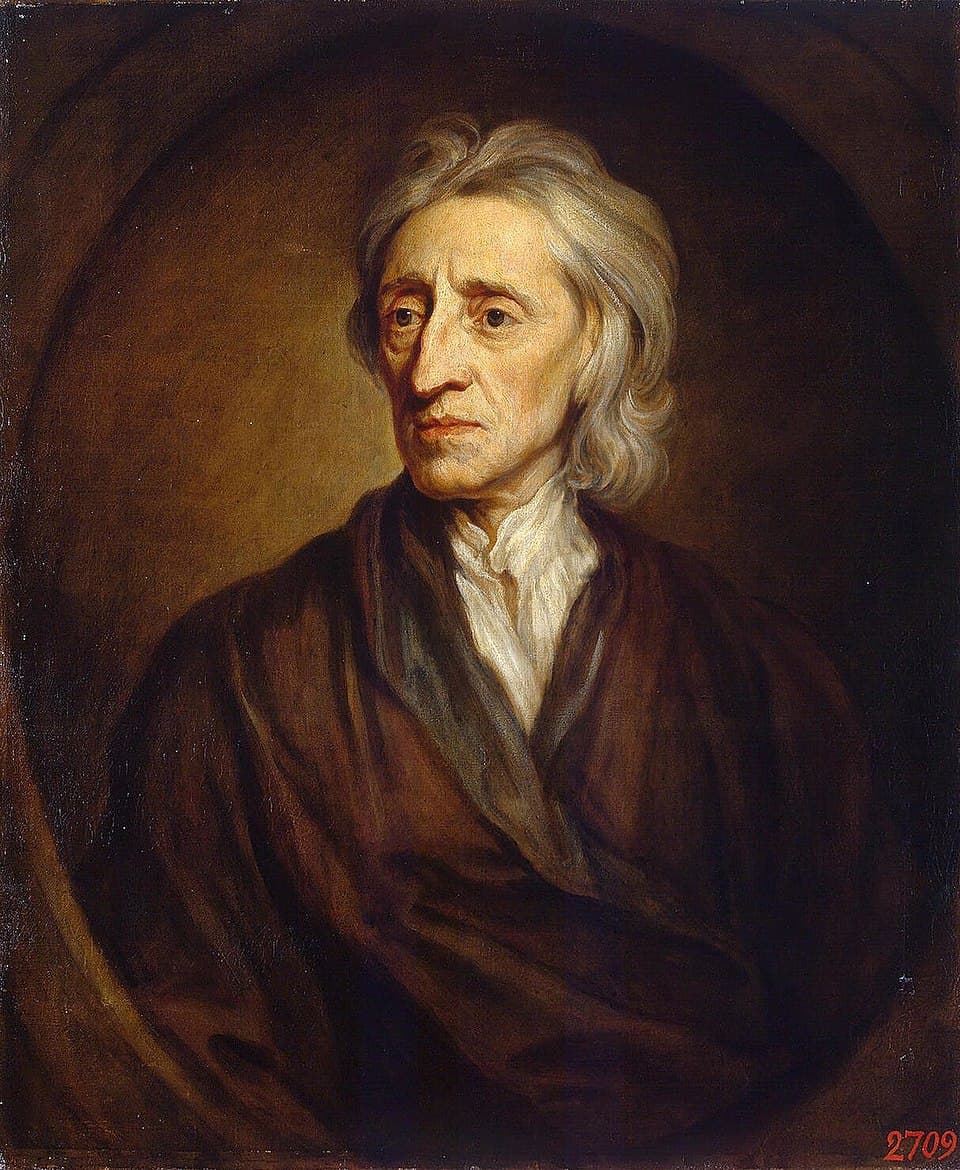
John Locke
1632–1704
English philosopher
John Locke’s life crossed medicine, experimental science, and the struggles over power in seventeenth-century England. His association with the politician Shaftesbury brought him into government and eventually exile in the Netherlands. He also served in colonial administration, a part of his career that complicates the familiar portrait of a philosopher devoted to liberty.1. William Uzgalis, “John Locke,” Stanford Encyclopedia of Philosophy, Winter 2024 edition, revised July 7, 2022, secs. 1.1–1.3.
Locke asks how experience furnishes our ideas and where human understanding reaches its limits. He urges belief proportioned to evidence, rather than inherited authority. His political arguments ground legitimate government in consent and the protection of natural rights. Religious toleration is another central concern, although the scope and exclusions of his defence remain subjects of debate.2. William Uzgalis, “John Locke,” Stanford Encyclopedia of Philosophy, Winter 2024 edition, revised July 7, 2022, introduction and secs. 2, 4.5–4.6, and 5.
How to read John Locke
Locke can be approached through government, belief or education before his longer account of understanding. Choose a question that interests you. These editorial paths select major writings; they are neither an exhaustive bibliography nor a publication timeline.3. William Uzgalis, “John Locke,” Stanford Encyclopedia of Philosophy, Winter 2024 edition, revised July 7, 2022, introduction and secs. 2–5.
Authority and conscience
A Letter Concerning Toleration is a compact entry into the limits of coercion. Compare its exclusions with its defence of religious liberty. In Two Treatises of Government, try the Second Treatise first for consent, property and resistance, then the First for Locke’s attack on inherited patriarchal authority.4. Alex Tuckness, “Locke’s Political Philosophy,” Stanford Encyclopedia of Philosophy, Winter 2024 edition, revised October 6, 2020, introduction and secs. 1–7. William Uzgalis, “John Locke,” Stanford Encyclopedia of Philosophy, Winter 2024 edition, revised July 7, 2022, sec. 5.
What can we know?
For An Essay Concerning Human Understanding, use its four books as a map: innate ideas, experience, language, then knowledge and belief. Survey that map before reading closely. Personal identity in Book II, chapter 27, offers a focused topic, but depends on distinctions developed earlier.5. Patrick J. Connolly, “John Locke (1632–1704),” Internet Encyclopedia of Philosophy, undated; accessed October 1, 2026, secs. 2 and 3.d.
Learning to judge
Some Thoughts Concerning Education and Of the Conduct of the Understanding connect philosophy with the cultivation of judgement. Read the former in its setting of education for the English gentry; the latter addresses habits of adult inquiry. The Conduct remained unfinished and was published after Locke’s death.6. William Uzgalis, “John Locke,” Stanford Encyclopedia of Philosophy, Winter 2024 edition, revised July 7, 2022, sec. 3.
Reason within Christianity
The Reasonableness of Christianity offers another route into Locke’s religious thinking. Its search for the essentials of Christian belief helps contextualise his toleration arguments. Read it as an intervention within Christianity, with its own assumptions about scripture.7. William Uzgalis, “John Locke,” Stanford Encyclopedia of Philosophy, Winter 2024 edition, revised July 7, 2022, secs. 1.3 and 5. Patrick J. Connolly, “John Locke (1632–1704),” Internet Encyclopedia of Philosophy, undated; accessed October 1, 2026, sec. 5.
Money in public life
Readers interested in political economy can turn to Some Considerations and Further Considerations after the property discussion in the Second Treatise. Their arguments about interest, silver and coinage respond to concrete monetary controversies; historical context makes their questions easier to follow.8. Lee Ward, “Trust and Distributive Justice in John Locke’s Politics of Money,” The Review of Politics, Cambridge University Press, published online October 21, 2021, Economic Controversies in 1690s England; The Natural Price of Money; The Recoinage Controversy; notes 25–26.
Reading guide sources
- William Uzgalis, “John Locke,” Stanford Encyclopedia of Philosophy, Winter 2024 edition, revised July 7, 2022, introduction and secs. 2–5.
- Alex Tuckness, “Locke’s Political Philosophy,” Stanford Encyclopedia of Philosophy, Winter 2024 edition, revised October 6, 2020, introduction and secs. 1–7. William Uzgalis, “John Locke,” Stanford Encyclopedia of Philosophy, Winter 2024 edition, revised July 7, 2022, sec. 5.
- Patrick J. Connolly, “John Locke (1632–1704),” Internet Encyclopedia of Philosophy, undated; accessed October 1, 2026, secs. 2 and 3.d.
- William Uzgalis, “John Locke,” Stanford Encyclopedia of Philosophy, Winter 2024 edition, revised July 7, 2022, sec. 3.
- William Uzgalis, “John Locke,” Stanford Encyclopedia of Philosophy, Winter 2024 edition, revised July 7, 2022, secs. 1.3 and 5. Patrick J. Connolly, “John Locke (1632–1704),” Internet Encyclopedia of Philosophy, undated; accessed October 1, 2026, sec. 5.
- Lee Ward, “Trust and Distributive Justice in John Locke’s Politics of Money,” The Review of Politics, Cambridge University Press, published online October 21, 2021, Economic Controversies in 1690s England; The Natural Price of Money; The Recoinage Controversy; notes 25–26.
Works in the library
3 available · 5 under developmentA Letter Concerning Toleration
An argument about religious liberty and the limits of civil coercion.
English · William PoppleTwo Treatises of Government
Two connected treatments of patriarchal authority, natural rights and legitimate government.
English · original textAn Essay Concerning Human Understanding
An investigation of ideas, experience, language and the limits of knowledge.
Under developmentSome Thoughts Concerning Education
Reflections on raising children, forming character and developing habits of learning.
Under developmentOf the Conduct of the Understanding
An unfinished work on habits of inquiry and the improvement of judgement.
English · original textThe Reasonableness of Christianity
An examination of the essentials of Christian belief as presented in scripture.
Under developmentSome Considerations of the Consequences of the Lowering of Interest and Raising the Value of Money
An intervention in debates about interest, trade and the value of money.
Under developmentFurther Considerations Concerning Raising the Value of Money
A response to proposed changes in silver coinage and monetary valuation.
Under development
Sources & portrait
- William Uzgalis, “John Locke,” Stanford Encyclopedia of Philosophy, Winter 2024 edition, revised July 7, 2022, secs. 1.1–1.3.
- William Uzgalis, “John Locke,” Stanford Encyclopedia of Philosophy, Winter 2024 edition, revised July 7, 2022, introduction and secs. 2, 4.5–4.6, and 5.
Portrait: Godfrey Kneller, Portrait of John Locke, 1697. Hermitage Museum. Image source. Public domain faithful reproduction of a public domain painting (PD-Art, PD-old-100-expired). Displayed in monochrome with a circular crop.
.jpg)