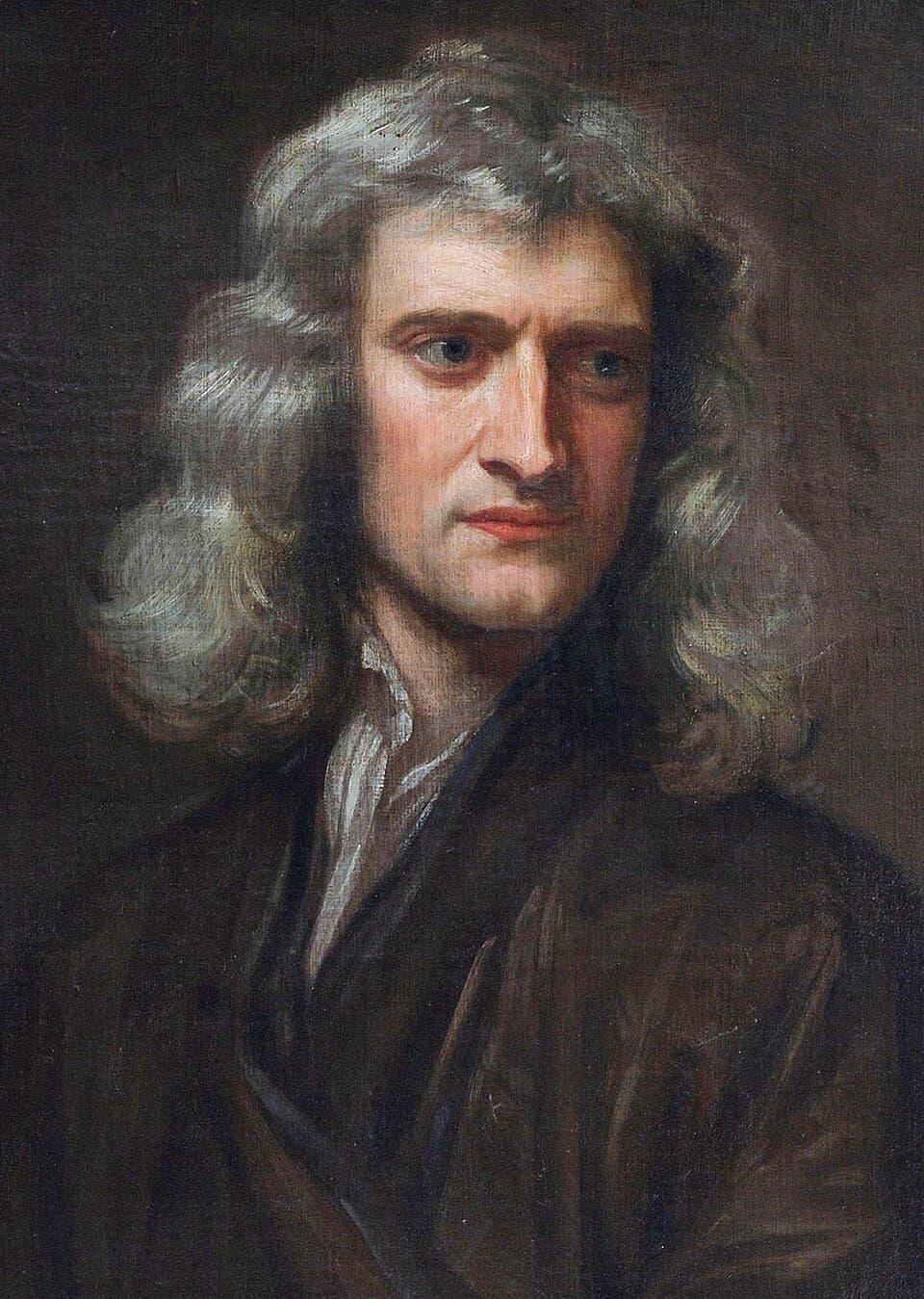
Isaac Newton
1642/43–1727
English mathematician and natural philosopher
Isaac Newton entered Trinity College, Cambridge, in 1661 and became Lucasian Professor of Mathematics eight years later. His investigations of motion, light, and mathematics developed alongside extensive private studies of alchemy and theology. Later he moved to London, served at the Royal Mint, and became president of the Royal Society.1. George Smith, “Isaac Newton,” Stanford Encyclopedia of Philosophy, Summer 2024 edition, published December 19, 2007, secs. 1.1–1.4; Bibliography: Primary Sources.
Newton’s Principia connected terrestrial and celestial motion through mathematical laws and universal gravitation. Opticks pursued questions about light through experiments and further queries. His surviving papers reveal a wider intellectual world, including biblical interpretation, ancient history, laboratory practice, and administrative work. Many of these writings remained unpublished during his lifetime and require attention to their manuscript setting.2. Rob Iliffe and Scott Mandelbrote, editors, “Introduction to the Texts,” University of Oxford, The Newton Project, undated; accessed October 21, 2026, secs. A–D, religious, mathematical, scientific and political materials. George Smith, “Isaac Newton,” Stanford Encyclopedia of Philosophy, Summer 2024 edition, published December 19, 2007, secs. 1.1–1.4; Bibliography: Primary Sources.
How to read Isaac Newton
Approach Newton through the question being investigated: motion, light, number, scripture, or historical time. Principia demands sustained mathematical reading; Opticks provides a more experimental entrance. This route follows the breadth of the surviving writings without presenting Newton’s private drafts as books he completed for publication.3. Rob Iliffe and Scott Mandelbrote, editors, “Introduction to the Texts,” University of Oxford, The Newton Project, undated; accessed October 21, 2026, secs. A–D, religious, mathematical, scientific and political materials.
Motion, light, and experiment
Opticks begins with experiments that are easier to follow than the mathematical demonstrations of Principia. The System of the World preserves an earlier form of its final book. Short papers and the optical lectures supply further evidence of how Newton developed and defended his claims.4. George Smith, “Isaac Newton,” Stanford Encyclopedia of Philosophy, Summer 2024 edition, published December 19, 2007, secs. 1.1–1.4; Bibliography: Primary Sources.
Mathematics
These treatises make the mathematical corpus visible beyond Principia. Some were printed only long after composition; their publication dates do not establish the order of Newton’s discoveries. Further problems, drafts, and lecture notes remain together in the mathematical-papers collection.5. George Smith, “Isaac Newton,” Stanford Encyclopedia of Philosophy, Summer 2024 edition, published December 19, 2007, secs. 1.1–1.4; Bibliography: Primary Sources.
Scripture, chronology, and natural philosophy
The published theological and chronological books are only part of this writing. Read the remaining manuscripts as drafts of different dates and purposes. The Bentley letters belong within correspondence; religious and alchemical manuscripts should retain their original archival identities.6. Rob Iliffe and Scott Mandelbrote, editors, “Newton’s Religious Writings,” University of Oxford, The Newton Project, undated; accessed October 21, 2026, Religious writings catalog, including THEM00193, THEM00091 and chronology drafts.
Notebooks, letters, and public work
Notebooks preserve reading and experiments at different stages. Correspondence includes the Bentley letters and the mathematical and optical exchanges. Mint and political papers belong to Newton’s public career; they should not disappear from a bibliography centred on physics.7. Rob Iliffe and Scott Mandelbrote, editors, “Introduction to the Texts,” University of Oxford, The Newton Project, undated; accessed October 21, 2026, secs. A–D, religious, mathematical, scientific and political materials.
Independent treatises are listed by work, while the remaining mathematical, scientific, religious, alchemical, political, and Mint writings form explicit collections. Notebooks and letters are grouped. The birth-year notation preserves the difference between the Julian and Gregorian calendars; no modern transcription or translation is cleared by this bibliography.8. Rob Iliffe and Scott Mandelbrote, editors, “Introduction to the Texts,” University of Oxford, The Newton Project, undated; accessed October 21, 2026, secs. A–D, religious, mathematical, scientific and political materials. Rob Iliffe and Scott Mandelbrote, editors, “Introducing Newton’s Notebooks,” University of Oxford, The Newton Project, undated; accessed October 21, 2026, Notebook descriptions.
Reading guide sources
- Rob Iliffe and Scott Mandelbrote, editors, “Introduction to the Texts,” University of Oxford, The Newton Project, undated; accessed October 21, 2026, secs. A–D, religious, mathematical, scientific and political materials.
- George Smith, “Isaac Newton,” Stanford Encyclopedia of Philosophy, Summer 2024 edition, published December 19, 2007, secs. 1.1–1.4; Bibliography: Primary Sources.
- George Smith, “Isaac Newton,” Stanford Encyclopedia of Philosophy, Summer 2024 edition, published December 19, 2007, secs. 1.1–1.4; Bibliography: Primary Sources.
- Rob Iliffe and Scott Mandelbrote, editors, “Newton’s Religious Writings,” University of Oxford, The Newton Project, undated; accessed October 21, 2026, Religious writings catalog, including THEM00193, THEM00091 and chronology drafts.
- Rob Iliffe and Scott Mandelbrote, editors, “Introduction to the Texts,” University of Oxford, The Newton Project, undated; accessed October 21, 2026, secs. A–D, religious, mathematical, scientific and political materials.
- Rob Iliffe and Scott Mandelbrote, editors, “Introduction to the Texts,” University of Oxford, The Newton Project, undated; accessed October 21, 2026, secs. A–D, religious, mathematical, scientific and political materials. Rob Iliffe and Scott Mandelbrote, editors, “Introducing Newton’s Notebooks,” University of Oxford, The Newton Project, undated; accessed October 21, 2026, Notebook descriptions.
Works in the library
22 under developmentMathematical Principles of Natural Philosophy (Principia)
Three books connecting laws of motion with terrestrial and celestial phenomena.
Under developmentOpticks
Experimental investigations of light, colour, reflection, refraction, and diffraction.
Under developmentThe System of the World
The earlier, less mathematical treatment intended for the final book of Principia.
Under developmentOptical Lectures
Newton’s Cambridge lectures on light and colour, preserved in manuscript and early editions.
Under developmentScientific and Optical Papers
Short papers and unpublished investigations, including the 1672 theory of light and colour.
Under developmentDe Analysi per Aequationes Numero Terminorum Infinitas
A treatise developing analysis through infinite series.
Under developmentThe Method of Fluxions and Infinite Series
A treatise on changing quantities and the methods of calculus.
Under developmentTractatus de Quadratura Curvarum
A tract on the quadrature of curves, first printed with Opticks.
Under developmentEnumeratio Linearum Tertii Ordinis
A classification of cubic curves, first printed with Opticks.
Under developmentArithmetica Universalis
Algebraic lectures published as a treatise on universal arithmetic.
Under developmentMethodus Differentialis
A short mathematical tract on finite differences and interpolation.
Under developmentMathematical Papers and Drafts
Additional mathematical investigations and drafts, with named treatises cataloged separately.
Under developmentThe Chronology of Ancient Kingdoms Amended
A reconstruction of ancient chronology published after Newton’s death.
Under developmentObservations upon the Prophecies of Daniel and the Apocalypse of St. John
A posthumous study of biblical prophecy and historical interpretation.
Under developmentA Dissertation upon the Sacred Cubit of the Jews
A study of ancient measurement connected with biblical and architectural inquiry.
Under developmentAn Historical Account of Two Notable Corruptions of Scripture
A textual argument concerning two passages used in Trinitarian controversy.
Under developmentReligious and Historical Manuscripts
Further theological, prophetic, chronological, and church-historical drafts and notes.
Under developmentAlchemical Manuscripts
Laboratory records, chemical notes, and alchemical treatises, including Praxis.
Under developmentNotebooks
Newton’s working notebooks, including student, mathematical, and laboratory records.
Under developmentCorrespondence
Letters across Newton’s mathematical, optical, theological, and administrative concerns.
Under developmentMint Papers
Reports, calculations, memoranda, and correspondence concerning coinage and Mint administration.
Under developmentPolitical and Institutional Papers
Writings concerning Cambridge, Parliament, the Royal Society, and public affairs.
Under development
Sources & portrait
- George Smith, “Isaac Newton,” Stanford Encyclopedia of Philosophy, Summer 2024 edition, published December 19, 2007, secs. 1.1–1.4; Bibliography: Primary Sources.
- Rob Iliffe and Scott Mandelbrote, editors, “Introduction to the Texts,” University of Oxford, The Newton Project, undated; accessed October 21, 2026, secs. A–D, religious, mathematical, scientific and political materials. George Smith, “Isaac Newton,” Stanford Encyclopedia of Philosophy, Summer 2024 edition, published December 19, 2007, secs. 1.1–1.4; Bibliography: Primary Sources.
Portrait: James Thornhill after Godfrey Kneller’s 1689 portrait of Isaac Newton. Isaac Newton Institute, University of Cambridge. Displayed in monochrome and cropped in a circular frame. Image source. Collection record. Public domain; faithful reproduction of an eighteenth-century painting after Godfrey Kneller.. Displayed in monochrome with a circular crop.

