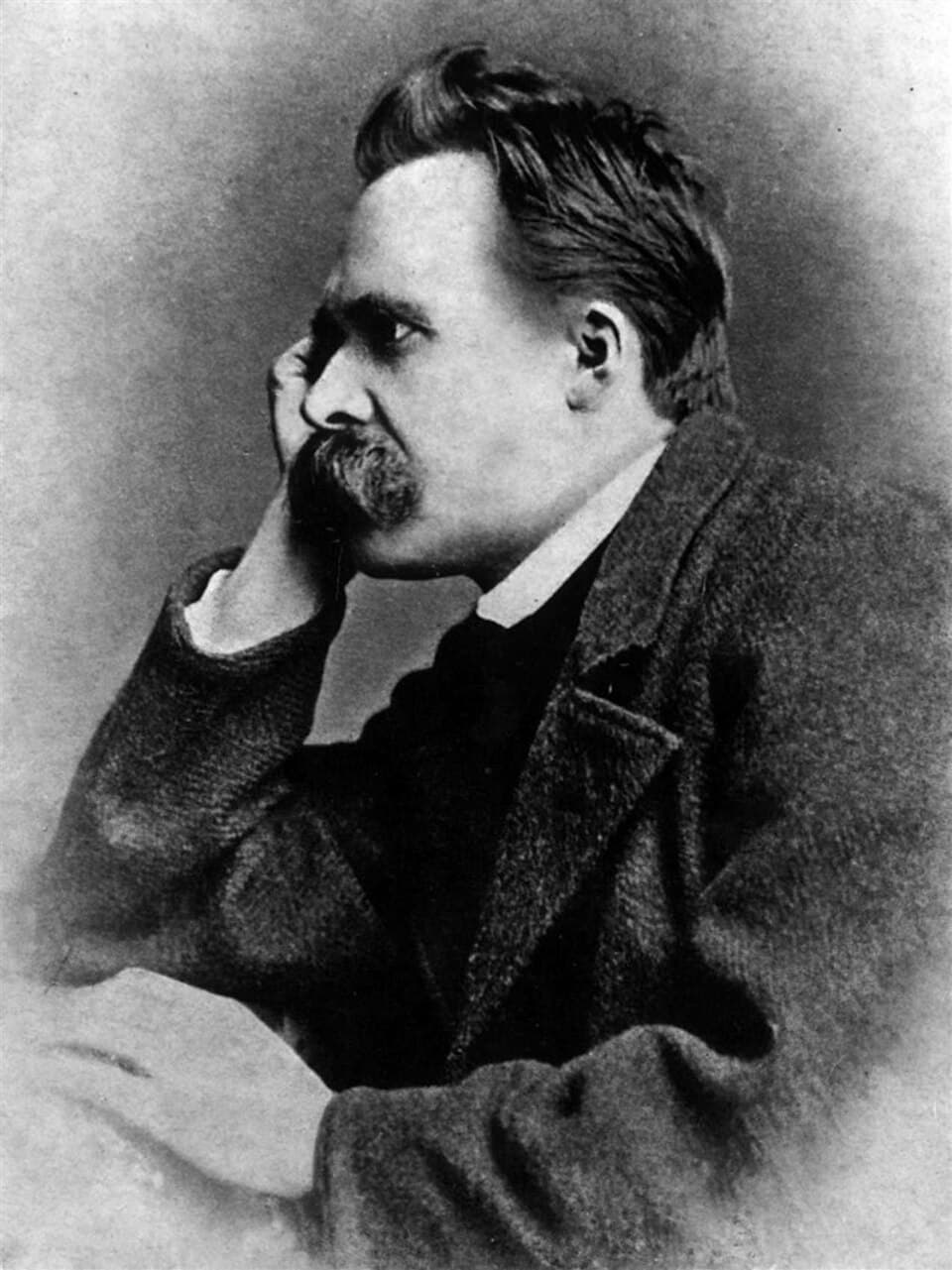
Friedrich Nietzsche
1844–1900
German philosopher and cultural critic
Friedrich Nietzsche began as a scholar of ancient Greek and Roman texts, becoming a professor in Basel at twenty-four. Persistent illness forced him to leave his post. He then moved between Switzerland and southern Europe, producing philosophical writing in varied forms, from brief aphorisms to sustained arguments and literary experiments.1. R. Lanier Anderson, “Friedrich Nietzsche,” Stanford Encyclopedia of Philosophy, Fall 2026 edition, revised June 25, 2026, secs. 1 and 5.
Nietzsche asks where our values come from and which forms of life they encourage or suppress. His attacks on Christian morality reach beyond religious belief to guilt, compassion, and moral equality. Alongside this unsettling critique, he explores creativity, self-formation, and the possibility of affirming life. His provocative style leaves substantial room for disagreement over how these ideas fit together.2. R. Lanier Anderson, “Friedrich Nietzsche,” Stanford Encyclopedia of Philosophy, Fall 2026 edition, revised June 25, 2026, secs. 2–5.
How to read Friedrich Nietzsche
Nietzsche’s short sections reward slow reading: tone, neighboring passages and changes of perspective matter. Our route begins with compact criticism, then moves among arguments, aphorisms and literary experiment. It selects major philosophical writings rather than reconstructing a single system or providing a complete bibliography.3. R. Lanier Anderson, “Friedrich Nietzsche,” Stanford Encyclopedia of Philosophy, Substantive revision 25 June 2026; Fall 2026 archive, §§1–2, Life and works; Critique of religion and morality; §5, Difficulties of philosophical writing; bibliography, Works in English.
A compact first encounter
Twilight of the Idols offers brief attacks on familiar philosophical assumptions. Read a few sections together and ask what each target has in common. Its compressed, provocative style can open questions that the longer works explore in greater detail.4. R. Lanier Anderson, “Friedrich Nietzsche,” Stanford Encyclopedia of Philosophy, Substantive revision 25 June 2026; Fall 2026 archive, §§1–2, Life and works; Critique of religion and morality; §5, Difficulties of philosophical writing; bibliography, Works in English.
How values acquire their force
Follow Beyond Good and Evil into the Genealogy’s three essays on moral values. Daybreak supplies an earlier collection of psychological observations about morality. Compare the arguments with the diagnoses: explaining where a belief comes from does not automatically refute it.5. Dale Wilkerson, “Friedrich Nietzsche,” Internet Encyclopedia of Philosophy, Undated; accessed 1 October 2026, §§1–3, Life, periodization and interpretation; §9b–c, Major works in English and writings from the Nachlass.
Experiments in thought and living
Human, All Too Human and The Gay Science invite reading across clusters of aphorisms. Then try Thus Spoke Zarathustra, whose speeches, scenes and recurring images require a different pace. Keep its dramatic voice in view when relating it to other books.6. Robert Wicks, “Nietzsche’s Life and Works,” Stanford Encyclopedia of Philosophy, Substantive revision 10 September 2021; corrected 14 March 2022; Spring 2022 archive, secs. 3–4, Middle period and Mature period.
Art, history and language
The Birth of Tragedy and Untimely Meditations show early cultural concerns. The unpublished early essay on truth and lies opens a branch into language. Read the Wagner writings alongside them to notice changes in Nietzsche’s views of art and culture.7. Robert Wicks, “Nietzsche’s Life and Works,” Stanford Encyclopedia of Philosophy, Substantive revision 10 September 2021; corrected 14 March 2022; Spring 2022 archive, secs. 2 and 5, Early writings and Final writings. Dale Wilkerson, “Friedrich Nietzsche,” Internet Encyclopedia of Philosophy, Undated; accessed 1 October 2026, §§1–3, Life, periodization and interpretation; §9b–c, Major works in English and writings from the Nachlass.
Late polemic and self-portrait
The Antichrist confronts Christianity; Ecce Homo looks back at Nietzsche’s own books through an extravagant self-portrait. Both were published after his productive life ended. The Will to Power is a posthumous editorial compilation of notebook material, not a book he completed.8. Robert Wicks, “Nietzsche’s Life and Works,” Stanford Encyclopedia of Philosophy, Substantive revision 10 September 2021; corrected 14 March 2022; Spring 2022 archive, secs. 5–6, Final writings and Unpublished notebooks.
Reading guide sources
- R. Lanier Anderson, “Friedrich Nietzsche,” Stanford Encyclopedia of Philosophy, Substantive revision 25 June 2026; Fall 2026 archive, §§1–2, Life and works; Critique of religion and morality; §5, Difficulties of philosophical writing; bibliography, Works in English.
- R. Lanier Anderson, “Friedrich Nietzsche,” Stanford Encyclopedia of Philosophy, Substantive revision 25 June 2026; Fall 2026 archive, §§1–2, Life and works; Critique of religion and morality; §5, Difficulties of philosophical writing; bibliography, Works in English.
- Dale Wilkerson, “Friedrich Nietzsche,” Internet Encyclopedia of Philosophy, Undated; accessed 1 October 2026, §§1–3, Life, periodization and interpretation; §9b–c, Major works in English and writings from the Nachlass.
- Robert Wicks, “Nietzsche’s Life and Works,” Stanford Encyclopedia of Philosophy, Substantive revision 10 September 2021; corrected 14 March 2022; Spring 2022 archive, secs. 3–4, Middle period and Mature period.
- Robert Wicks, “Nietzsche’s Life and Works,” Stanford Encyclopedia of Philosophy, Substantive revision 10 September 2021; corrected 14 March 2022; Spring 2022 archive, secs. 2 and 5, Early writings and Final writings. Dale Wilkerson, “Friedrich Nietzsche,” Internet Encyclopedia of Philosophy, Undated; accessed 1 October 2026, §§1–3, Life, periodization and interpretation; §9b–c, Major works in English and writings from the Nachlass.
- Robert Wicks, “Nietzsche’s Life and Works,” Stanford Encyclopedia of Philosophy, Substantive revision 10 September 2021; corrected 14 March 2022; Spring 2022 archive, secs. 5–6, Final writings and Unpublished notebooks.
Works in the library
1 available · 13 under developmentTwilight of the Idols
A compact collection criticizing philosophical, moral and cultural assumptions.
Under developmentBeyond Good and Evil
An examination of philosophers’ prejudices, morality and possible future values.
Under developmentOn the Genealogy of Morality
Three essays investigating the development and value of moral concepts.
English · Horace Barnett SamuelDaybreak
Aphoristic reflections on moral judgments, habits and their psychological origins.
Under developmentHuman, All Too Human
Aphorisms examining culture, religion, knowledge and the life of a free spirit.
Under developmentThe Gay Science
Experiments in knowledge, morality, art and the affirmation of life.
Under developmentThus Spoke Zarathustra
A philosophical literary work unfolding through Zarathustra’s speeches and encounters.
Under developmentThe Birth of Tragedy
An early account of Greek tragedy, artistic creation and culture.
Under developmentUntimely Meditations
Four essays on culture, history, education and intellectual exemplars.
Under developmentOn Truth and Lies in a Nonmoral Sense
An early essay on language and truth, unpublished during Nietzsche’s life.
Under developmentThe Case of Wagner
A late polemic examining Wagner’s music and its cultural significance.
Under developmentNietzsche Contra Wagner
An author-arranged selection of passages reconsidering Nietzsche’s relationship with Wagner.
Under developmentThe Antichrist
A late critique of Christianity, published after Nietzsche ceased writing.
Under developmentEcce Homo
An intellectual self-portrait revisiting Nietzsche’s works and philosophical aims.
Under development
Sources & portrait
- R. Lanier Anderson, “Friedrich Nietzsche,” Stanford Encyclopedia of Philosophy, Fall 2026 edition, revised June 25, 2026, secs. 1 and 5.
- R. Lanier Anderson, “Friedrich Nietzsche,” Stanford Encyclopedia of Philosophy, Fall 2026 edition, revised June 25, 2026, secs. 2–5.
Portrait: Gustav-Adolf Schultze, portrait of Friedrich Nietzsche, September 1882. Scan processed by Anton, 2005. Image source. Public domain historic photograph and mechanical scan (PD-scan, PD-old-100, PD-US-expired). Displayed in monochrome with a circular crop.
