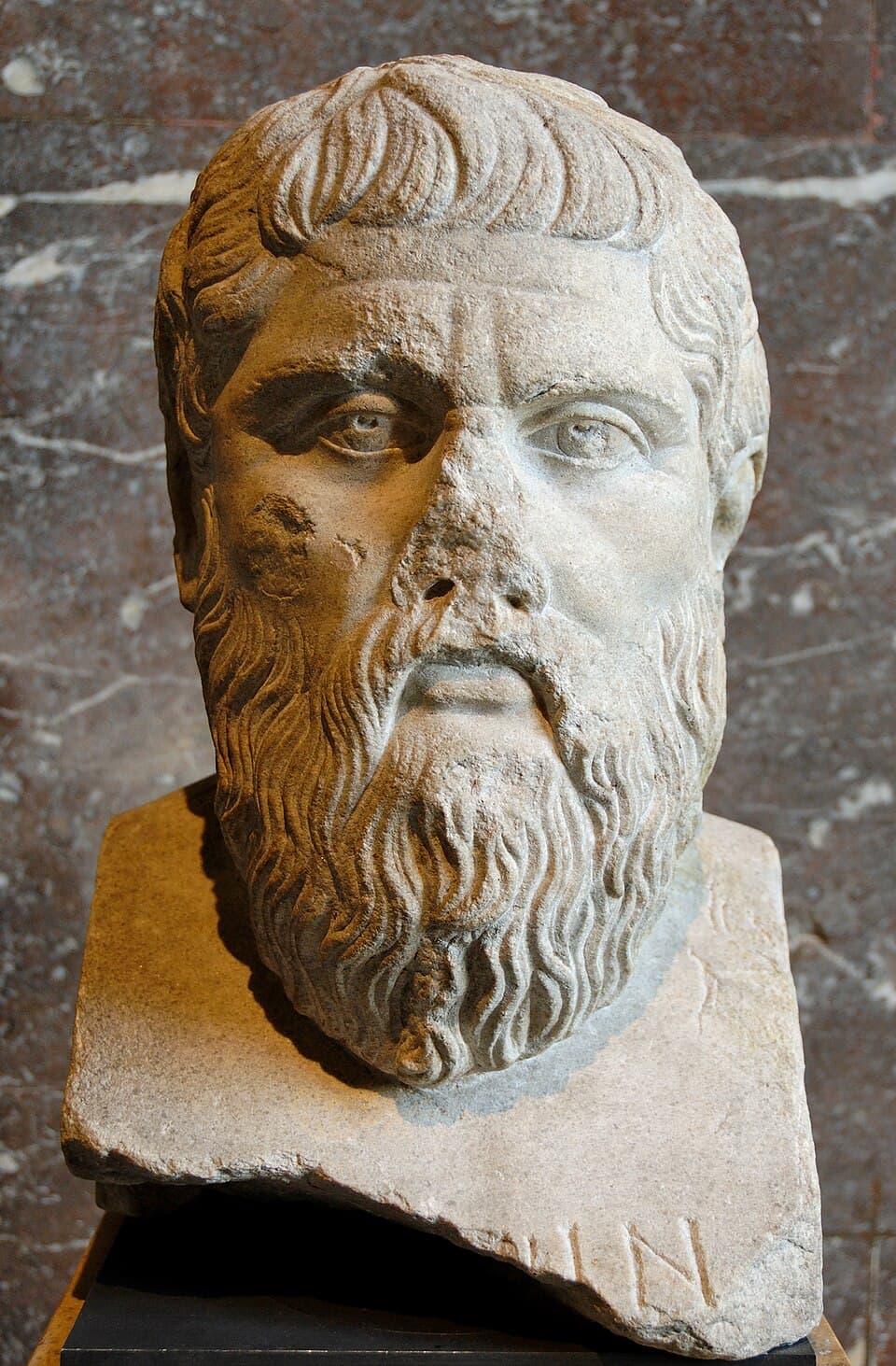
Plato
c. 428–347 BC
Athenian philosopher
Plato lived in ancient Athens, where he founded the Academy, a school devoted to philosophical inquiry. His life dates are approximate. Socrates, whose questioning made a lasting impression on him, appears throughout his writing. These conversations unfold among friends, rivals, and teachers, giving philosophical disagreement a recognizably human setting.1. Thomas Brickhouse and Nicholas D. Smith, “Plato,” Internet Encyclopedia of Philosophy, undated; accessed October 1, 2026, secs. 1a–1c and 2d. Richard Kraut, “Plato,” Stanford Encyclopedia of Philosophy, Summer 2026 edition, revised April 24, 2026, secs. 3–4.
Questions about justice and the good life lead into others about knowledge, love, education, and the soul. Many dialogues distinguish changing things from enduring forms, such as beauty or goodness itself. Yet they also test their own proposals. Their puzzles and unfinished arguments ask readers to weigh the reasoning, rather than simply collect conclusions.2. Richard Kraut, “Plato,” Stanford Encyclopedia of Philosophy, Summer 2026 edition, revised April 24, 2026, secs. 1–3 and 10–12.
How to read Plato
Apology offers a direct introduction to Socrates’ trial and his commitment to questioning. Try Euthyphro and Crito next. Notice who is speaking, what each person assumes, and where an argument leaves them: a dialogue’s unfinished answer can be part of its purpose.3. Paul Woodruff, “Plato’s Shorter Ethical Works,” Stanford Encyclopedia of Philosophy, Summer 2026 archive, Revised 18 December 2022, Sections 1–3 and 11–20.
The groups below suggest a route through the surviving collected writings, including works attributed to Plato. This is an editorial reading path, not a chronology. Plato usually writes through characters, and neither their statements nor the order of the dialogues can simply be treated as his own autobiography.4. Richard Kraut, “Plato,” Stanford Encyclopedia of Philosophy, Summer 2026 archive, Revised 24 April 2026, Sections 1–3, 5, 8 and 11.
Socrates in conversation
After the trial sequence, explore shorter discussions before Protagoras and Gorgias. Hippias Major belongs here thematically; although its authorship has been challenged, most contemporary scholars accept it as Plato’s.5. Paul Woodruff, “Plato’s Shorter Ethical Works,” Stanford Encyclopedia of Philosophy, Summer 2026 archive, Revised 18 December 2022, Sections 1–3 and 11–20. Thomas Brickhouse and Nicholas D. Smith, “Plato,” Internet Encyclopedia of Philosophy, n.d., Sections 3b and 4a–c.
Learning and language
Meno makes a useful next step into inquiry and learning. Cratylus asks how names relate to things; keep track of the competing proposals rather than expecting a tidy theory.6. Richard Kraut, “Plato,” Stanford Encyclopedia of Philosophy, Summer 2026 archive, Revised 24 April 2026, Sections 1–3, 5, 8 and 11.
Soul, love, and justice
Move from Phaedo and Symposium to Republic, then Phaedrus. Their different settings matter: a prison conversation, banquet speeches, a sustained political inquiry, and a discussion of love and persuasion.7. Richard Kraut, “Plato,” Stanford Encyclopedia of Philosophy, Summer 2026 archive, Revised 24 April 2026, Sections 1–3, 5, 8 and 11.
Knowledge and being
Follow Theaetetus with Sophist and Statesman, which continue its dramatic sequence. Return to Parmenides when ready for a demanding challenge to forms and an extended exercise in argument.8. Richard Kraut, “Plato,” Stanford Encyclopedia of Philosophy, Summer 2026 archive, Revised 24 April 2026, Sections 1–3, 5, 8 and 11. Sophie-Grace Chappell and Francesco Verde, “Plato on Knowledge in the Theaetetus,” Stanford Encyclopedia of Philosophy, Summer 2026 archive, Revised 7 February 2025, Sections 1–3.
Pleasure, nature, and law
Philebus returns to the good life. Read Timaeus with its unfinished continuation, Critias; approach Laws in smaller stretches, watching how institutions and education fit together.9. Richard Kraut, “Plato,” Stanford Encyclopedia of Philosophy, Summer 2026 archive, Revised 24 April 2026, Sections 1–3, 5, 8 and 11. Donald Zeyl and Barbara Sattler, “Plato’s Timaeus,” Stanford Encyclopedia of Philosophy, Summer 2026 archive, Revised 13 May 2022, Introduction and sections 1–2.
Debated attributions
These dialogues and the thirteen Letters belong to the historical collection, but their authorship is contested in different ways. Treat Letter VII as disputed evidence, rather than an unquestioned account by Plato.10. Thomas Brickhouse and Nicholas D. Smith, “Plato,” Internet Encyclopedia of Philosophy, n.d., Sections 3b and 4a–c. Richard Kraut, “Plato,” Stanford Encyclopedia of Philosophy, Summer 2026 archive, Revised 24 April 2026, Sections 1–3, 5, 8 and 11.
Other collected writings
These pieces are generally considered non-Platonic. They remain part of the catalogue because they were transmitted under his name; Definitions is a compilation rather than a conversation.11. Thomas Brickhouse and Nicholas D. Smith, “Plato,” Internet Encyclopedia of Philosophy, n.d., Sections 3b and 4a–c.
Poems attributed to Plato
The Epigrams add a different literary form. Most are probably not Plato’s, though some have been defended as genuine; attribution needs to be considered poem by poem.12. Thomas Brickhouse and Nicholas D. Smith, “Plato,” Internet Encyclopedia of Philosophy, n.d., Sections 3b and 4a–c.
For a shorter first journey, try Apology, Euthyphro, Crito, Meno, Symposium, and Republic.13. Paul Woodruff, “Plato’s Shorter Ethical Works,” Stanford Encyclopedia of Philosophy, Summer 2026 archive, Revised 18 December 2022, Sections 1–3 and 11–20. Richard Kraut, “Plato,” Stanford Encyclopedia of Philosophy, Summer 2026 archive, Revised 24 April 2026, Sections 1–3, 5, 8 and 11.
Reading guide sources
- Paul Woodruff, “Plato’s Shorter Ethical Works,” Stanford Encyclopedia of Philosophy, Summer 2026 archive, Revised 18 December 2022, Sections 1–3 and 11–20.
- Richard Kraut, “Plato,” Stanford Encyclopedia of Philosophy, Summer 2026 archive, Revised 24 April 2026, Sections 1–3, 5, 8 and 11.
- Paul Woodruff, “Plato’s Shorter Ethical Works,” Stanford Encyclopedia of Philosophy, Summer 2026 archive, Revised 18 December 2022, Sections 1–3 and 11–20. Thomas Brickhouse and Nicholas D. Smith, “Plato,” Internet Encyclopedia of Philosophy, n.d., Sections 3b and 4a–c.
- Richard Kraut, “Plato,” Stanford Encyclopedia of Philosophy, Summer 2026 archive, Revised 24 April 2026, Sections 1–3, 5, 8 and 11.
- Richard Kraut, “Plato,” Stanford Encyclopedia of Philosophy, Summer 2026 archive, Revised 24 April 2026, Sections 1–3, 5, 8 and 11.
- Richard Kraut, “Plato,” Stanford Encyclopedia of Philosophy, Summer 2026 archive, Revised 24 April 2026, Sections 1–3, 5, 8 and 11. Sophie-Grace Chappell and Francesco Verde, “Plato on Knowledge in the Theaetetus,” Stanford Encyclopedia of Philosophy, Summer 2026 archive, Revised 7 February 2025, Sections 1–3.
- Richard Kraut, “Plato,” Stanford Encyclopedia of Philosophy, Summer 2026 archive, Revised 24 April 2026, Sections 1–3, 5, 8 and 11. Donald Zeyl and Barbara Sattler, “Plato’s Timaeus,” Stanford Encyclopedia of Philosophy, Summer 2026 archive, Revised 13 May 2022, Introduction and sections 1–2.
- Thomas Brickhouse and Nicholas D. Smith, “Plato,” Internet Encyclopedia of Philosophy, n.d., Sections 3b and 4a–c. Richard Kraut, “Plato,” Stanford Encyclopedia of Philosophy, Summer 2026 archive, Revised 24 April 2026, Sections 1–3, 5, 8 and 11.
- Thomas Brickhouse and Nicholas D. Smith, “Plato,” Internet Encyclopedia of Philosophy, n.d., Sections 3b and 4a–c.
- Thomas Brickhouse and Nicholas D. Smith, “Plato,” Internet Encyclopedia of Philosophy, n.d., Sections 3b and 4a–c.
- Paul Woodruff, “Plato’s Shorter Ethical Works,” Stanford Encyclopedia of Philosophy, Summer 2026 archive, Revised 18 December 2022, Sections 1–3 and 11–20. Richard Kraut, “Plato,” Stanford Encyclopedia of Philosophy, Summer 2026 archive, Revised 24 April 2026, Sections 1–3, 5, 8 and 11.
Works in the library
45 availableEuthyphro
Socrates and Euthyphro ask what it means to be pious.
English · Benjamin JowettApology
Socrates defends his life and philosophy before the Athenian jury.
English · Benjamin JowettCrito
Socrates and Crito consider justice and whether to escape from prison.
English · Benjamin JowettLaches
Socrates, Laches and Nicias examine courage and the education of the young.
English · Benjamin JowettCharmides
Socrates, Charmides and Critias examine temperance and self-knowledge.
English · Benjamin JowettLysis
Socrates, Lysis and Menexenus investigate what makes someone a friend.
English · Benjamin JowettIon
Socrates and Ion examine poetic performance, expertise and inspiration.
English · Benjamin JowettHippias Minor
Socrates and Hippias question lying, knowledge and voluntary wrongdoing.
English · Benjamin JowettProtagoras
Socrates and Protagoras debate whether virtue can be taught.
English · Benjamin JowettGorgias
Socrates examines rhetoric, power and justice with Gorgias, Polus and Callicles.
English · Benjamin JowettMenexenus
Socrates recites a funeral oration attributed within the dialogue to Aspasia.
English · Benjamin JowettEuthydemus
Socrates recounts an encounter with Euthydemus and Dionysodorus and their verbal puzzles.
English · Benjamin JowettMeno
A conversation about virtue, inquiry, and learning.
English · Benjamin JowettCratylus
Names and their relationship to what they name.
English · Benjamin JowettPhaedo
The soul and philosophy on Socrates’ final day.
English · Benjamin JowettSymposium
Speeches on love at an Athenian drinking party.
English · Benjamin JowettRepublic
Justice, education, and the ordering of a city.
English · Benjamin JowettPhaedrus
Love, rhetoric, and the limits of writing.
English · Benjamin JowettTheaetetus
An inquiry into what it means to know.
English · Benjamin JowettParmenides
Challenges to forms and an exercise on oneness.
English · Benjamin JowettSophist
An investigation of sophistry, being, and not-being.
English · Benjamin JowettStatesman
Political expertise and good rule; also called Politicus.
English · Benjamin JowettPhilebus
Pleasure and understanding in a good human life.
English · Benjamin JowettTimaeus
A cosmological account of order and its causes.
English · Benjamin JowettCritias
An unfinished account of ancient Athens and Atlantis.
English · Benjamin JowettLaws
Law and education in a proposed political community.
English · Benjamin JowettHippias Major
Socrates and Hippias investigate what is beautiful.
English · Harold North FowlerAlcibiades I
A dialogue traditionally transmitted among Plato’s works.
English · Benjamin Jowett · Disputed attributionClitophon
A short work included in the Platonic collection.
English · Robert Gregg Bury · Disputed attributionTheages
A Socratic dialogue with debated Platonic authorship.
English · George Burges · Disputed attributionHipparchus
One of the dialogues preserved under Plato’s name.
English · George Burges · Disputed attributionMinos
An attributed dialogue retained in the collected corpus.
English · George Burges · Disputed attributionRival Lovers
Also known as Lovers or Rivals.
English · George Burges · Disputed attributionAlcibiades II
Also called Second Alcibiades; its attribution is debated.
English · Benjamin Jowett · Disputed attributionEpinomis
An attributed sequel to the discussion in Laws.
English · George Burges · Disputed attributionLetters I–XIII
Thirteen attributed epistles; individual claims of authenticity vary.
English · Robert Gregg Bury · Disputed attributionAxiochus
An attributed dialogue generally excluded from Plato’s authentic writings.
English · George Burges · Spurious attributionDemodocus
A brief work preserved in the spurious Platonic corpus.
English · George Burges · Spurious attributionEryxias
A dialogue included among works falsely attributed to Plato.
English · Benjamin Jowett · Spurious attributionHalcyon
An ancient dialogue wrongly attributed to Plato.
English · Thomas Francklin · Spurious attributionOn Justice
A short conversation in the wider Platonic collection.
English · George Burges · Spurious attributionOn Virtue
An attributed discussion generally considered non-Platonic.
English · George Burges · Spurious attributionSisyphus
A surviving dialogue classified with the Platonic spuria.
English · George Burges · Spurious attributionDefinitions
A collection of definitions rather than a dialogue.
English · George Burges · Spurious attributionEpigrams
Short poems attributed to Plato; most are probably by others.
English · W. R. Paton, George Burges · Disputed attribution
Sources & portrait
- Thomas Brickhouse and Nicholas D. Smith, “Plato,” Internet Encyclopedia of Philosophy, undated; accessed October 1, 2026, secs. 1a–1c and 2d. Richard Kraut, “Plato,” Stanford Encyclopedia of Philosophy, Summer 2026 edition, revised April 24, 2026, secs. 3–4.
- Richard Kraut, “Plato,” Stanford Encyclopedia of Philosophy, Summer 2026 edition, revised April 24, 2026, secs. 1–3 and 10–12.
Portrait: Roman marble portrait after Silanion (attributed), 2nd century CE. Louvre Ma 3654. Photograph: Marie-Lan Nguyen, 2007. Image source. Public domain; photograph dedicated to the public domain by its creator. Displayed in monochrome with a circular crop.

