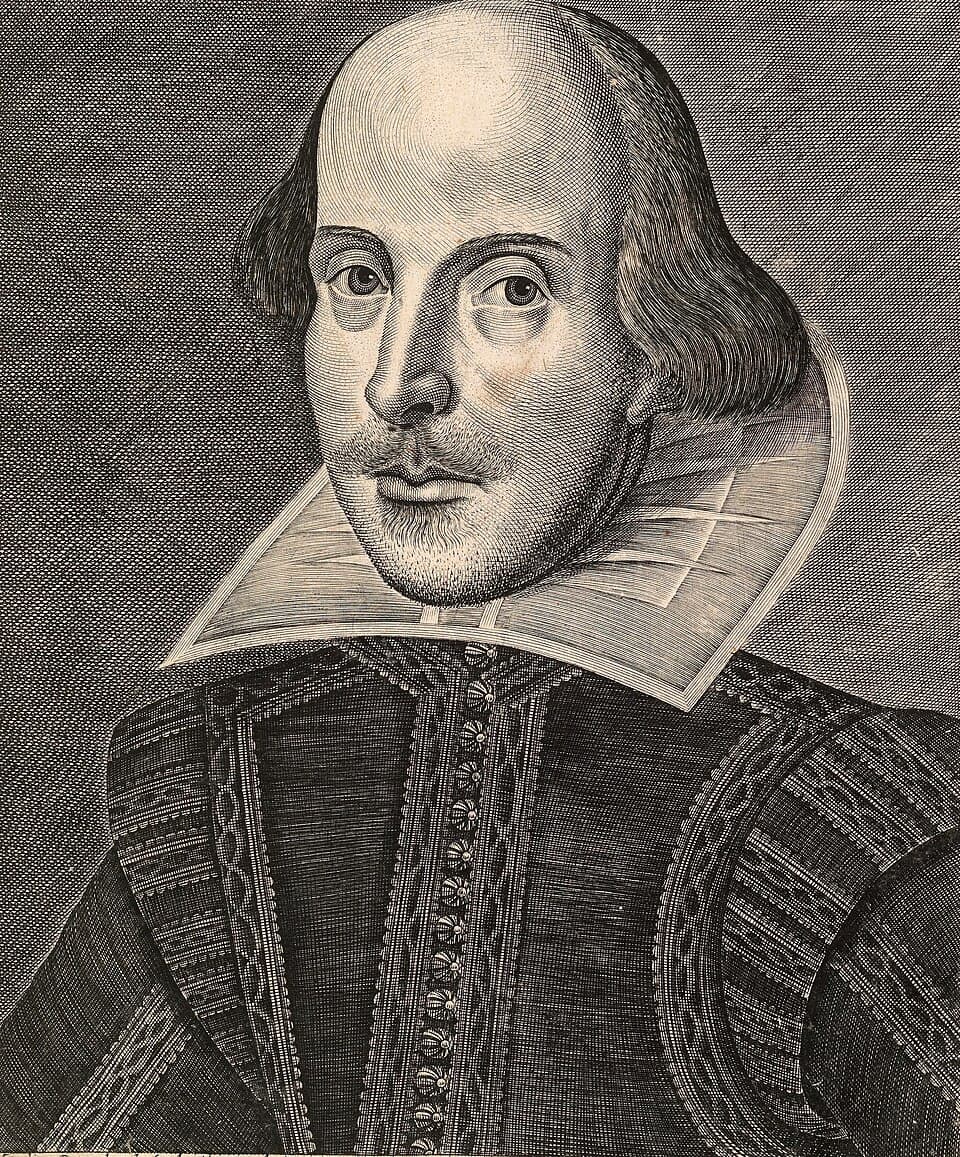
William Shakespeare
1564–1616
English playwright and poet
William Shakespeare grew up in Stratford-upon-Avon and built his theatrical career in London. He worked as an actor, playwright, and shareholder in the company later called the King’s Men. Records establish much of his professional life, though gaps remain, including the years before he emerged as a London dramatist.1. Folger Shakespeare Library, “Shakespeare’s life,” Folger Shakespeare Library, undated; accessed 21 October 2026, Birth and childhood; London theater; Final years.
His plays move between domestic comedy, political history, tragedy, and stories of separation and reunion. Characters argue, perform, and misunderstand one another in language shaped for the stage. Alongside the plays, his sonnets and narrative poems explore desire, time, violence, and remembrance. Some dramatic works were written collaboratively, and their surviving texts often differ between early editions.2. Folger Shakespeare Library, “All Shakespeare’s works,” Folger Shakespeare Library, undated; accessed 21 October 2026, A–Z introductions to plays and poems.
How to read William Shakespeare
Try A Midsummer Night’s Dream for comedy or Macbeth for tragedy, then read across forms. Stage directions, pauses, and changes of audience are part of the writing: these are scripts for speaking and acting.3. Folger Shakespeare Library, “All Shakespeare’s works,” Folger Shakespeare Library, undated; accessed 21 October 2026, A–Z introductions to plays and poems.
This map covers the surviving collected plays and poems, with collaborative additions and qualified attributions. Lost works such as Love’s Labor’s Won and Cardenio are not presented as recoverable books. Early quartos and the First Folio may preserve different versions of the same play.4. Folger Shakespeare Library, “All Shakespeare’s works,” Folger Shakespeare Library, undated; accessed 21 October 2026, A–Z introductions to plays and poems.
Comedy and difficult courtships
Read the comedies as performances: disguise and overheard speech often make the audience know more than the characters. The later comedies also press uncomfortable questions about coercion and judgment.5. Folger Shakespeare Library, “All Shakespeare’s works,” Folger Shakespeare Library, undated; accessed 21 October 2026, A–Z introductions to plays and poems.
English kings and civil conflict
Richard II, both Henry IV plays, and Henry V form a useful sequence. The Henry VI plays and Richard III continue into the later dynastic struggle; their dramatic history is shaped by the conditions of Shakespeare’s theater.6. Folger Shakespeare Library, “All Shakespeare’s works,” Folger Shakespeare Library, undated; accessed 21 October 2026, A–Z introductions to plays and poems. Folger Shakespeare Library, “Henry VI, Part 1: Act 1, scene 1,” Folger Shakespeare Library, undated; accessed October 21, 2026, Scene synopsis: funeral of Henry V.
Tragedy, argument, and revenge
Macbeth offers a compact entrance to tragedy; Hamlet is more expansive and questioning. Attend to what a character says in public and what changes in soliloquy.7. Folger Shakespeare Library, “All Shakespeare’s works,” Folger Shakespeare Library, undated; accessed 21 October 2026, A–Z introductions to plays and poems.
Separation and return
The late romances mix danger, loss, and reunion. Pericles and The Two Noble Kinsmen belong to Shakespeare’s collaborative theater, rather than a purely solitary authorship.8. Folger Shakespeare Library, “All Shakespeare’s works,” Folger Shakespeare Library, undated; accessed 21 October 2026, A–Z introductions to plays and poems.
Poems and collected sonnets
The sonnets form one collection, rather than 154 separate catalog entries. The Passionate Pilgrim entry covers Shakespeare’s contributions only; the anthology as a whole is not his work.9. Folger Shakespeare Library, “Shakespeare’s poems,” Folger Shakespeare Library, undated; accessed 21 October 2026, Sonnets and Poems. Peter Kirwan, “The Passionate Pilgrim, second edition,” Shakespeare Documented / Folger Shakespeare Library, updated 11 August 2020, Authorship: five Shakespeare poems within twenty-poem miscellany. Barbara Mowat and Paul Werstine, “An Introduction to This Text: Venus and Adonis,” Folger Shakespeare Library, undated; accessed 21 October 2026, Publication history and disputed attribution of A Lover’s Complaint.
Collaborative additions
These entries extend the familiar collected canon. Edward III has a debated division of authorship; Sir Thomas More concerns Shakespeare’s contribution to a play with several writers.10. Giorgio Melchiori, editor, “King Edward III,” Cambridge University Press, 1998, New Cambridge Shakespeare: authorship and contents. John Jowett, editor, “Sir Thomas More,” Arden Shakespeare / Bloomsbury, 2011, Publisher description; collaborative authorship.
Reading guide sources
- Folger Shakespeare Library, “All Shakespeare’s works,” Folger Shakespeare Library, undated; accessed 21 October 2026, A–Z introductions to plays and poems.
- Folger Shakespeare Library, “All Shakespeare’s works,” Folger Shakespeare Library, undated; accessed 21 October 2026, A–Z introductions to plays and poems.
- Folger Shakespeare Library, “All Shakespeare’s works,” Folger Shakespeare Library, undated; accessed 21 October 2026, A–Z introductions to plays and poems.
- Folger Shakespeare Library, “All Shakespeare’s works,” Folger Shakespeare Library, undated; accessed 21 October 2026, A–Z introductions to plays and poems. Folger Shakespeare Library, “Henry VI, Part 1: Act 1, scene 1,” Folger Shakespeare Library, undated; accessed October 21, 2026, Scene synopsis: funeral of Henry V.
- Folger Shakespeare Library, “All Shakespeare’s works,” Folger Shakespeare Library, undated; accessed 21 October 2026, A–Z introductions to plays and poems.
- Folger Shakespeare Library, “All Shakespeare’s works,” Folger Shakespeare Library, undated; accessed 21 October 2026, A–Z introductions to plays and poems.
- Folger Shakespeare Library, “Shakespeare’s poems,” Folger Shakespeare Library, undated; accessed 21 October 2026, Sonnets and Poems. Peter Kirwan, “The Passionate Pilgrim, second edition,” Shakespeare Documented / Folger Shakespeare Library, updated 11 August 2020, Authorship: five Shakespeare poems within twenty-poem miscellany. Barbara Mowat and Paul Werstine, “An Introduction to This Text: Venus and Adonis,” Folger Shakespeare Library, undated; accessed 21 October 2026, Publication history and disputed attribution of A Lover’s Complaint.
- Giorgio Melchiori, editor, “King Edward III,” Cambridge University Press, 1998, New Cambridge Shakespeare: authorship and contents. John Jowett, editor, “Sir Thomas More,” Arden Shakespeare / Bloomsbury, 2011, Publisher description; collaborative authorship.
Works in the library
46 under developmentThe Comedy of Errors
Two pairs of twins multiply mistaken identities.
Under developmentThe Taming of the Shrew
Courtship becomes a contest over obedience and power.
Under developmentThe Two Gentlemen of Verona
Friendship and desire collide in exile.
Under developmentLove’s Labor’s Lost
Promises of scholarly retreat meet unexpected courtship.
Under developmentA Midsummer Night’s Dream
Lovers and players wander into fairy quarrels.
Under developmentThe Merchant of Venice
A debt binds friendship, prejudice, and legal judgment.
Under developmentThe Merry Wives of Windsor
Two women turn Falstaff’s schemes against him.
Under developmentMuch Ado About Nothing
Wit and malicious rumor unsettle two courtships.
Under developmentAs You Like It
Exile and disguise open new possibilities for love.
Under developmentTwelfth Night
A shipwreck leads to disguise and crossed desires.
Under developmentAll’s Well That Ends Well
Helen pursues a husband who rejects her.
Under developmentMeasure for Measure
Sexual coercion tests a ruler’s claims to justice.
Under developmentKing John
Dynastic claims and political loyalty unsettle England.
Under developmentRichard II
A king’s deposition exposes the fragility of authority.
Under developmentHenry IV, Part 1
Prince Hal negotiates rebellion and competing father figures.
Under developmentHenry IV, Part 2
Succession brings Prince Hal toward kingship.
Under developmentHenry V
Conquest tests royal rhetoric and the costs of war.
Under developmentHenry VI, Part 1
Foreign war and faction threaten a young king.
Under developmentHenry VI, Part 2
Court intrigue and rebellion erode royal power.
Under developmentHenry VI, Part 3
Civil war turns families against themselves.
Under developmentRichard III
A calculating claimant gains and loses the throne.
Under developmentHenry VIII
Courtly ambition reshapes a royal marriage and succession.
Under developmentTitus Andronicus
Revenge transforms Roman honor into escalating violence.
Under developmentRomeo and Juliet
Young lovers confront a feud between their families.
Under developmentJulius Caesar
Assassination turns republican claims into civil conflict.
Under developmentHamlet
A prince questions how to avenge his father.
Under developmentOthello
Manipulation turns marital trust into destructive suspicion.
Under developmentKing Lear
A divided kingdom exposes betrayal and dependence.
Under developmentMacbeth
A prediction feeds murderous ambition and fear.
Under developmentAntony and Cleopatra
Love and imperial rivalry pull rulers apart.
Under developmentCoriolanus
Military pride clashes with popular political authority.
Under developmentTimon of Athens
A generous patron turns against human society.
Under developmentTroilus and Cressida
Love and martial reputation unravel during the Trojan War.
Under developmentPericles
A wandering prince endures separation and reunion.
Under developmentCymbeline
Slander and disguise disrupt a British royal family.
Under developmentThe Winter’s Tale
Jealousy breaks a family across a long separation.
Under developmentThe Tempest
An exiled ruler stages encounters on an island.
Under developmentThe Two Noble Kinsmen
Two imprisoned cousins become rivals in love.
Under developmentSonnets
The sequence of 154 sonnets considers desire, time, and poetry.
Under developmentVenus and Adonis
Venus pursues a young hunter who resists her.
Under developmentThe Rape of Lucrece
Sexual violence becomes a crisis of Roman rule.
Under developmentThe Phoenix and Turtle
A brief allegorical poem mourns an exceptional union.
Under developmentA Lover’s Complaint
A woman recounts seduction and abandonment; attribution has been debated.
Under development · Disputed attributionContributions to The Passionate Pilgrim
Five Shakespeare poems within a mixed-authorship anthology issued under his name.
Under developmentEdward III
A collaborative history play about war and royal desire.
Under developmentContribution to Sir Thomas More
The surviving additions conventionally associated with Shakespeare’s Hand D.
Under development
Sources & portrait
- Folger Shakespeare Library, “Shakespeare’s life,” Folger Shakespeare Library, undated; accessed 21 October 2026, Birth and childhood; London theater; Final years.
- Folger Shakespeare Library, “All Shakespeare’s works,” Folger Shakespeare Library, undated; accessed 21 October 2026, A–Z introductions to plays and poems.
Portrait: Martin Droeshout, engraving for the First Folio, 1623. Reproduction of the Bodleian Libraries copy. Displayed in monochrome. Image source. Collection record. Public-domain historical work and faithful reproduction. Displayed in monochrome with a circular crop.

