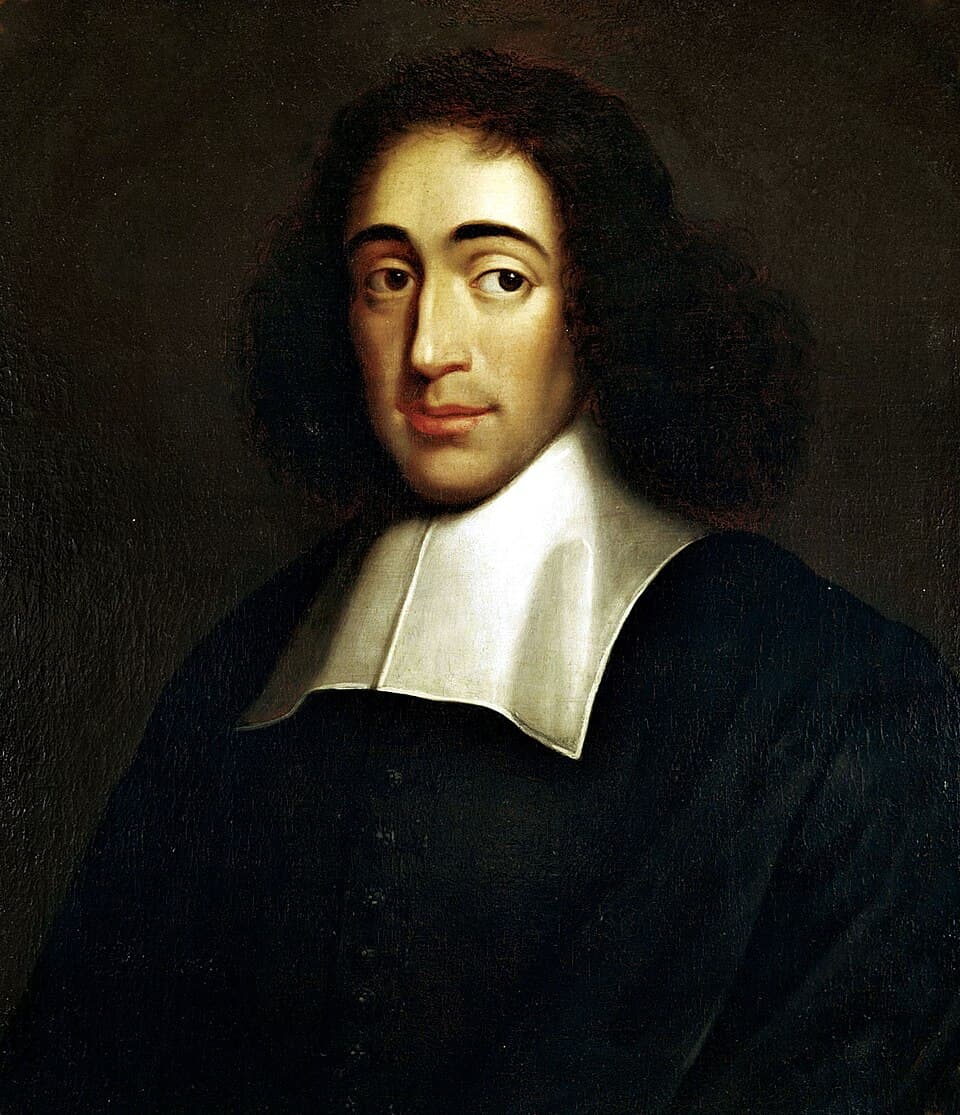
Baruch Spinoza
1632–1677
Dutch philosopher
Baruch Spinoza grew up in Amsterdam’s Portuguese-Jewish community and was expelled from it in 1656; the precise grounds remain uncertain. He later lived near Leiden and in The Hague. His challenges to received ideas about God and scripture provoked fierce opposition, and his major political intervention appeared anonymously during his lifetime.1. Steven Nadler, “Baruch Spinoza,” Stanford Encyclopedia of Philosophy, Summer 2026 edition, revised November 8, 2023, sec. 1.
Spinoza treats human beings as part of nature, subject to the same necessary order as everything else. God is no external ruler of this order. Understanding the causes of our emotions can, he argues, lessen their hold on us and support a more active life. His political thought also defends freedom of belief and philosophical inquiry within an ordered society.2. Steven Nadler, “Baruch Spinoza,” Stanford Encyclopedia of Philosophy, Summer 2026 edition, revised November 8, 2023, secs. 2.1–2.5 and 3.2.
How to read Baruch Spinoza
A manageable first encounter is the opening of the unfinished Treatise on the Emendation of the Intellect: it asks what is worth pursuing and how understanding might improve a life. The sequence here is an editorial route through different kinds of writing, not a reconstruction of their dates.3. Steven Nadler, “Baruch Spinoza,” Stanford Encyclopedia of Philosophy, Summer 2026 archive, Revised 8 November 2023, Sections 1–3; bibliography, Spinoza’s Works.
The question of understanding
Continue the Emendation with its account of method. The Short Treatise offers an earlier presentation of themes developed in Ethics; use it for comparison rather than assuming every formulation stayed unchanged.4. Steven Nadler, “Baruch Spinoza,” Stanford Encyclopedia of Philosophy, Summer 2026 archive, Revised 8 November 2023, Sections 1–3; bibliography, Spinoza’s Works.
Working through Ethics
Read the five parts in order, recording definitions and following references back to earlier propositions. The explanatory notes, or scholia, help illuminate the proofs. Substance, attribute, and mode are technical terms; translate them consistently in your notes.5. Steven Nadler, “Baruch Spinoza,” Stanford Encyclopedia of Philosophy, Summer 2026 archive, Revised 8 November 2023, Sections 1–3; bibliography, Spinoza’s Works.
Religion and political freedom
For a less geometrical entry, try the Theological-Political Treatise’s preface and chapter 20, then read the intervening arguments about Scripture and authority. Political Treatise shifts the focus towards institutions and ends unfinished.6. Justin Steinberg, “Spinoza’s Political Philosophy,” Stanford Encyclopedia of Philosophy, Summer 2026 archive, Revised 30 September 2024, Sections 3–4.
The Cartesian background
Principles of Cartesian Philosophy expounds Descartes through geometrical demonstration. Read its attached Metaphysical Thoughts alongside it, taking care to distinguish an exposition of Cartesian positions from Spinoza’s own mature commitments.7. Steven Nadler, “Baruch Spinoza,” Stanford Encyclopedia of Philosophy, Summer 2026 archive, Revised 8 November 2023, Sections 1–3; bibliography, Spinoza’s Works. Indiana University Libraries, “The collected works of Spinoza,” IUCAT bibliographic catalogue, 1985–2016, Contents; edited and translated by Edwin Curley, Princeton University Press. W. N. A. Klever, “Spinoza’s life and works,” The Cambridge Companion to Spinoza, Cambridge University Press, 1995; online 28 May 2006, Pages 13–60; chapter summary.
Questions beyond the treatises
Use the Letters to revisit a particular difficulty through exchanges with correspondents. The Compendium of Hebrew Grammar is listed for readers interested in language and biblical interpretation; no reader is available, and it is not a prerequisite for Ethics.8. Indiana University Libraries, “The collected works of Spinoza,” IUCAT bibliographic catalogue, 1985–2016, Contents; edited and translated by Edwin Curley, Princeton University Press. Steven Nadler, “Compendium of the Grammar of the Hebrew Language,” The Cambridge Spinoza Lexicon, Cambridge University Press, 2024; online 9 January 2025, Pages 93–94.
Reading guide sources
- Steven Nadler, “Baruch Spinoza,” Stanford Encyclopedia of Philosophy, Summer 2026 archive, Revised 8 November 2023, Sections 1–3; bibliography, Spinoza’s Works.
- Steven Nadler, “Baruch Spinoza,” Stanford Encyclopedia of Philosophy, Summer 2026 archive, Revised 8 November 2023, Sections 1–3; bibliography, Spinoza’s Works.
- Steven Nadler, “Baruch Spinoza,” Stanford Encyclopedia of Philosophy, Summer 2026 archive, Revised 8 November 2023, Sections 1–3; bibliography, Spinoza’s Works.
- Justin Steinberg, “Spinoza’s Political Philosophy,” Stanford Encyclopedia of Philosophy, Summer 2026 archive, Revised 30 September 2024, Sections 3–4.
- Steven Nadler, “Baruch Spinoza,” Stanford Encyclopedia of Philosophy, Summer 2026 archive, Revised 8 November 2023, Sections 1–3; bibliography, Spinoza’s Works. Indiana University Libraries, “The collected works of Spinoza,” IUCAT bibliographic catalogue, 1985–2016, Contents; edited and translated by Edwin Curley, Princeton University Press. W. N. A. Klever, “Spinoza’s life and works,” The Cambridge Companion to Spinoza, Cambridge University Press, 1995; online 28 May 2006, Pages 13–60; chapter summary.
- Indiana University Libraries, “The collected works of Spinoza,” IUCAT bibliographic catalogue, 1985–2016, Contents; edited and translated by Edwin Curley, Princeton University Press. Steven Nadler, “Compendium of the Grammar of the Hebrew Language,” The Cambridge Spinoza Lexicon, Cambridge University Press, 2024; online 9 January 2025, Pages 93–94.
Works in the library
8 available · 1 unavailableTreatise on the Emendation of the Intellect
An unfinished investigation of knowledge and philosophical method.
English · Robert Harvey Monro ElwesShort Treatise on God, Man, and His Well-Being
An early account of themes later developed in Ethics.
English · Abraham WolfEthics
God and nature, the mind, emotions, and human freedom.
English · Robert Harvey Monro ElwesTheological-Political Treatise
Scriptural interpretation, religious authority, and freedom of thought.
English · Robert Harvey Monro ElwesPolitical Treatise
An unfinished study of power and political institutions.
English · Robert Harvey Monro ElwesPrinciples of Cartesian Philosophy
A geometrical exposition of Descartes’ philosophical principles.
English · Halbert Hains BritanMetaphysical Thoughts
A metaphysical appendix to the exposition of Descartes.
English · Halbert Hains BritanLetters
Philosophical correspondence with friends, critics, and other thinkers. The available English edition is A. Wolf’s 1928 collection of 86 entries; it omits later discoveries such as Letter 12A (to Meyer, 26 July 1663).
English · Abraham WolfCompendium of Hebrew Grammar
An unfinished study of the Hebrew language.
Not available
Sources & portrait
- Steven Nadler, “Baruch Spinoza,” Stanford Encyclopedia of Philosophy, Summer 2026 edition, revised November 8, 2023, sec. 1.
- Steven Nadler, “Baruch Spinoza,” Stanford Encyclopedia of Philosophy, Summer 2026 edition, revised November 8, 2023, secs. 2.1–2.5 and 3.2.
Portrait: Unknown artist, Portrait of Benedictus de Spinoza, about 1665. Herzog August Library, Wolfenbüttel. Image source. Public domain faithful reproduction of a public domain painting (PD-Art, PD-old-100-expired). Displayed in monochrome with a circular crop.
