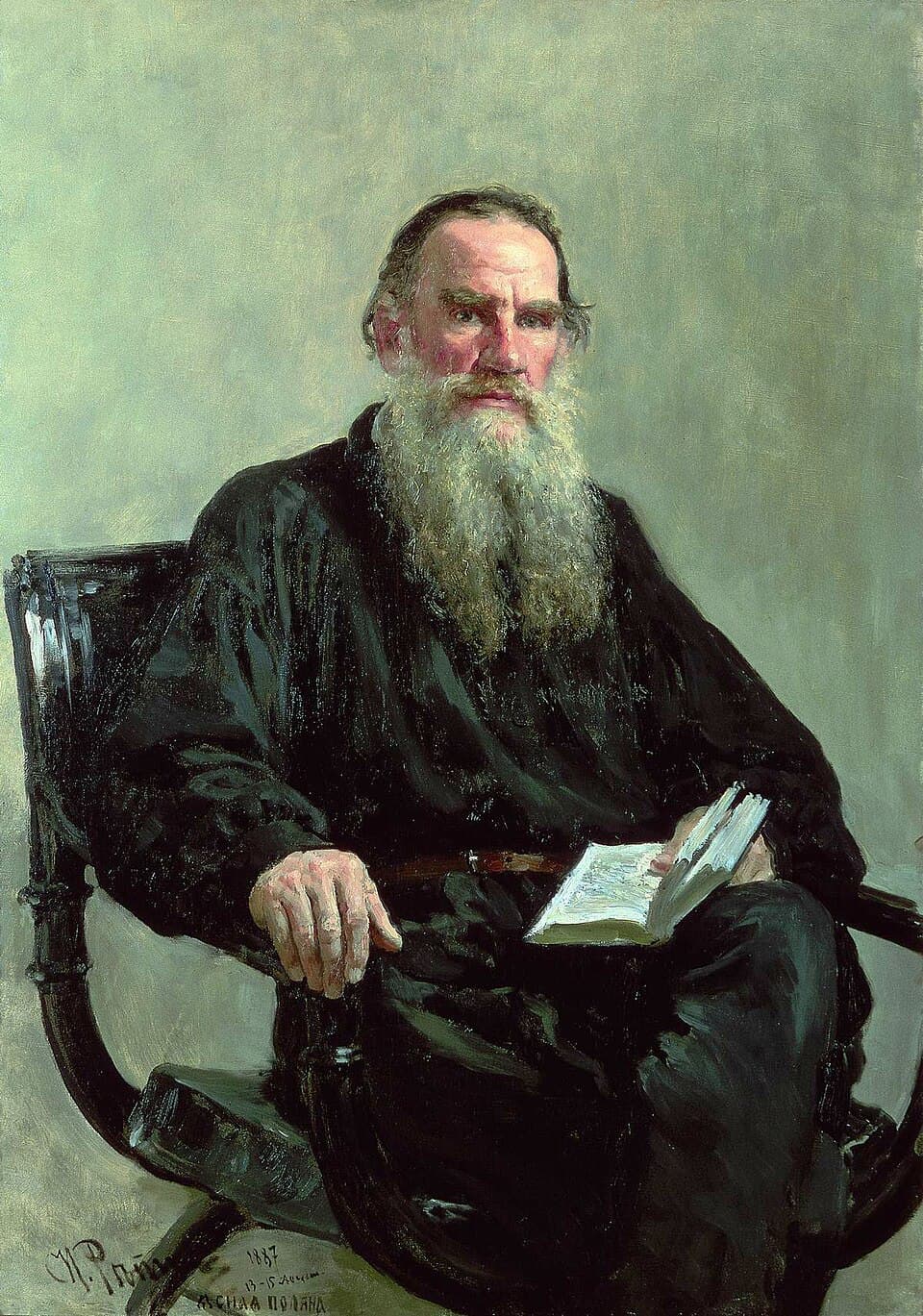
Leo Tolstoy
1828–1910
Russian novelist and moral thinker
Leo Tolstoy was born at Yasnaya Polyana into a Russian aristocratic family. Military service in the Caucasus and at Sevastopol informed his early fiction. Back at his estate, he experimented with education for peasant children. Marriage and family life accompanied the long work of writing War and Peace and Anna Karenina.1. Yasnaya Polyana Museum, “History of Yasnaya Polyana,” Yasnaya Polyana Museum, undated; accessed 21 October 2026, 1828–1910: Tolstoy’s life at the estate.
His attention to gesture, memory, and conflicting motives gives private experience a place within large social worlds. Later religious and moral inquiries challenged church authority, property, punishment, and war. These commitments shaped essays, stories, plays, and educational writing, while his diaries and correspondence record continuing tensions between the life he advocated and the circumstances in which he lived.2. Irina V. Petrovitskaya, “Leo Tolstoy: Publicist and Public Figure,” Tolstoy.ru / Moscow State University scholar’s guide, undated; accessed 21 October 2026, Chronological guide to religious, educational, and social writings.
How to read Leo Tolstoy
The Death of Ivan Ilyich offers a short route into Tolstoy’s attention to ordinary habits and profound doubt. Anna Karenina and War and Peace reward a slower engagement with many connected lives. His essays make a different demand: they openly ask readers to change how they live.3. Irina V. Petrovitskaya, “Leo Tolstoy: Publicist and Public Figure,” Tolstoy.ru / Moscow State University scholar’s guide, undated; accessed 21 October 2026, Chronological guide to religious, educational, and social writings. State Museum of Leo Tolstoy and Yasnaya Polyana Museum, “Complete Works in Ninety Volumes,” Tolstoy.ru, 1928–1958; accessed 21 October 2026, Volume list: works 1–45, diaries 46–58, letters 59–89, additions 90.
This is a collected-corpus map at book and collection level, bounded by the ninety-volume Jubilee Edition. Independently listed novels, longer narratives, plays, primers, and major treatises sit beside scoped collections covering remaining stories, essays, translations, diaries, letters, and drafts. A collection entry may contain many individually titled pieces. No text, translation, or modern editorial apparatus is published here.4. State Museum of Leo Tolstoy and Yasnaya Polyana Museum, “Complete Works in Ninety Volumes,” Tolstoy.ru, 1928–1958; accessed 21 October 2026, Volume list: works 1–45, diaries 46–58, letters 59–89, additions 90.
Novels and the autobiographical trilogy
Childhood, Boyhood, and Youth follow a fictional development informed by Tolstoy’s early experience. Read Anna Karenina or War and Peace in sustained stretches; Resurrection belongs to the later phase of his social and religious criticism.5. State Museum of Leo Tolstoy and Yasnaya Polyana Museum, “Complete Works in Ninety Volumes,” Tolstoy.ru, 1928–1958; accessed 21 October 2026, Volume list: works 1–45, diaries 46–58, letters 59–89, additions 90.
Longer stories and novellas
The Death of Ivan Ilyich is a focused entrance into Tolstoy’s writing about mortality. The Cossacks and Hadji Murad approach the Caucasus from different moments in his career; their settings also require attention to empire and unequal power.6. State Museum of Leo Tolstoy and Yasnaya Polyana Museum, “Complete Works in Ninety Volumes,” Tolstoy.ru, 1928–1958; accessed 21 October 2026, Volume list: works 1–45, diaries 46–58, letters 59–89, additions 90.
- Two Hussars
- A Landowner’s Morning
- Family Happiness
- The Cossacks
- Polikushka
- The Death of Ivan Ilyich
- Kholstomer: The Story of a Horse
- Walk in the Light While There Is Light
- Notes of a Madman
- The Kreutzer Sonata
- The Devil
- Master and Man
- Father Sergius
- Hadji Murad
- The Forged Coupon
- The Decembrists
- The Posthumous Memoirs of Fyodor Kuzmich
Collected short fiction
The three Sevastopol sketches stay together. The remaining short fiction is grouped by the collected edition’s boundaries, including folk tales, fables, adaptations, and surviving fragments; individually listed novellas and educational readers are excluded from those groups.7. State Museum of Leo Tolstoy and Yasnaya Polyana Museum, “Complete Works in Ninety Volumes,” Tolstoy.ru, 1928–1958; accessed 21 October 2026, Volume list: works 1–45, diaries 46–58, letters 59–89, additions 90.
Plays and dramatic fragments
The Power of Darkness makes household dependence and violence visible in dialogue. The other plays range from satire to moral drama. Unfinished scripts and short dramatic conversations retain their fragmentary status.8. Leo Tolstoy; Jubilee Edition scholarly editorial board, “Complete Works in Ninety Volumes, volume 7,” State Literary Publishing House; Tolstoy.ru digital edition, 1928–1958; accessed 21 October 2026, Main writings and table of contents. Leo Tolstoy; Jubilee Edition scholarly editorial board, “Complete Works in Ninety Volumes, volume 26,” State Literary Publishing House; Tolstoy.ru digital edition, 1928–1958; accessed 21 October 2026, Main writings and table of contents. Leo Tolstoy; Jubilee Edition scholarly editorial board, “Complete Works in Ninety Volumes, volume 37,” State Literary Publishing House; Tolstoy.ru digital edition, 1928–1958; accessed 21 October 2026, Main writings and table of contents.
Religion, ethics, and social criticism
A Confession explains the crisis from which Tolstoy’s later religious writing developed. The Kingdom of God Is Within You develops nonresistance; What Is Art? brings his moral expectations to artistic practice. These arguments belong alongside his fiction without erasing differences of form.9. Irina V. Petrovitskaya, “Leo Tolstoy: Publicist and Public Figure,” Tolstoy.ru / Moscow State University scholar’s guide, undated; accessed 21 October 2026, Chronological guide to religious, educational, and social writings.
- A Confession
- A Critique of Dogmatic Theology
- What I Believe
- The Four Gospels: Harmonization and Translation
- The Gospel in Brief
- What Then Must We Do?
- On Life
- The Kingdom of God Is Within You
- What Is Art?
- Christian Teaching
- What Is Religion and What Is Its Essence?
- The Slavery of Our Times
- On Shakespeare and the Drama
- The Law of Love and the Law of Violence
- Other Essays, Appeals, and Public Writings
Education, readers, and compilations
The educational books mix instruction with stories and adapted material. The later calendars and reading cycles also gather other writers; Tolstoy’s role as compiler or translator must remain distinct from authorship of their sources.10. State Museum of Leo Tolstoy and Yasnaya Polyana Museum, “Complete Works in Ninety Volumes,” Tolstoy.ru, 1928–1958; accessed 21 October 2026, Volume list: works 1–45, diaries 46–58, letters 59–89, additions 90.
Memoirs, diaries, correspondence, and drafts
Private writings show the long duration of Tolstoy’s self-examination. The bibliography uses the ninety-volume Jubilee Edition as a historical boundary, rather than claiming an exhaustive account of material discovered or edited later.11. State Museum of Leo Tolstoy and Yasnaya Polyana Museum, “Complete Works in Ninety Volumes,” Tolstoy.ru, 1928–1958; accessed 21 October 2026, Volume list: works 1–45, diaries 46–58, letters 59–89, additions 90.
Reading guide sources
- Irina V. Petrovitskaya, “Leo Tolstoy: Publicist and Public Figure,” Tolstoy.ru / Moscow State University scholar’s guide, undated; accessed 21 October 2026, Chronological guide to religious, educational, and social writings. State Museum of Leo Tolstoy and Yasnaya Polyana Museum, “Complete Works in Ninety Volumes,” Tolstoy.ru, 1928–1958; accessed 21 October 2026, Volume list: works 1–45, diaries 46–58, letters 59–89, additions 90.
- State Museum of Leo Tolstoy and Yasnaya Polyana Museum, “Complete Works in Ninety Volumes,” Tolstoy.ru, 1928–1958; accessed 21 October 2026, Volume list: works 1–45, diaries 46–58, letters 59–89, additions 90.
- State Museum of Leo Tolstoy and Yasnaya Polyana Museum, “Complete Works in Ninety Volumes,” Tolstoy.ru, 1928–1958; accessed 21 October 2026, Volume list: works 1–45, diaries 46–58, letters 59–89, additions 90.
- State Museum of Leo Tolstoy and Yasnaya Polyana Museum, “Complete Works in Ninety Volumes,” Tolstoy.ru, 1928–1958; accessed 21 October 2026, Volume list: works 1–45, diaries 46–58, letters 59–89, additions 90.
- State Museum of Leo Tolstoy and Yasnaya Polyana Museum, “Complete Works in Ninety Volumes,” Tolstoy.ru, 1928–1958; accessed 21 October 2026, Volume list: works 1–45, diaries 46–58, letters 59–89, additions 90.
- Leo Tolstoy; Jubilee Edition scholarly editorial board, “Complete Works in Ninety Volumes, volume 7,” State Literary Publishing House; Tolstoy.ru digital edition, 1928–1958; accessed 21 October 2026, Main writings and table of contents. Leo Tolstoy; Jubilee Edition scholarly editorial board, “Complete Works in Ninety Volumes, volume 26,” State Literary Publishing House; Tolstoy.ru digital edition, 1928–1958; accessed 21 October 2026, Main writings and table of contents. Leo Tolstoy; Jubilee Edition scholarly editorial board, “Complete Works in Ninety Volumes, volume 37,” State Literary Publishing House; Tolstoy.ru digital edition, 1928–1958; accessed 21 October 2026, Main writings and table of contents.
- Irina V. Petrovitskaya, “Leo Tolstoy: Publicist and Public Figure,” Tolstoy.ru / Moscow State University scholar’s guide, undated; accessed 21 October 2026, Chronological guide to religious, educational, and social writings.
- State Museum of Leo Tolstoy and Yasnaya Polyana Museum, “Complete Works in Ninety Volumes,” Tolstoy.ru, 1928–1958; accessed 21 October 2026, Volume list: works 1–45, diaries 46–58, letters 59–89, additions 90.
- State Museum of Leo Tolstoy and Yasnaya Polyana Museum, “Complete Works in Ninety Volumes,” Tolstoy.ru, 1928–1958; accessed 21 October 2026, Volume list: works 1–45, diaries 46–58, letters 59–89, additions 90.
Works in the library
68 under developmentChildhood
A child’s perceptions reveal affection, loss, and social difference.
Under developmentBoyhood
The developing narrator encounters insecurity, friendship, and family change.
Under developmentYouth
A young student tests ambitions and ideals against his conduct.
Under developmentWar and Peace
Families and armies move through the Napoleonic wars.
Under developmentAnna Karenina
Love, family obligations, and social judgment shape intertwined lives.
Under developmentResurrection
A juror’s encounter with a defendant unsettles his privileged life.
Under developmentTwo Hussars
Two generations of officers expose a changing code of conduct.
Under developmentA Landowner’s Morning
A young landowner’s reforms meet the realities of peasant life.
Under developmentFamily Happiness
A marriage changes as youthful expectations encounter daily life.
Under developmentThe Cossacks
A Russian officer seeks renewal in a Cossack community.
Under developmentPolikushka
A dependent servant’s errand becomes a tragedy of mistrust.
Under developmentThe Death of Ivan Ilyich
A dying official questions the life he has considered proper.
Under developmentKholstomer: The Story of a Horse
A horse’s life exposes human assumptions about property and status.
Under developmentWalk in the Light While There Is Light
A historical tale contrasts worldly security with Christian commitment.
Under developmentNotes of a Madman
An unfinished narrative traces a crisis of death and meaning.
Under developmentThe Kreutzer Sonata
A passenger recounts jealousy, marriage, and murder.
Under developmentThe Devil
Desire threatens a landowner’s attempt at respectable domestic life.
Under developmentMaster and Man
A winter journey changes the relation between employer and servant.
Under developmentFather Sergius
An ambitious man’s retreat into holiness becomes another struggle with pride.
Under developmentHadji Murad
A Caucasian leader is caught between Shamil’s forces and Russian imperial rule.
Under developmentThe Forged Coupon
A fraudulent payment sets off connected acts of harm and renewal.
Under developmentThe Decembrists
An unfinished novel follows the return of a political exile.
Under developmentThe Posthumous Memoirs of Fyodor Kuzmich
An unfinished fictional memoir imagines a retired ruler’s past.
Under developmentSevastopol Sketches
Three linked sketches of the besieged city during the Crimean War.
Under developmentOther Early Stories and Juvenilia
Other fiction in volumes 1–7 and 17, including The Raid, The Snowstorm, Albert, and Three Deaths.
Under developmentFolk Stories and Parables
The popular stories in volume 25, including What Men Live By and How Much Land Does a Man Need?
Under developmentOther Later Stories and Fragments
Other fiction in volumes 26–40: stories, adaptations, and unfinished narratives outside separately listed units.
Under developmentThe Infected Family
A comedy about generational conflict and fashionable radical ideas.
Under developmentThe Nihilist
An early three-act comedy preserved among the collected dramatic writings.
Under developmentThe First Distiller
A devil introduces distilled spirits into peasant life.
Under developmentThe Power of Darkness
A peasant household is drawn into concealment and violence.
Under developmentThe Fruits of Enlightenment
A wealthy household’s spiritualism collides with peasant needs.
Under developmentPeter the Breadman
An unfinished religious drama about wealth and self-renunciation.
Under developmentThe Light Shines in Darkness
An unfinished drama sets Christian conviction against family and social obligations.
Under developmentThe Living Corpse
A husband’s attempted disappearance creates a legal and moral crisis.
Under developmentThe Wisdom of Children
Short dramatic dialogues let children question adult customs.
Under developmentThe Traveler and the Peasant
A brief dramatic encounter questions comfort and unequal labor.
Under developmentThe Cause of It All
A two-act play connects drinking with household catastrophe.
Under developmentOther Dramatic Fragments
The Noble Family, The Practical Man, Uncle’s Blessing, Free Love, the Aggeus adaptation, and an untitled late play fragment.
Under developmentA Confession
An account of a search for meaning amid spiritual crisis.
Under developmentA Critique of Dogmatic Theology
A sustained challenge to the claims of Orthodox theology.
Under developmentWhat I Believe
An interpretation of Christianity centered on Jesus’s practical commands.
Under developmentThe Four Gospels: Harmonization and Translation
Tolstoy’s combined translation, arrangement, and investigation of the Gospels.
Under developmentThe Gospel in Brief
A condensed presentation of Tolstoy’s reading of Jesus’s teaching.
Under developmentWhat Then Must We Do?
Urban poverty prompts questions about wealth, labor, and responsibility.
Under developmentOn Life
An inquiry into life, reason, love, and individual existence.
Under developmentThe Kingdom of God Is Within You
A defense of Christian nonresistance against institutional violence.
Under developmentWhat Is Art?
Art is examined through the communication of feeling and moral purpose.
Under developmentChristian Teaching
A systematic account of Tolstoy’s understanding of religious life.
Under developmentWhat Is Religion and What Is Its Essence?
A statement of religion’s relation to human conduct.
Under developmentThe Slavery of Our Times
A critique of coerced labor and modern economic dependence.
Under developmentOn Shakespeare and the Drama
A polemical assessment of Shakespeare and the purposes of drama.
Under developmentThe Law of Love and the Law of Violence
A late argument against violence as a basis of social life.
Under developmentOther Essays, Appeals, and Public Writings
The remaining essays, public letters, prefaces, and reports in volumes 1–45 and 90, excluding separately listed books and collections.
Under developmentEducational Articles and School Documents
The pedagogical writings of volume 8 and related educational papers.
Under developmentABC Book
The four-part Azbuka of 1871–1872, combining instruction and reading material.
Under developmentNew ABC Book
The revised primer developed in 1874–1875.
Under developmentRussian Reading Books
The four reading books associated with the revised primer.
Under developmentCalendar with Proverbs for 1887
A calendar bringing proverbial sayings into daily reading.
Under developmentThoughts of Wise People for Every Day
A compilation of daily reflections assembled by Tolstoy.
Under developmentA Circle of Reading
A two-volume cycle of readings and reflections.
Under developmentFor Every Day
A further two-part sequence of daily readings.
Under developmentThe Path of Life
A late arrangement of moral reflections by subject.
Under developmentOther Translations, Adaptations, and Compilations
Other source-based and anthological writings in volume 40 and the Jubilee corpus, preserving their original writers’ identities.
Under developmentMemoirs and Autobiographical Fragments
My Life, the later Reminiscences, and related autobiographical notes.
Under developmentDiaries and Notebooks, 1847–1910
The private writings collected in volumes 46–58, with additions from volume 90.
Under developmentSurviving Letters, 1844–1910
The correspondence in volumes 59–89, with the additional letters in volume 90.
Under developmentDrafts, Plans, and Variants
Tolstoy’s surviving composition materials within the ninety-volume edition, including the dedicated novel-draft volumes.
Under development
Sources & portrait
- Yasnaya Polyana Museum, “History of Yasnaya Polyana,” Yasnaya Polyana Museum, undated; accessed 21 October 2026, 1828–1910: Tolstoy’s life at the estate.
- Irina V. Petrovitskaya, “Leo Tolstoy: Publicist and Public Figure,” Tolstoy.ru / Moscow State University scholar’s guide, undated; accessed 21 October 2026, Chronological guide to religious, educational, and social writings.
Portrait: Ilya Repin, Portrait of Leo Tolstoy, oil on canvas, 1887. State Tretyakov Gallery, Moscow. Displayed in monochrome. Image source. Public-domain historical work and faithful reproduction. Displayed in monochrome with a circular crop.

