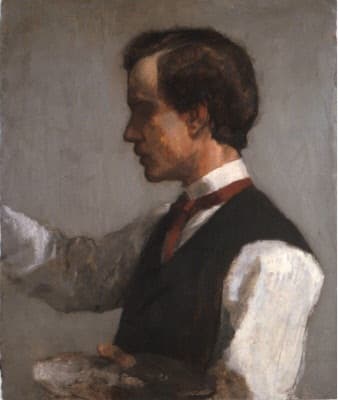
William James
1842–1910
American psychologist and philosopher
William James grew up between the United States and Europe, first considering a life in painting before turning to science and medicine. He earned a medical degree at Harvard but did not practise as a physician. Teaching physiology led him toward psychology and philosophy, fields he continued to connect throughout his career.1. Russell Goodman, “William James,” Stanford Encyclopedia of Philosophy, Summer 2026 edition, revised November 3, 2021, secs. 1–6.
Attention, habit, feeling, and choice occupy the centre of James’s account of mental life. His pragmatism asks what difference an idea makes in experience, while his writings on religion examine individual lives without assuming that one system contains them all. His later philosophy explores a plural universe whose possibilities are not settled in advance.2. Russell Goodman, “William James,” Stanford Encyclopedia of Philosophy, Summer 2026 edition, revised November 3, 2021, secs. 1–6.
How to read William James
James often developed arguments for listeners. Pragmatism and Talks to Teachers preserve that directness; The Principles of Psychology rewards slower reading by topic. His proposed ways of testing ideas differ across psychology, philosophy, and religious inquiry, so notice which kind of question he is asking.3. Russell Goodman, “William James,” Stanford Encyclopedia of Philosophy, Summer 2026 edition, revised November 3, 2021, secs. 1–6.
Psychology and education
Psychology: Briefer Course offers a shorter route into the larger Principles. Talks to Teachers connects attention and habit with education. The independently issued extracts below remain identified as extracts, so their relation to the larger books is visible.4. Ralph Barton Perry, “Annotated Bibliography of the Writings of William James,” Longmans, Green and Co.; California Digital Library copy, 1920, Chronological bibliography, 1867–1920, pp. 1–62.
Belief, religion, and philosophical argument
Pragmatism is a useful entrance into James’s public philosophical lectures. Read Varieties as an inquiry into reported experiences, and follow The Meaning of Truth for his replies to criticism. Some Problems remained unfinished when he died.5. Russell Goodman, “William James,” Stanford Encyclopedia of Philosophy, Summer 2026 edition, revised November 3, 2021, secs. 1–6.
Public essays and collected shorter writing
Memories and Studies and Collected Essays and Reviews are historical collections. The later scholarly thematic collections extend coverage of the scattered papers; they overlap those earlier books and must not be mistaken for additional lifetime books James assembled.6. Frederick H. Burkhardt, Fredson Bowers and Ignas K. Skrupskelis, editors, “The Works of William James: Electronic Edition,” InteLex Past Masters; based on Harvard University Press edition, undated; accessed October 21, 2026, Contents: seventeen titles in nineteen volumes; editorial introduction.
Editorial work and private writing
Letters and manuscript materials reveal work in progress. The Literary Remains is Henry James Sr.’s work edited and introduced by William: only William’s editorial contribution belongs to his authored corpus. Modern editorial apparatus requires its own rights review.7. Ralph Barton Perry, “Annotated Bibliography of the Writings of William James,” Longmans, Green and Co.; California Digital Library copy, 1920, Chronological bibliography, 1867–1920, pp. 1–62.
The list combines independent books and issued extracts with the thematic units of the Harvard collected works, letters, and manuscripts. Posthumous collections overlap earlier publications. Their presence maps the corpus and does not clear the modern editors’ contributions or activate any text.8. Frederick H. Burkhardt, Fredson Bowers and Ignas K. Skrupskelis, editors, “The Works of William James: Electronic Edition,” InteLex Past Masters; based on Harvard University Press edition, undated; accessed October 21, 2026, Contents: seventeen titles in nineteen volumes; editorial introduction.
Reading guide sources
- Russell Goodman, “William James,” Stanford Encyclopedia of Philosophy, Summer 2026 edition, revised November 3, 2021, secs. 1–6.
- Ralph Barton Perry, “Annotated Bibliography of the Writings of William James,” Longmans, Green and Co.; California Digital Library copy, 1920, Chronological bibliography, 1867–1920, pp. 1–62.
- Russell Goodman, “William James,” Stanford Encyclopedia of Philosophy, Summer 2026 edition, revised November 3, 2021, secs. 1–6.
- Frederick H. Burkhardt, Fredson Bowers and Ignas K. Skrupskelis, editors, “The Works of William James: Electronic Edition,” InteLex Past Masters; based on Harvard University Press edition, undated; accessed October 21, 2026, Contents: seventeen titles in nineteen volumes; editorial introduction.
- Ralph Barton Perry, “Annotated Bibliography of the Writings of William James,” Longmans, Green and Co.; California Digital Library copy, 1920, Chronological bibliography, 1867–1920, pp. 1–62.
- Frederick H. Burkhardt, Fredson Bowers and Ignas K. Skrupskelis, editors, “The Works of William James: Electronic Edition,” InteLex Past Masters; based on Harvard University Press edition, undated; accessed October 21, 2026, Contents: seventeen titles in nineteen volumes; editorial introduction.
Works in the library
25 under developmentThe Principles of Psychology
Two volumes examining consciousness, attention, habit, emotion, memory, and will.
Under developmentPsychology: Briefer Course
James’s shorter account of psychology, revised for students.
Under developmentTalks to Teachers on Psychology and to Students on Some of Life’s Ideals
Lectures connecting psychological observation with teaching and the conduct of life.
Under developmentHabit
An independently issued extract from The Principles of Psychology.
Under developmentOn Vital Reserves
A small collection reprinting The Energies of Men and The Gospel of Relaxation.
Under developmentOn Some of Life’s Ideals
A separate reprint of two student addresses originally collected in Talks to Teachers.
Under developmentThe Will to Believe and Other Essays in Popular Philosophy
Essays on commitment, freedom, moral questions, and the demands of belief.
Under developmentHuman Immortality: Two Supposed Objections to the Doctrine
An Ingersoll lecture considering objections to survival beyond bodily death.
Under developmentThe Varieties of Religious Experience
Gifford lectures examining conversion, saintliness, mysticism, and religious experience.
Under developmentPragmatism
Lectures presenting the pragmatic method and its consequences for truth and belief.
Under developmentA Pluralistic Universe
Hibbert lectures testing philosophical systems against the diversity of experience.
Under developmentThe Meaning of Truth
Essays developing and defending James’s pragmatic account of truth.
Under developmentSome Problems of Philosophy
An unfinished, posthumously published introduction to philosophical problems.
Under developmentEssays in Radical Empiricism
A posthumous collection exploring experience and the relations within it.
Under developmentMemories and Studies
Posthumously collected portraits, addresses, and essays, including The Moral Equivalent of War.
Under developmentCollected Essays and Reviews
Ralph Barton Perry’s posthumous collection of scientific and philosophical papers.
Under developmentEssays in Philosophy
A scholarly collection of philosophical papers beyond the principal books.
Under developmentEssays in Psychology
A scholarly collection of James’s psychological articles and related writings.
Under developmentEssays in Religion and Morality
A scholarly collection of shorter writings on belief and conduct.
Under developmentEssays in Psychical Research
Collected investigations, reports, and discussions of purported psychical phenomena.
Under developmentEssays, Comments, and Reviews
Collected miscellaneous essays, public letters, and reviews not otherwise gathered in the scholarly edition.
Under developmentThe Literary Remains of the Late Henry James: Introduction and Editorial Contribution
William James’s introduction and editorial work on his father’s writings.
Under developmentManuscript Essays and Notes
Posthumously edited philosophical drafts, notes, and unfinished arguments.
Under developmentManuscript Lectures
Lecture manuscripts documenting James’s teaching across psychology and philosophy.
Under developmentCorrespondence
James’s letters, represented as a collection across the historical and scholarly editions.
Under development
Sources & portrait
- Russell Goodman, “William James,” Stanford Encyclopedia of Philosophy, Summer 2026 edition, revised November 3, 2021, secs. 1–6.
- Russell Goodman, “William James,” Stanford Encyclopedia of Philosophy, Summer 2026 edition, revised November 3, 2021, secs. 1–6.
Portrait: John La Farge, William James, c. 1859. National Portrait Gallery, Smithsonian Institution, NPG.91.6. Displayed in monochrome and cropped in a circular frame. Image source. Public domain; faithful reproduction of a painting by John La Farge (1835–1910).. Displayed in monochrome with a circular crop.

