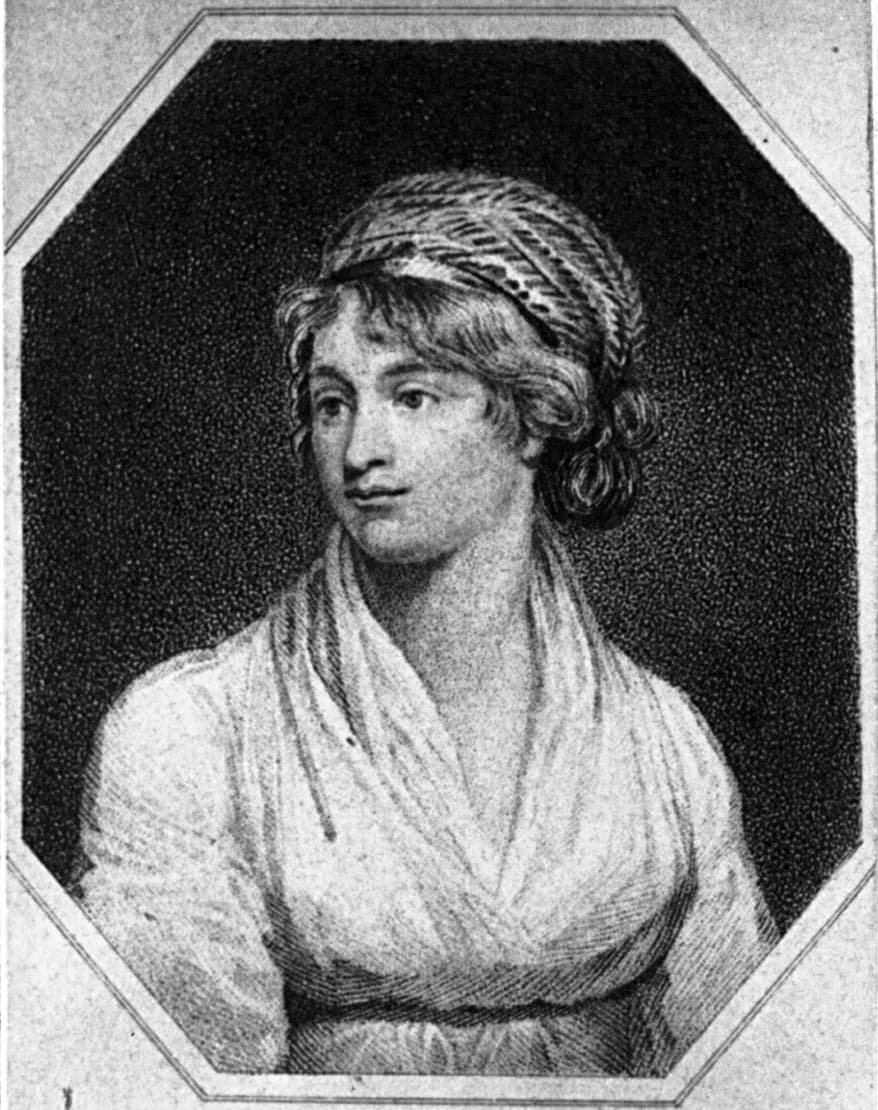
Mary Wollstonecraft
1759–1797
English philosopher and writer
Mary Wollstonecraft earned her living as a teacher, governess, translator, and reviewer before becoming known for political writing. Her experience of women’s limited opportunities accompanied a wider concern with poverty, privilege, and dependence. She travelled to revolutionary France and later Scandinavia, writing across forms that included argument, fiction, history, and letters.1. Sylvana Tomaselli, “Mary Wollstonecraft,” Stanford Encyclopedia of Philosophy, Spring 2025 edition, revised February 22, 2025, introduction and secs. 1 and 3.
For Wollstonecraft, women’s education was a matter of justice and of the moral life of society. A culture that trained women to please and depend on men obstructed their development as rational people. She connected rights with duties and argued for relationships grounded in friendship. Her later writing also explored how reason, emotion, and imagination work together.2. Sylvana Tomaselli, “Mary Wollstonecraft,” Stanford Encyclopedia of Philosophy, Spring 2025 edition, revised February 22, 2025, secs. 2–4.
How to read Mary Wollstonecraft
Wollstonecraft writes philosophy through political argument, education, fiction and travel. Our suggested path starts with her case for women’s education, then follows these different forms. The selection covers her principal original books; it does not attempt to collect her reviews, correspondence or translations.3. Sylvana Tomaselli, “Mary Wollstonecraft,” Stanford Encyclopedia of Philosophy, Substantive revision 22 February 2025; Spring 2025 archive, §§2–4, Pedagogical writings; Moral and political writings; Wollstonecraft the philosopher.
Education and independence
Start with A Vindication of the Rights of Woman. Follow how education, economic dependence and expectations of femininity enter its argument about virtue. Ask which assumptions she accepts as well as which she challenges; her case reaches beyond access to schooling.4. Sylvana Tomaselli, “Mary Wollstonecraft,” Stanford Encyclopedia of Philosophy, Substantive revision 22 February 2025; Spring 2025 archive, §§2–4, Pedagogical writings; Moral and political writings; Wollstonecraft the philosopher.
The revolutionary argument
Turn back to A Vindication of the Rights of Men, her response to Edmund Burke, for the dispute over privilege and political authority. Her history of the French Revolution develops that debate in another form; it is an interpretation of events, not a detached chronicle.5. Sylvana Tomaselli, “Mary Wollstonecraft,” Stanford Encyclopedia of Philosophy, Substantive revision 22 February 2025; Spring 2025 archive, §§2–4, Pedagogical writings; Moral and political writings; Wollstonecraft the philosopher. Mary Wollstonecraft, “An Historical and Moral View of the Origin and Progress of the French Revolution,” Historical text reproduced by Project Gutenberg, 1794; digital text accessed 1 October 2026, Title page; Preface; Contents.
How character is formed
Compare the early Thoughts on the Education of Daughters with Original Stories from Real Life. Practical advice and conversations with children show how habits and examples shape moral character. Their educational setting helps explain concerns that later become explicitly political.6. Mary Wollstonecraft, “Thoughts on the Education of Daughters,” Historical text reproduced by Project Gutenberg, 1787; digital text accessed 1 October 2026, Title page; Preface; Moral Discipline; Boarding-Schools. Mary Wollstonecraft, “Original Stories from Real Life,” Historical text reproduced by Project Gutenberg, 1796 edition; digital text accessed 1 October 2026, Title page; Preface; Introduction.
Feeling, travel and fiction
The Scandinavian Letters weave descriptions of places and people into personal reflection. Mary: A Fiction and the unfinished Maria approach dependence and freedom through imagined lives. Read their narrators and characters as literary perspectives, while noticing how questions from the arguments return in altered form.7. Mary Wollstonecraft, “Letters Written during a Short Residence in Sweden, Norway, and Denmark,” Historical text reproduced by Project Gutenberg, 1796; digital text accessed 1 October 2026, Advertisement; Letters I–III and XIX–XXIV. Mary Wollstonecraft, “Maria; or, The Wrongs of Woman,” Historical text reproduced by Project Gutenberg, 1798 posthumous publication; digital text accessed 1 October 2026, Author’s Preface; Chapters I–II; concluding unfinished material.
Reading guide sources
- Sylvana Tomaselli, “Mary Wollstonecraft,” Stanford Encyclopedia of Philosophy, Substantive revision 22 February 2025; Spring 2025 archive, §§2–4, Pedagogical writings; Moral and political writings; Wollstonecraft the philosopher.
- Sylvana Tomaselli, “Mary Wollstonecraft,” Stanford Encyclopedia of Philosophy, Substantive revision 22 February 2025; Spring 2025 archive, §§2–4, Pedagogical writings; Moral and political writings; Wollstonecraft the philosopher.
- Sylvana Tomaselli, “Mary Wollstonecraft,” Stanford Encyclopedia of Philosophy, Substantive revision 22 February 2025; Spring 2025 archive, §§2–4, Pedagogical writings; Moral and political writings; Wollstonecraft the philosopher. Mary Wollstonecraft, “An Historical and Moral View of the Origin and Progress of the French Revolution,” Historical text reproduced by Project Gutenberg, 1794; digital text accessed 1 October 2026, Title page; Preface; Contents.
- Mary Wollstonecraft, “Thoughts on the Education of Daughters,” Historical text reproduced by Project Gutenberg, 1787; digital text accessed 1 October 2026, Title page; Preface; Moral Discipline; Boarding-Schools. Mary Wollstonecraft, “Original Stories from Real Life,” Historical text reproduced by Project Gutenberg, 1796 edition; digital text accessed 1 October 2026, Title page; Preface; Introduction.
- Mary Wollstonecraft, “Letters Written during a Short Residence in Sweden, Norway, and Denmark,” Historical text reproduced by Project Gutenberg, 1796; digital text accessed 1 October 2026, Advertisement; Letters I–III and XIX–XXIV. Mary Wollstonecraft, “Maria; or, The Wrongs of Woman,” Historical text reproduced by Project Gutenberg, 1798 posthumous publication; digital text accessed 1 October 2026, Author’s Preface; Chapters I–II; concluding unfinished material.
Works in the library
3 available · 5 under developmentA Vindication of the Rights of Woman
A political and moral argument for women’s rational education and independence.
Under developmentA Vindication of the Rights of Men
A response to Burke addressing inherited privilege and political rights.
English · original textAn Historical and Moral View of the Origin and Progress of the French Revolution
A history interpreting the origins and early course of the Revolution.
Under developmentThoughts on the Education of Daughters
Early reflections on education, conduct and the formation of character.
English · original textOriginal Stories from Real Life
Educational stories and conversations about habits, feelings and moral conduct.
Under developmentLetters Written during a Short Residence in Sweden, Norway, and Denmark
Travel letters combining observations of society with personal and philosophical reflection.
Under developmentMary: A Fiction
A novel about feeling, relationships and a woman’s constrained circumstances.
English · original textMaria; or, The Wrongs of Woman
An unfinished, posthumously published novel examining women’s dependence and injustice.
Under development
Sources & portrait
- Sylvana Tomaselli, “Mary Wollstonecraft,” Stanford Encyclopedia of Philosophy, Spring 2025 edition, revised February 22, 2025, introduction and secs. 1 and 3.
- Sylvana Tomaselli, “Mary Wollstonecraft,” Stanford Encyclopedia of Philosophy, Spring 2025 edition, revised February 22, 2025, secs. 2–4.
Portrait: James Heath, portrait of Mary Wollstonecraft, about 1797, after John Opie. Historical reproduction by Rockwood Photographer, 1850–1870. Library of Congress, LOT 13301, no. 108. Image source. Collection record. Public domain historic engraving and reproduction (PD-Art, PD-old-100); Library of Congress states no known restrictions on publication. Displayed in monochrome with a circular crop.

