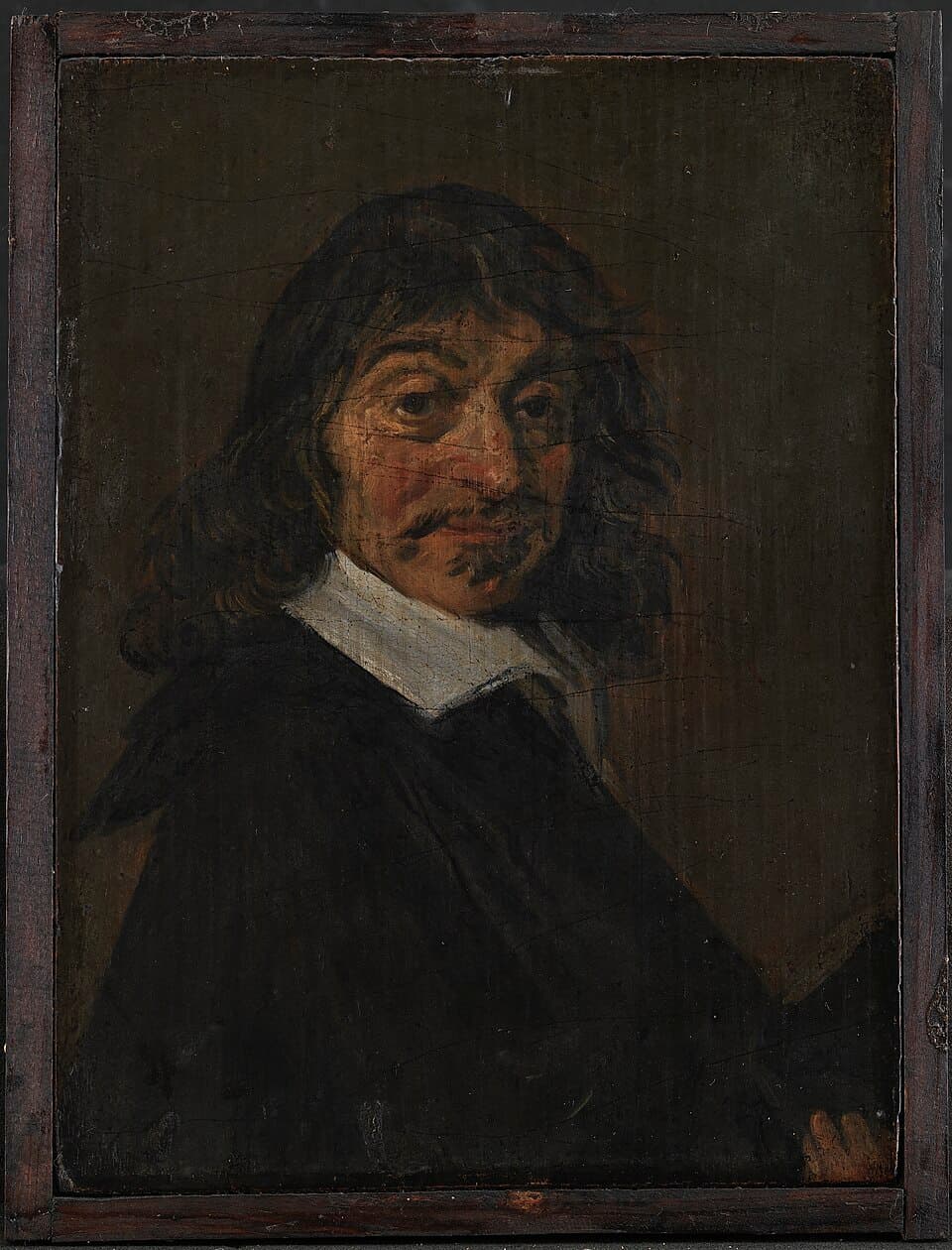
René Descartes
1596–1650
French philosopher and mathematician
René Descartes was trained in France but spent much of his working life in the Dutch Republic. Mathematics and the study of nature shaped his philosophical ambitions: he wanted methods that could make difficult problems tractable. His investigations moved between geometry, optics, the workings of bodies, and the foundations of knowledge.1. Gary Hatfield, “René Descartes,” Stanford Encyclopedia of Philosophy, Fall 2026 edition, revised October 23, 2023, introduction and secs. 1.1–1.3.
His method of doubt asks what can survive the possibility that appearances deceive us. The act of thinking provides an initial certainty: the thinker exists. From there, Descartes argues about God, matter, and the distinction between mind and body. That distinction raises a lasting difficulty within his own account: how can thought and a physical body act together?2. Gary Hatfield, “René Descartes,” Stanford Encyclopedia of Philosophy, Fall 2026 edition, revised October 23, 2023, secs. 3.1–3.4.
How to read René Descartes
Descartes is easier to approach through a short account of his project before tackling its foundations. This is our suggested reading route through major philosophical writings, rather than a chronology or a complete inventory of his papers.3. Gary Hatfield, “René Descartes,” Stanford Encyclopedia of Philosophy, Fall 2026 edition, revised October 23, 2023, introduction and secs. 1.2–1.4.
A method takes shape
The Discourse on the Method offers an approachable starting point, placing philosophical inquiry within a story of education, travel and dissatisfaction. Notice its provisional rules for living as well as its rules for thinking. Return later to the unfinished Rules for the Direction of the Mind to explore his earlier approach to method.4. Gary Hatfield, “René Descartes,” Stanford Encyclopedia of Philosophy, Fall 2026 edition, revised October 23, 2023, secs. 1.2–1.3. Denis Kambouchner and Louis Rouquayrol, “Descartes’ Ethics,” Stanford Encyclopedia of Philosophy, published May 20, 2026, sec. 2.
Follow the doubt
Read the six Meditations in order, keeping track of what the narrator is entitled to claim at each stage. Their Objections and Replies bring other thinkers into the argument and belong with the work. The unfinished Search for Truth revisits philosophical inquiry through conversation; its composition date remains uncertain. The short Comments on a Certain Broadsheet answers Regius, a former follower whose broadsheet departed from Descartes’s account of the human mind.5. Lex Newman, “Descartes’ Epistemology,” Stanford Encyclopedia of Philosophy, Fall 2026 edition, revised November 27, 2023, introduction and secs. 1.3, 2–7. John Cottingham, Robert Stoothoff and Dugald Murdoch, “Translators’ preface,” The Philosophical Writings of Descartes, vol. 2, Cambridge University Press, 1985; online June 5, 2012, p. 399; preface to The Search for Truth: unfinished dialogue and uncertain composition date. Gary Hatfield, “René Descartes,” Stanford Encyclopedia of Philosophy, Fall 2026 edition, revised October 23, 2023, sec. 1.5.
Feeling and the embodied mind
The Passions of the Soul opens another way into Descartes: emotions, bodily processes and the conduct of life. Read its account of the body alongside its discussion of how passions can be guided. It combines physiological explanation with ethical concerns rather than presenting a separate, comprehensive moral system.6. Denis Kambouchner and Louis Rouquayrol, “Descartes’ Ethics,” Stanford Encyclopedia of Philosophy, published May 20, 2026, introduction and secs. 4–5.
Beyond the meditating self
For the larger system, move to Part I of the Principles of Philosophy, then its account of nature. The World and Treatise on Man extend the picture to matter and living bodies. These mechanical explanations repay historical reading; they should not be mistaken for present-day scientific accounts.7. Gary Hatfield, “René Descartes,” Stanford Encyclopedia of Philosophy, Fall 2026 edition, revised October 23, 2023, secs. 1.3–1.4 and 4–5.
Musical sound
The Compendium of Music examines rhythm, consonances, degrees and modes. Read it as a focused account of musical sound alongside the broader philosophical works.8. René Descartes; translated by William Brouncker, “Excellent compendium of musick,” London: Thomas Harper for Humphrey Moseley, 1653, treatise, printed pp. 1–57.
Reading guide sources
- Gary Hatfield, “René Descartes,” Stanford Encyclopedia of Philosophy, Fall 2026 edition, revised October 23, 2023, introduction and secs. 1.2–1.4.
- Gary Hatfield, “René Descartes,” Stanford Encyclopedia of Philosophy, Fall 2026 edition, revised October 23, 2023, secs. 1.2–1.3. Denis Kambouchner and Louis Rouquayrol, “Descartes’ Ethics,” Stanford Encyclopedia of Philosophy, published May 20, 2026, sec. 2.
- Lex Newman, “Descartes’ Epistemology,” Stanford Encyclopedia of Philosophy, Fall 2026 edition, revised November 27, 2023, introduction and secs. 1.3, 2–7. John Cottingham, Robert Stoothoff and Dugald Murdoch, “Translators’ preface,” The Philosophical Writings of Descartes, vol. 2, Cambridge University Press, 1985; online June 5, 2012, p. 399; preface to The Search for Truth: unfinished dialogue and uncertain composition date. Gary Hatfield, “René Descartes,” Stanford Encyclopedia of Philosophy, Fall 2026 edition, revised October 23, 2023, sec. 1.5.
- Denis Kambouchner and Louis Rouquayrol, “Descartes’ Ethics,” Stanford Encyclopedia of Philosophy, published May 20, 2026, introduction and secs. 4–5.
- Gary Hatfield, “René Descartes,” Stanford Encyclopedia of Philosophy, Fall 2026 edition, revised October 23, 2023, secs. 1.3–1.4 and 4–5.
- René Descartes; translated by William Brouncker, “Excellent compendium of musick,” London: Thomas Harper for Humphrey Moseley, 1653, treatise, printed pp. 1–57.
Works in the library
12 availableDiscourse on the Method
An autobiographical introduction to method, knowledge and the reform of inquiry.
English · John VeitchRules for the Direction of the Mind
An unfinished investigation of method and the orderly pursuit of knowledge.
English · George Robert Thomson RossMeditations on First Philosophy
Six meditations on doubt, certainty, God, mind and body, with Objections and Replies.
English · John VeitchThe Search for Truth by Means of the Natural Light
An unfinished dialogue about discovering truth through the exercise of reason.
English · Elizabeth Sanderson Haldane and George Robert Thomson RossThe Passions of the Soul
A study of emotions, their bodily causes and their place in human conduct.
English · Elizabeth Sanderson Haldane and George Robert Thomson RossThe World, or Treatise on Light
A mechanical account of the material world and its natural phenomena.
French · original textTreatise on Man
An account of the body, sensation and physiological mechanisms.
French · original textComments on a Certain Broadsheet
Descartes’s reply to Regius’s broadsheet on the human mind, which he reprints and answers article by article.
English · Elizabeth Sanderson Haldane and George Robert Thomson RossCompendium of Music
Descartes examines musical sound, rhythm, consonances, degrees and modes.
English · William BrounckerPrefatory Letters to The Passions of the Soul
A prefatory warning and four letters: two from an unnamed friend and two replies by Descartes, dated 1648–1649.
French · original textOptics (Dioptrics)
An account of light, refraction, vision and the construction of optical instruments.
French · original textMeteorology (Les Météores)
Descartes’s account of atmospheric phenomena, including clouds, rain, snow and the rainbow.
French · original text
Sources & portrait
- Gary Hatfield, “René Descartes,” Stanford Encyclopedia of Philosophy, Fall 2026 edition, revised October 23, 2023, introduction and secs. 1.1–1.3.
- Gary Hatfield, “René Descartes,” Stanford Encyclopedia of Philosophy, Fall 2026 edition, revised October 23, 2023, secs. 3.1–3.4.
Portrait: Frans Hals, Portrait of René Descartes, 1649. Statens Museum for Kunst, DEP7. Image source. Public domain artwork; digital reproduction released under CC0 1.0 by Statens Museum for Kunst. Displayed in monochrome with a circular crop.
